Carbohydrates Structure and Chemical Formula

Reviewed by Editorial Team
The ProProfs editorial team is comprised of experienced subject matter experts. They've collectively created over 10,000 quizzes and lessons, serving over 100 million users. Our team includes in-house content moderators and subject matter experts, as well as a global network of rigorously trained contributors. All adhere to our comprehensive editorial guidelines, ensuring the delivery of high-quality content.
Learn about Our Editorial Process
| By Alfredhook3
A
Alfredhook3
Community Contributor
Quizzes Created: 5562 | Total Attempts: 3,155,788
| Attempts: 11 | Questions: 10 | Updated: Sep 25, 2026
Please wait...
Question 1 / 11
🏆 Rank #-- ▾
0 %
0/100
Score 0/100

1. Identify the carbohydrate structure and its correct chemical formula: A six-carbon monosaccharide that serves as the body's main source of energy, existing in both cyclical and linear configurations.

Explanation

Glucose is a six-carbon monosaccharide and is the primary energy source for the body. It is categorized as a hexose sugar, which means it contains six carbon atoms, and its chemical formula is C₆H₁₂O₆. Glucose can exist in both linear and cyclic forms, allowing it to participate in various biochemical processes. Its structure is essential for cellular respiration, where it is metabolized to produce ATP, the energy currency of cells. This makes glucose vital for maintaining energy levels in living organisms.

Submit
Please wait...
About This Quiz
Carbohydrates Structure and Chemical Formula - Quiz

This assessment focuses on carbohydrates, testing your understanding of their structures and chemical formulas. Key concepts include identifying monosaccharides, disaccharides, and polysaccharides, as well as recognizing isomers and the effects of hydrolysis. This knowledge is essential for students of biology and nutrition, providing a solid foundation in carbohydrate chemistry.

2.

What first name or nickname would you like us to use?

You may optionally provide this to label your report, leaderboard, or certificate.

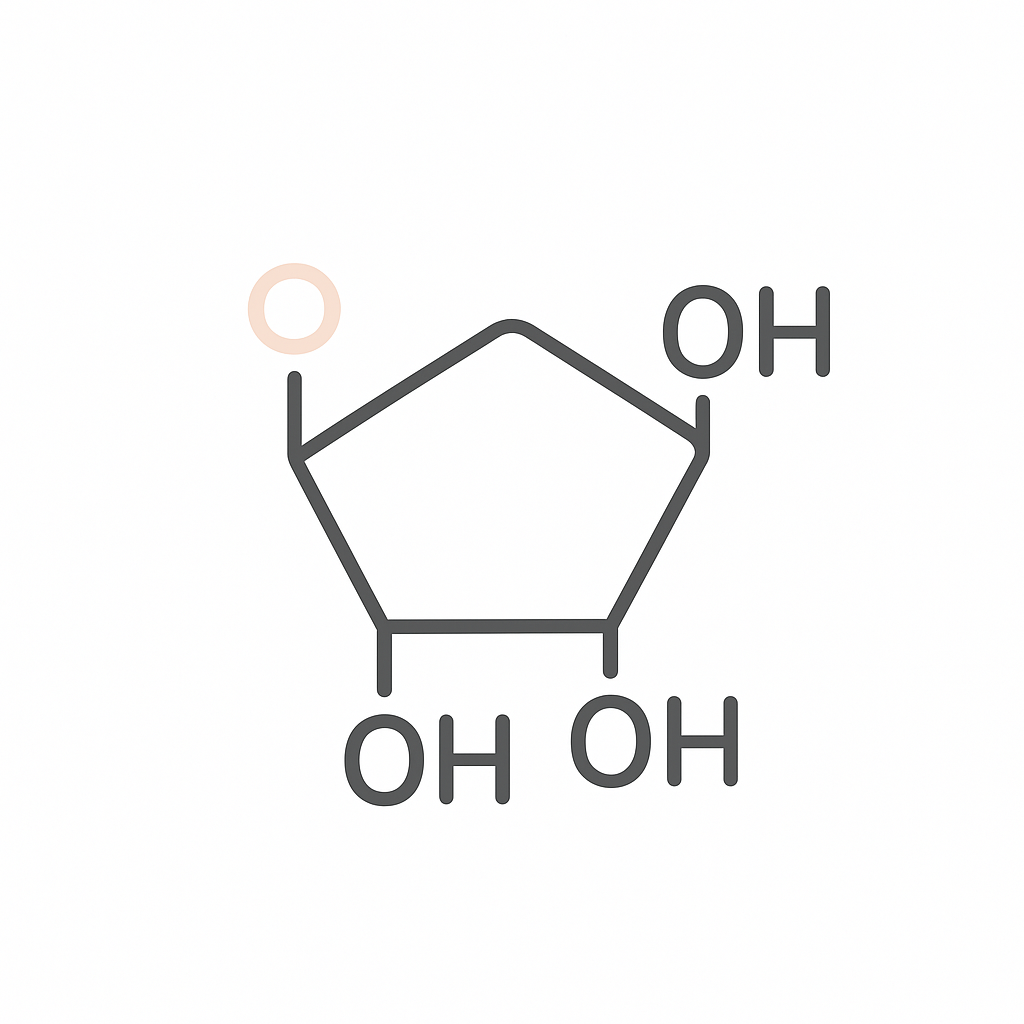
2. Which chemical formula correctly represents the monosaccharide ribose, a five-carbon sugar?

Explanation

Ribose is a pentose monosaccharide, meaning it contains five carbon atoms. Its molecular formula is C₅H₁₀O₅, which reflects the typical structure of a sugar with five carbons, ten hydrogens, and five oxygens. This formula indicates that ribose has the necessary components to form its ring structure and participate in biological processes, such as being a key component of RNA. The other options either represent different sugars or do not accurately reflect the composition of ribose.

Submit

3. Erythrose is a four-carbon monosaccharide. What is its correct chemical formula based on the general monosaccharide formula (C₁H₂O₁)ₙ?

Explanation

Erythrose, being a four-carbon monosaccharide, follows the general formula for monosaccharides, which is (C₁H₂O₁)ₙ, where n represents the number of carbon atoms. For erythrose, n equals 4. Therefore, the chemical formula can be derived as C₄H₈O₄, indicating it has four carbon atoms, eight hydrogen atoms, and four oxygen atoms. This aligns with the structural characteristics of erythrose as an aldose sugar, confirming its classification within the monosaccharide category.

Submit

4. Which of the following correctly matches the carbohydrate structural level with its number of monomers and chemical formula (using glucose as the base unit)?

Explanation

Monosaccharides are the simplest form of carbohydrates and consist of a single sugar unit, represented by the chemical formula C₆H₁₂O₆, which is the formula for glucose. In contrast, disaccharides are composed of two monosaccharides and have a different formula (C₁₂H₂₂O₁₁) due to the loss of a water molecule during their formation. Therefore, the correct match for a monosaccharide is one monomer, specifically C₆H₁₂O₆, confirming its status as a basic building block of carbohydrates.

Submit

5. Ribose (C₅H₁₀O₅), xylose (C₅H₁₀O₅), and arabinose (C₅H₁₀O₅) share the same chemical formula. What structural characteristic distinguishes them from one another, and what classification do they fall under?

Explanation

Ribose, xylose, and arabinose all have the same molecular formula (C₅H₁₀O₅), but they differ in the arrangement of their atoms, which leads to different structural forms. This variation in molecular arrangement classifies them as structural isomers, meaning they have the same molecular formula but different structural formulas and properties. Each sugar has distinct functional characteristics despite sharing the same elemental composition, highlighting the importance of molecular structure in determining chemical behavior.

Submit

6. Based on the general monosaccharide formula (C₁H₂O₁)ₙ, which of the following statements correctly describes the atomic ratio and identifies the formula when n = 5?

Explanation

Monosaccharides follow the general formula (C₁H₂O₁)ₙ, indicating that for every n carbon atoms, there are 2n hydrogen atoms and n oxygen atoms. When n = 5, this results in 5 carbon atoms, 10 hydrogen atoms, and 5 oxygen atoms, leading to the formula C₅H₁₀O₅. The atomic ratio of carbon to hydrogen to oxygen is thus 1:2:1, which aligns with the characteristics of typical monosaccharides. This confirms that the correct description of the atomic ratio and formula for n = 5 is accurate.

Submit

7. A disaccharide is formed by joining two glucose monomers through dehydration synthesis. What is the resulting chemical formula of this disaccharide?

Explanation

When two glucose molecules (C₆H₁₂O₆) undergo dehydration synthesis, a water molecule (H₂O) is removed, resulting in the formation of a disaccharide. The combined molecular formula of two glucose units is C₁₂H₂₄O₂₁. However, since one water molecule is lost during the process, we subtract H₂O (H₂ and O) from the total, leading to the final formula of C₁₂H₂₂O₁₁ for the disaccharide. This process illustrates how carbohydrates are formed through the linkage of monomer units.

Submit

8. Sucrose (C₁₂H₂₂O₁₁) undergoes hydrolysis. Which pair of monosaccharides and their formulas are the correct products of this reaction?

Explanation

Sucrose is a disaccharide composed of glucose and fructose linked by a glycosidic bond. When sucrose undergoes hydrolysis, it reacts with water, breaking this bond and resulting in the formation of its constituent monosaccharides. The hydrolysis of sucrose specifically yields one molecule of glucose and one molecule of fructose, both of which have the formula C₆H₁₂O₆. This reaction is catalyzed by enzymes such as sucrase or by acid, leading to the release of these two simple sugars.

Submit

9. Glucose, fructose, and galactose all share the same chemical formula C₆H₁₂O₆ but differ in structure. What term describes these compounds?

Explanation

Glucose, fructose, and galactose are classified as isomers because they have the same molecular formula (C₆H₁₂O₆) but differ in their structural arrangement. Isomers can vary in the connectivity of atoms or the spatial orientation of their molecules, leading to different chemical properties and functions despite having identical compositions. This structural variation is what defines them as isomers, distinguishing them from other types of compounds such as polymers or monomers.

Submit

10. A polysaccharide composed of four glucose monomers (C₆H₁₂O₆ each) is formed through repeated dehydration synthesis. What is the correct chemical formula of this polysaccharide?

Explanation

To determine the chemical formula of a polysaccharide made from four glucose monomers (C₆H₁₂O₆), we start with the total formula for four glucose units, which is C₂₄H₄₈O₂₄. However, during the dehydration synthesis process, water molecules (H₂O) are released. For four monomers, three water molecules are removed, resulting in a reduction of three oxygen atoms and six hydrogen atoms. Therefore, the final formula becomes C₂₄H₄₂O₂₁, accounting for the loss of water during the synthesis.

Submit
×
Saved
Thank you for your feedback!
View My Results
Cancel
  • All
    All (10)
  • Unanswered
    Unanswered ()
  • Answered
    Answered ()
Identify the carbohydrate structure and its correct chemical formula:...
Which chemical formula correctly represents the monosaccharide ribose,...
Erythrose is a four-carbon monosaccharide. What is its correct...
Which of the following correctly matches the carbohydrate structural...
Ribose (C₅H₁₀O₅), xylose (C₅H₁₀O₅), and arabinose...
Based on the general monosaccharide formula (C₁H₂O₁)ₙ, which...
A disaccharide is formed by joining two glucose monomers through...
Sucrose (C₁₂H₂₂O₁₁) undergoes hydrolysis. Which pair of...
Glucose, fructose, and galactose all share the same chemical formula...
A polysaccharide composed of four glucose monomers (C₆H₁₂O₆...
play-Mute sad happy unanswered_answer up-hover down-hover success oval cancel Check box square blue
Alert!



