There’s a specific kind of frustration that hits somewhere around slide 12 of a 45-minute training session. You glance at the participant list. Half the names are gray. The other half haven’t typed anything in 20 minutes. The content is solid. The delivery is fine. But the room, virtual or physical, has already left.
If that sounds familiar, you don’t have an engagement problem. You have a tool mismatch problem.
I’ve spent time across tools like ProProfs Quiz Maker for assessments, Slido for live sessions, and everything in between, and the pattern I keep seeing is the same: teams pick the wrong category of tool before they ever compare features.
In this guide, we’ll fix that by matching the right tools to real engagement problems, so you can stop guessing and start choosing with clarity.
What Are Audience Engagement Tools?
If you’ve ever felt like you’re talking at your audience instead of with them, you’re not alone. I’ve been there too.
Audience engagement tools solve that.
They’re digital platforms that help you turn passive listeners into active participants. Instead of just presenting, you can involve people in real time through things like live polls, quick quizzes, Q&A, and even gamified activities.
What I find most useful is that you don’t have to guess if people are paying attention. You can actually see their responses as they come in.
So instead of one-way communication, you and your audience are part of a conversation. And that’s what makes sessions more engaging, more insightful, and honestly, more effective.
Which Tool Are You Actually Looking For?
Different engagement goals require fundamentally different architectures. A live polling tool cannot certify your employees. An assessment platform cannot run your hybrid conference. Picking the wrong tool category is the real reason most teams feel like “engagement software doesn’t work.”
Use this to self-identify before you read a single product description:
| If you're trying to... | And you're tired of... | Hire this type of tool |
|---|---|---|
| Train and certify employees or students | Manually grading, chasing completions, re-running tests for cheaters | Quiz and assessment platform |
| Get real-time crowd response during a talk | Talking at people, blank reactions, no idea if anything landed | Live polling or Q&A tool |
| Run engaging hybrid or virtual events | Events that feel like webinars pretending to be conferences | Event engagement platform |
| Build team culture through field activities | Generic icebreakers nobody cares about | Location-based game platform |
| Capture leads or segment your audience through quizzes | Cold email lists with zero personalization | Lead capture quiz tool |
| Make meetings less of a calendar obligation | One-way presentations, zero participation, 90% of the meeting on mute | Meeting engagement tool |
If your situation doesn’t map cleanly to one row, that’s actually useful information. It means you need a platform that handles multiple jobs, which narrows the list considerably.
The 10 Best Audience Engagement Tools in 2026
Now that you’ve identified your use case, here’s a closer look at the tools worth your time. I’ve used or evaluated each of these across real training sessions, live events, and workshops, so what follows is less a feature inventory and more an honest account of what each tool actually does well and where it falls short. The goal is to give you enough to make a confident decision without having to sit through five demo calls first.
Here’s a quick glance before we get into the details for each tool:
| Tool | Hire It To... | Best For | Free Plan | Starting Price |
|---|---|---|---|---|
| ProProfs Quiz Maker | Assess, certify, and prove learning happened | L&D teams, educators, HR | Yes | $19.99/month |
| Typeform | Capture opinions and run market research | Understanding what your audience actually thinks | Yes (limited) | $29/month |
| Slido | Make presentations a two-way conversation | Speakers, facilitators | Limited | $12.50/month |
| Mentimeter | Turn your slides into the engagement layer | Trainers, workshop leads | Limited | $11.99/month |
| VirtualPro | Run a full event, not just a meeting | Event organizers | No | Custom pricing |
| LoQuiz | Get people moving and competing in the real world | Team-building, tourism, and field training | Trial only | €9/month |
| CrowdPurr | Host live trivia and games people remember | Event hosts, entertainment | No | $49.99/month |
| Whova | Run enterprise-grade meeting experiences at scale | Enterprise events teams | No | Custom pricing |
| Vevox | Add reliable polling to classes and meetings | Educators, corporate trainers | No | $6.75/month |
| Wayground (formerly Quizizz) | Let AI adapt the experience to each learner | Teachers, L&D, e-learning teams | Limited | $19/month |
1. ProProfs Quiz Maker – Best for Easily Creating Quizzes & Assessments for Business, Training, and Education With AI

Let ProProfs AI Build a Quiz
There’s a real difference between keeping someone entertained for 45 minutes and knowing whether they retained anything that changes how they work. If your goal is the latter, ProProfs Quiz Maker is the tool I’d point you to first.
I’ve used it across hiring assessments, compliance training, and classroom exams, and the thing that keeps bringing me back is how much setup time it eliminates. The AI quiz generator creates full assessments with explanations in seconds, and it can convert documents (Word, PDF, PowerPoint), videos, and even webpages directly into quizzes. If you have a training manual sitting in a shared drive, you can turn it into a scored assessment before lunch.
The security architecture sets it apart from most competitors. When stakes are high, whether that’s a certification exam or a hiring screen, you can run automated webcam and screen proctoring, browser lockdown, IP tracking, and question randomization simultaneously. Question pooling from shared banks means each attempt serves a different set of questions, which matters a lot for anything employees or students might retake.
Beyond the security layer, the grading and feedback system is built for learning, not just scoring. Learners get instant explanations after each question. You get detailed analytics that surface where specific individuals or groups are falling short. The AI actually reads that report the moment you open it and surfaces the same insight up front, so you’re not the one hunting through rows of data to find who needs help.
Certifications are issued automatically when criteria are met and can be branded with your logo. And with over a million ready-to-use questions and 20+ question types (including video response and image-based items), you’re unlikely to hit a ceiling on the kinds of assessments you can build.
The one thing I’d flag honestly: if you’re new to assessment platforms, there’s a real learning curve in the first week as you figure out question banks, pooling logic, and certification workflows. It’s worth it, but budget for it.
What you’ll like:
- AI-generated quizzes from documents, videos, or prompts, built in seconds
- Automated webcam and screen proctoring, browser lockdown, and IP tracking for high-stakes exams
- Question pooling from shared banks, so no two attempts are identical
- Time limits configurable at the quiz level or per individual question
- Instant feedback with explanations that turn each attempt into a learning moment
- Automated certification and recertification with branded certificates
- 20+ question types, including image-based and video response formats
What to know before you buy:
- No dark mode, which matters if your team runs long sessions
- Cloud-only. If your organization requires on-premise deployment, this isn’t the one
Pricing: Free for short quizzes and core features. Paid plans start at $19.99/month.
Watch: How to Create an Online Quiz in 5 minutes
2. Typeform – Best for Understanding What Your Audience Actually Thinks
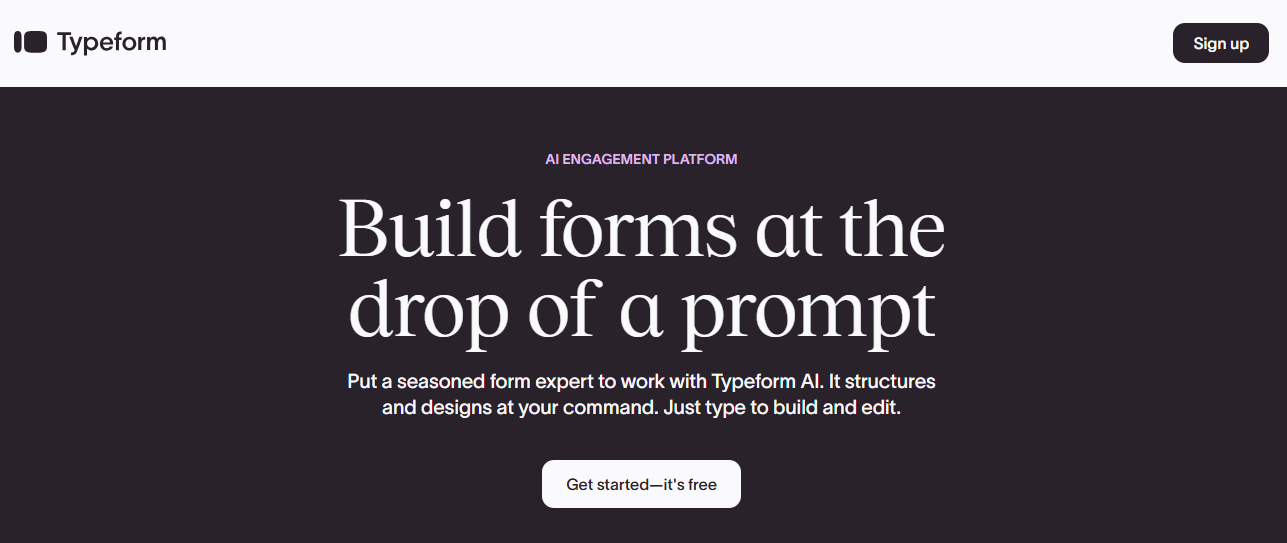
Polls and surveys look similar on the surface, but serve completely different jobs from assessment tools. A quiz measures what someone knows. A poll or survey surfaces what they think, prefer, or feel. If you’re running market research, gathering product feedback, or trying to understand where a customer dropped off in your funnel, Typeform is the tool for that job.
What makes it genuinely different from most form builders is the experience it creates for the person filling it out. Typeform’s conversational interface mimics a natural dialogue, making surveys feel more like a friendly chat than a tedious questionnaire. That distinction sounds cosmetic until you look at completion rates. When a form feels human, more people finish it, and the data you get back is cleaner.
The logic branching is where it earns its keep for serious research use. Survey paths adapt based on how someone answers earlier questions, which means you’re not sending a 15-question form to someone who answered “no” to question 2. Typeform also connects responses directly to tools like Google Sheets, Slack, HubSpot, or your CRM, so you don’t have to manually export data after every campaign.
One honest caveat: the free plan is genuinely limited. The free tier allows only 10 responses per month, which is useful for testing but not for running a real research study. Budget for a paid plan if this is going into any kind of recurring workflow.
What you’ll like:
- Conversational, one-question-at-a-time format that lifts completion rates
- Logic branching and conditional paths for multi-segment research flows
- Clean, brandable design with no technical skills required
- Native integrations with HubSpot, Salesforce, Google Sheets, Zapier, and more
- Real-time analytics and visual response summaries
What to know before you buy:
- The free plan caps at 10 responses per month, which is not enough for real use
- Removing Typeform branding requires the Plus plan at $59/month, so factor that in if you’re client-facing
- Response volume limits can escalate costs quickly if you run high-traffic campaigns
Pricing: Free plan available. Paid plans start at $29/month for Basic, $59/month for Plus, and $99/month for Business.
3. Slido – Best for Making Presentations a Two-Way Conversation
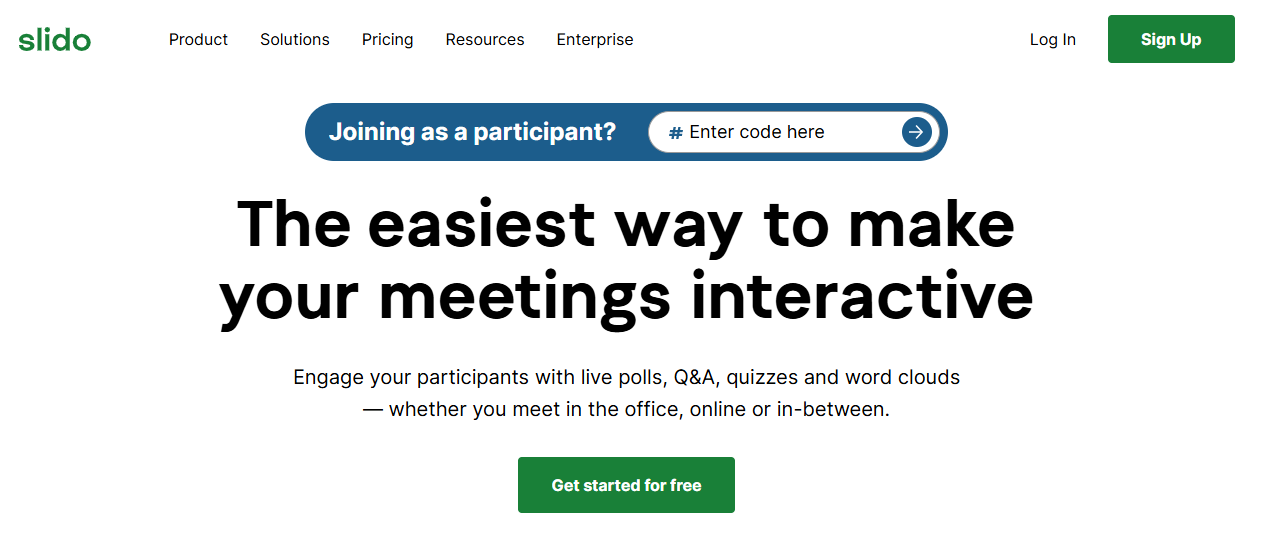
Slido does one thing better than almost anything else on this list: it gives a quiet audience a voice without disrupting the presenter’s flow.
The core mechanism is a live Q&A feed where audience members submit questions from any device and upvote the ones they want answered most. As a presenter or facilitator, you see the ranked list in real time and can address what the room actually cares about instead of guessing. It also runs five types of live polls (multiple choice, word cloud, rating, open text, ranking) that can be embedded directly into a PowerPoint or Google Slides deck.
What I’d call out specifically is the moderation layer. Unlike tools where every submission immediately goes public, Slido lets you review and approve questions before they appear. For large events or anything externally facing, that matters. You can also export engagement data, so if you’re reporting on event effectiveness to a leadership team, you have numbers.
What you’ll like:
- Live Q&A with upvoting so the best questions surface naturally
- Five poll formats including word cloud and ranking
- Robust moderation tools for public-facing events
- Direct integration with PowerPoint and Google Slides
- Participant engagement metrics for post-event reporting
What to know before you buy:
- The free plan strips out moderation, branding, and analytics. For anything professional, you’ll need a paid plan
- Technically sensitive to weak Wi-Fi. If your venue has unreliable connectivity, test beforehand
Pricing: Starts at $12.50/month, billed annually.
4. Mentimeter – Best for Turning Your Slides Into the Engagement Layer
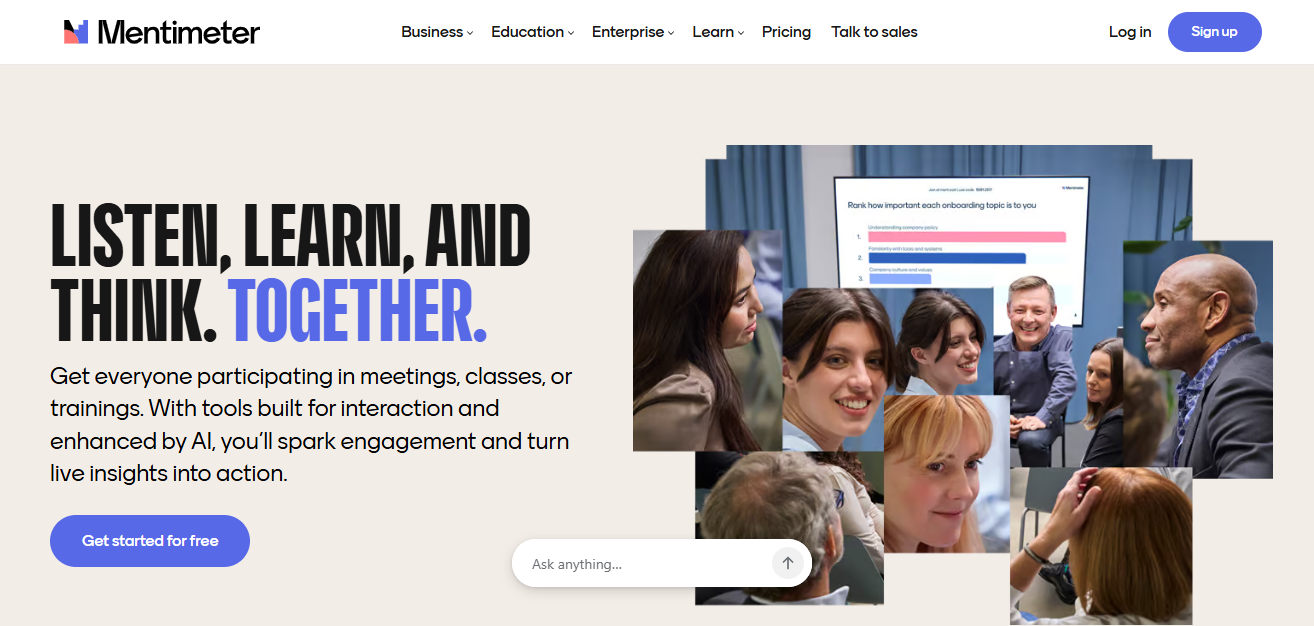
Slido adds engagement on top of a presentation. Mentimeter builds engagement directly into the presentation itself. If your slides are doing nothing until you start speaking, Mentimeter changes that. The different slide types in Mentimeter are not optional add-ons: polls, word clouds, prioritization matrices, and quizzes are native slide formats.
The word cloud feature is genuinely one of the more effective live tools I’ve seen for workshops and strategy sessions. You ask a question, the room responds, and a visual representation of the most common answers builds in real time on the screen. It’s the kind of thing that makes people lean forward.
The 100-point prioritization and BCG Matrix slide types are also worth calling out specifically for business audiences. If you’re facilitating a strategy session where groups need to evaluate options against each other, those formats do real work that no other presentation tool handles natively.
What you’ll like:
- Word clouds, rating scales, and prioritization matrices as native slide types
- Real-time visualization of audience input during live sessions
- Timers, leaderboards, and sound effects for quiz-style engagement
- Collaborative presentation building across teams
- Quizzes and surveys alongside standard presentation slides in one deck
What to know before you buy:
- The free plan is genuinely limited. Two presentations, each expiring after two days
- Pricing is on the steeper side for growing businesses with modest budgets
Pricing: Starts at $11.99/month, billed annually.
5. VirtualPRO – Best for Running a Full Event, Not Just a Meeting
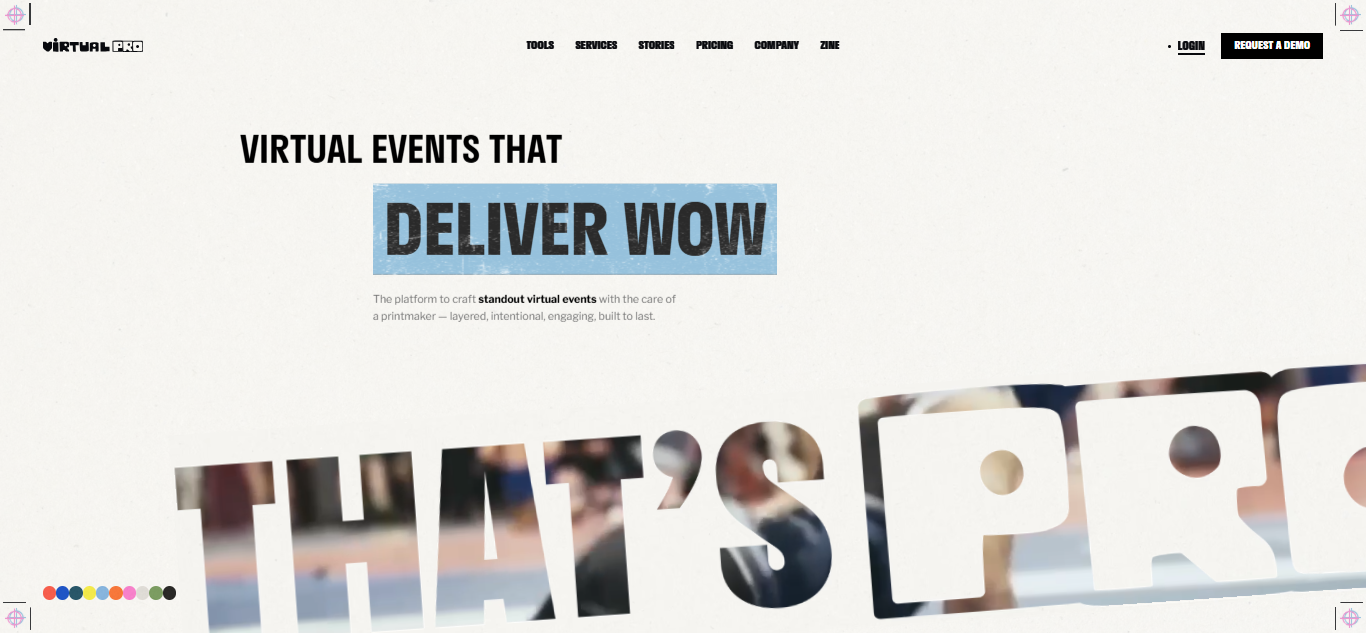
Most of the tools on this list are built for recurring sessions and training workflows. VirtualPRO is built for events, which is a different job entirely. Event organizers need to handle attendee registration, live engagement, networking, and branded experiences simultaneously, yet most tools do only one of those.
VirtualPRO handles all of them. It offers a wide array of tools designed to keep audiences active and interacting, including a gamification suite with points, badges, and leaderboards, multiple networking modes with virtual lounges and one-on-one meeting scheduling, and a branded mobile app that mirrors the desktop experience for hybrid attendees.
What I find specifically useful about VirtualPRO for event teams is the engagement analytics layer. You don’t just run the event and wonder what happened; you get detailed reports on every interaction, which matters when you’re justifying event ROI to a leadership team or a client. Integrations with CRM and marketing automation tools like HubSpot, Mailchimp, and Salesforce mean attendee data flows into the tools your team already uses.
What you’ll like:
- Gamification with points, badges, and leaderboards to drive active participation
- Virtual lounges, breakout rooms, and one-on-one meeting scheduling for networking
- Branded mobile app that delivers a consistent experience for in-person and virtual attendees
- Deep engagement analytics and reports on every attendee interaction
- Integrations with HubSpot, Salesforce, Mailchimp, and more
What to know before you buy:
- The entry-level plan does not include registration and ticketing features, and you’ll need to upgrade to access advanced engagement features like gamification
- Pricing is custom and not publicly listed, so get the quote early before you’re locked into a budget conversation
Pricing: Custom pricing. Contact VirtualPRO directly for a quote based on event size and feature requirements.
6. LoQuiz – Best for Getting People Moving and Competing in the Real World
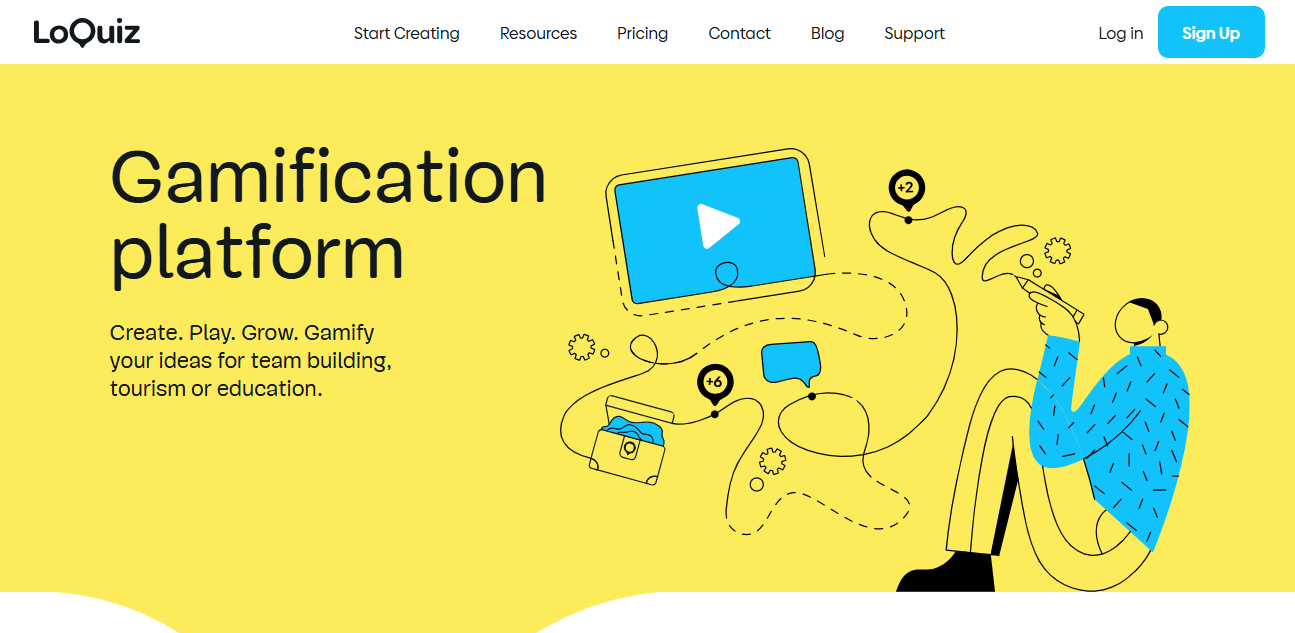
Most team-building activities have the same problem: they’re generic, they feel mandatory, and your most skeptical team members check out in the first ten minutes. LoQuiz is the exception I’d point to because it uses physical space, GPS, and geolocation to tie engagement to specific real-world locations. People can’t zone out when they’re literally trying to find where to go next.
The platform supports city tours, scavenger hunts, treasure hunts, and educational field games. Players need to physically be at a designated location to unlock content, which creates a kind of engagement that no screen-based poll can replicate. I tried it out with a small group for an outdoor team session and the competitive momentum it creates is different from anything you get in a conference room.
Custom questions, clues, QR codes, audio effects, and media content can all be built into the game experience, so you’re not stuck with generic trivia. You can build a game that’s specifically about your city, your company history, or your industry.
What you’ll like:
- GPS and geolocation-gated content that requires physical presence to unlock
- Multiple game types: city tours, scavenger hunts, treasure hunts, educational games
- Full media support: audio, images, video, and interactive tasks
- Online and offline play via the LoQuiz app
- QR codes and hints layered into the physical experience
What to know before you buy:
- Compatibility issues on some devices and older browsers have been reported
- The pricing model can feel steep if you’re running small, infrequent groups
Pricing: Free 14-day trial. Paid plans start at €9/month.
7. CrowdPurr – Best for Hosting Live Trivia and Games People Remember
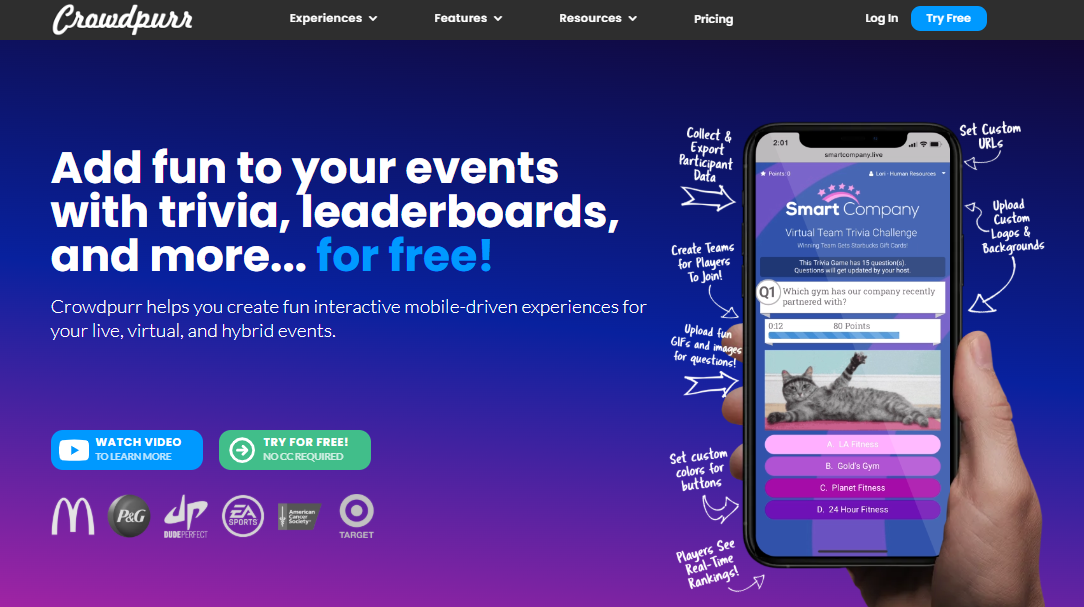
If you’ve ever hosted a live event and watched the energy in the room drop the moment someone opened a spreadsheet presentation, you understand what CrowdPurr is solving for. It’s built specifically for live entertainment-grade engagement: trivia, games, and polls where the experience is the point, not just a check-in mechanism.
The customization depth is what makes it worth using over generic quiz tools. You can build questions with your own images and GIFs, pull from a library of over 1,000 pre-built trivia games, run drag-and-drop ordering questions alongside multiple choice, and display results and rankings live on a presentation screen or live stream. Word clouds for group brainstorming and lead capture fields built directly into the game experience are features that most entertainment-focused tools ignore.
It works equally well for in-person events and virtual ones, and the audience segmentation feature lets you split groups for targeted activities.
What you’ll like:
- Deep customization with your own questions, images, and GIFs
- Over 1,000 pre-built trivia games if you want to skip the build
- Real-time leaderboards and results display on the presentation or stream view
- Word clouds for group brainstorming alongside competitive game formats
- Lead capture fields embedded directly in the game experience
What to know before you buy:
- The default color scheme is not intuitive and can confuse participants on first use. Budget time for customization
- Technical delays have been reported with larger participant groups
Pricing: Starts at $49.99/month for up to 100 participants.
8. Whova – Best for Enterprise-Grade Event Experiences at Scale
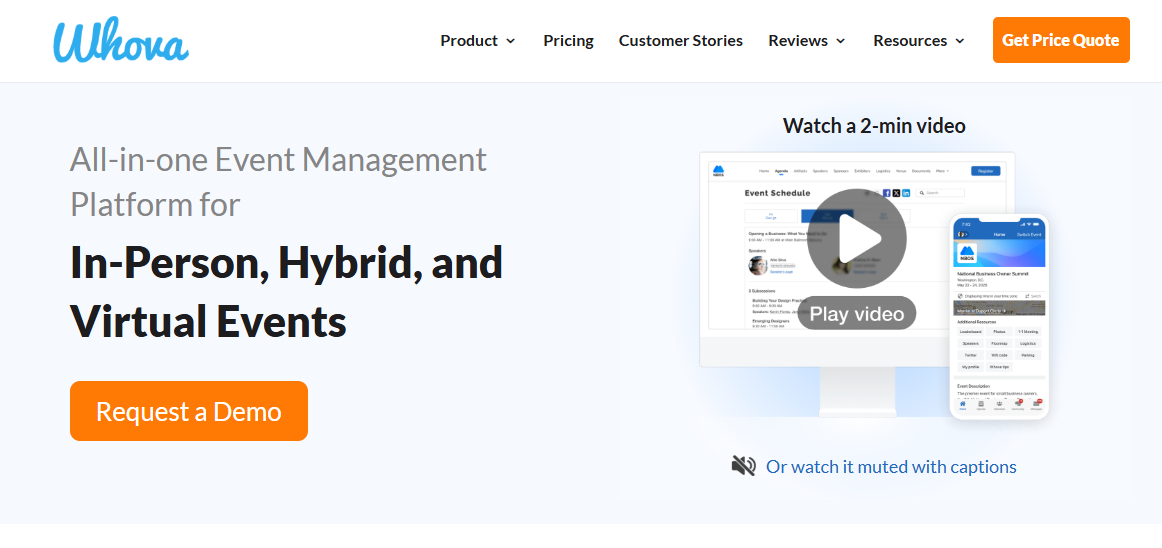
Whova is not the tool for a 10-person weekly standup. It’s built for organizations running large-scale in-person, hybrid, and virtual events where managing the attendee experience from registration through to post-event follow-up is a serious operational challenge. Think multi-track conferences, association events, trade shows, and corporate all-hands where hundreds or thousands of people need to feel connected and informed simultaneously.
Whova has been recognized by the Event Technology Awards for nine years in a row, with clients including Google, Microsoft, American Express, Harvard University, and NASA. That track record matters when you’re putting your name behind a large event.
The mobile event app is the centerpiece. Attendees use it to build personalized agendas, receive live announcements, participate in polls, and connect with other participants through community boards and direct messaging before, during, and after the event. It integrates with Zoom, Slack, Salesforce, HubSpot, Google Calendar, Outlook, Mailchimp, Eventbrite, Stripe, and PayPal, so it plugs into most enterprise tech stacks without friction.
If you’re running serious events at any real scale, Whova removes the ceiling on what the attendee experience can be.
What you’ll like:
- Award-winning event app covering registration, agenda, networking, and live engagement in one place
- Personalized attendee agendas with session selection and live schedule updates
- Live polls, Q&A, community boards, and attendee networking built into the same app
- Name badge printing, QR check-in, and lead retrieval for exhibitors
- Deep integrations with Salesforce, HubSpot, Zoom, Eventbrite, and more
What to know before you buy:
- Pricing is not publicly listed and is quoted per event, so budget conversations need to happen early
- Some reviewers note that fees can feel high for smaller events and pricing details are not always clear upfront
Pricing: Custom pricing per event. Contact Whova directly for a quote based on event size and features needed.
9. Vevox – Best for Reliable Live Polling in Classes and Corporate Meetings
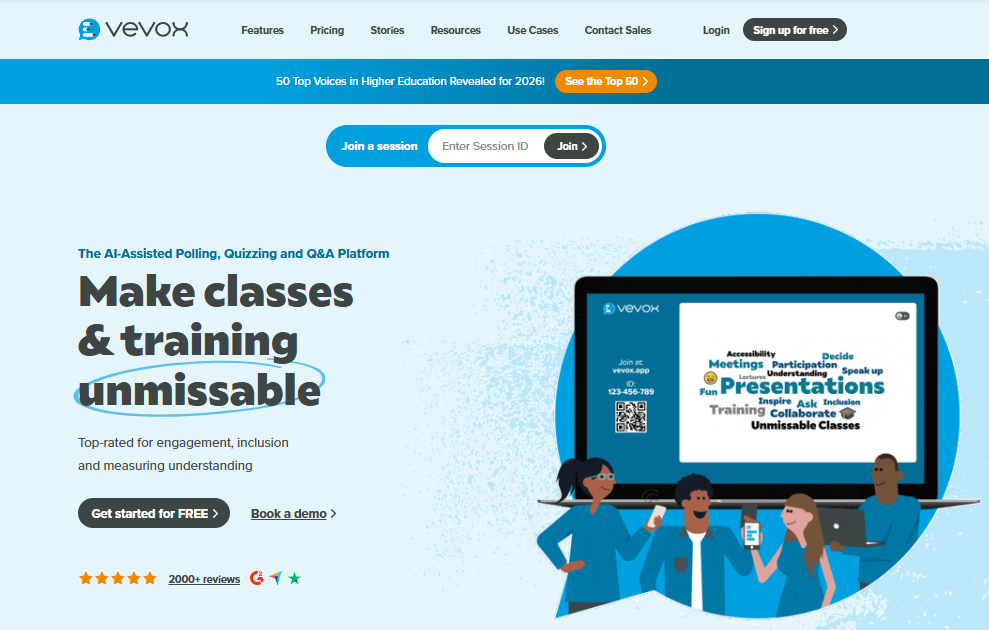
Vevox has a narrower scope than most tools on this list, and I mean that as a compliment. It does live polling and Q&A in meetings and classes, it does it well, and it doesn’t try to be everything else simultaneously.
The poll type variety is genuinely impressive for a focused tool: multiple choice, word cloud, open text, star rating, numeric, ranking, XY plot, pin-on-image, and LaTeX (which matters for anyone teaching math or sciences). The anonymous response mode is something educators and HR teams specifically appreciate because it gets more honest data from groups that might self-censor in attribution-based formats.
The AI question generator creates new polls in seconds, and the PowerPoint integration means you can run live polls inside your slide deck without switching windows. If you’re running recurring corporate training or university lectures and just need the polling layer to work reliably without drama, Vevox is the tool I’d reach for.
What you’ll like:
- 10 poll types, including XY plot, pin-on-image, and LaTeX for specialized audiences
- Anonymous response mode for genuinely candid feedback
- AI question generator to build polls in seconds
- Native PowerPoint integration for in-slide polling
- Export poll data and responses for reporting and analysis
What to know before you buy:
- No free plan, which makes it harder to evaluate before committing
- No audio or video poll support if that’s a format you need
Pricing: Starts at $6.75/month, billed annually.
10. Wayground (formerly Quizizz) – Best for AI-Powered Quizzes That Adapt to Each Learner
Wayground (formerly Quizizz) earns its place at the end of this list because it solves a problem the other tools don’t: adapting the experience’s difficulty to the individual as they go. The AI engine adjusts question difficulty in real time based on each participant’s performance, so a quiz isn’t the same experience for a novice and an expert in the same session.
The content creation speed is also notable. You can paste text, upload a document or PDF, or drop in a link to a public website, and Wayground (formerly Quizizz) generates an aligned quiz from that source material in seconds. The gamification layer (leaderboards, points, memes, timers) creates enough competitive energy that it tends to work for audiences who’d tune out a standard assessment.
The team mode, where groups collaborate to answer questions toward a shared goal, is the feature I’d specifically flag for anyone doing collaborative training rather than individual assessment.
What you’ll like:
- AI that adapts question difficulty to each individual’s performance in real time
- Quiz generation from documents, PDFs, pasted text, or URLs in seconds
- Competitive gamification: leaderboards, points, timers, and memes
- Team mode for collaborative group participation
- Live and asynchronous modes so not everyone has to be present simultaneously
- AI-powered resource recommendations based on individual performance
What to know before you buy:
- Question count limits apply on standard plans
- The most compelling features are locked behind paid tiers
Pricing: Limited free plan. Paid starts at $19/month, billed annually.
How I Evaluated These Tools
I didn’t build this list by skimming feature pages or copying comparison grids. Each tool here has been used in real sessions or evaluated in the context of actual use cases, such as training, workshops, and live events.
Here’s what I focused on:
- Hands-on usability: How quickly can you go from sign-up to a live session or working setup? If a tool slows you down in the first hour, it’s a problem.
- Category fit for the job: This mattered more than features. I looked at whether the tool actually solves the specific job it claims to do, not whether it tries to do everything.
- Engagement in real scenarios: Not just “does it have polls,” but does it actually get people to respond, interact, and stay involved during a session.
- Pricing clarity and scalability: Are costs predictable as you grow? Are key features locked behind upgrades you’ll need anyway?
- Integration depth: Can it plug into tools you already use, like LMS platforms, CRMs, or presentation software, without friction?
- Community and user feedback: Patterns from real users helped validate where tools perform well and where they tend to break under pressure.
The goal wasn’t to find the most feature-rich tools. It was to find the ones that actually work for specific engagement problems without creating new ones.
The Mistake Most People Make When Picking These Tools
I want to be direct about something most comparison guides skip: the majority of “engagement tool doesn’t work” stories I hear are not about a bad product. They’re about buying a polling tool to do an assessment platform’s job, or an event app to run weekly training sessions.
Here’s the real distinction worth internalizing. There are two completely different jobs that look similar from the outside:
Engagement for learning is about knowledge retention, measurable skill change, and provable outcomes. The tool needs scoring, grading, proctoring, certification, and analytics that show what changed. No live polling tool does this job.
Engagement for participation is about attention, atmosphere, and real-time connection. The tool needs responsiveness, minimal friction, and to work when 400 people are trying to submit answers simultaneously. No assessment platform is optimized for this.
Buying the wrong one doesn’t mean your team is bad at engagement. It means you’ve hired a chef to fix your plumbing.
Map your use case to a category first. Then compare products within that category.
Stop Treating Engagement as a Feature. Start Treating It as a System.
Engagement doesn’t fail because your audience doesn’t care. It fails because the tool you’re using wasn’t built for the specific job you need done.
When you hire the right tool for the right job, the experience of running a session changes. You stop dreading the silence and start seeing participation as the default. You stop manually checking completions and start getting reports that tell you exactly where people dropped off and why. You stop running the same flat presentation format and start adapting to your audience in real time.
That shift doesn’t require a massive budget or a full platform overhaul. It usually requires choosing one tool in the right category, learning it well, and building your first session around what it actually does well.
Start there. The rest follows.
Frequently Asked Questions

What's the difference between an audience engagement tool and an assessment platform?
Audience engagement tools capture reactions, opinions, and participation in real time. Assessment platforms measure knowledge and skills against a rubric, with scoring, grading, and often certification or compliance tracking. Some tools handle both, but they optimize differently. If accountability and documentation matter, you need an assessment platform, not a polling tool.
Which audience engagement tool works best for corporate training and L&D?
For corporate training that involves compliance requirements, skill validation, or certification workflows, a dedicated assessment platform is the right category. ProProfs Quiz Maker specifically covers question banks, automated grading, anti-cheating controls, and certification in a single platform. Quizizz is the better fit if you want AI-adaptive difficulty and a gamified format.
Can audience engagement tools integrate with LMS platforms?
Most enterprise-grade options do. ProProfs Quiz Maker, Quizizz, and Vevox all support LMS integrations. Before committing to a plan, verify that the specific LMS your organization uses (Moodle, Canvas, Cornerstone, Workday Learning) is on the supported list. Not all integrations are equal in depth.
How do you prevent cheating in online assessments?
The four controls that matter most are question randomization (different orders for each attempt), question pooling from shared banks (different questions for different people or attempts), browser lockdown (preventing switching tabs or applications), and automated proctoring (webcam and screen monitoring). ProProfs Quiz Maker includes all four in combination.
Are there genuinely free audience engagement tools?
ProProfs Quiz Maker offers free tiers for short quizzes and basic polls, not just free trials. Slido and Mentimeter have free plans but restrict moderation, branding, and analytics in ways that limit professional use. For serious recurring use, most teams will need a paid plan within 30 to 60 days of starting.
Let ProProfs AI Build a Quiz

 We'd love your feedback!
What did you like & how can we make it even better?
 Thanks for your feedback!
 Ask Your Question
Have a question? Get expert help to make your decision easier.