Ch. 5 Section 5.1 & 5.2 Evaluating Driver Response In Path Intrusion Crashes

Reviewed by Editorial Team
The ProProfs editorial team is comprised of experienced subject matter experts. They've collectively created over 10,000 quizzes and lessons, serving over 100 million users. Our team includes in-house content moderators and subject matter experts, as well as a global network of rigorously trained contributors. All adhere to our comprehensive editorial guidelines, ensuring the delivery of high-quality content.
Learn about Our Editorial Process
| By CSRG
C
CSRG
Community Contributor
Quizzes Created: 5 | Total Attempts: 2,048
| Attempts: 505 | Questions: 35 | Updated: Mar 14, 2025
Please wait...
Question 1 / 36
🏆 Rank #--
Score 0/100

1. One of the primary reasons to reconstruct a crash is to determine if the crash was avoidable or not, and it is impossible to determine avoidability without knowing something about the time that was available and the response time necessary for a given scenario.

Explanation

The explanation for the given correct answer is that reconstructing a crash helps in determining if the crash could have been avoided or not. This is because knowing the time available and the necessary response time for a given scenario is crucial in assessing the avoidability of the crash.

Submit
Please wait...
About This Quiz
Ch. 5 Section 5.1 & 5.2 Evaluating Driver Response In Path Intrusion Crashes - Quiz

This quiz evaluates knowledge on driver response in path intrusion crashes, focusing on crash reconstruction to determine crash avoidability, analyzing pre-response times, and utilizing specific methods and studies like those by Harwood et al. It's aimed at improving understanding of factors influencing crash outcomes.

2.

What first name or nickname would you like us to use?

You may optionally provide this to label your report, leaderboard, or certificate.

2. When responding to one object, response time remains relatively constant despite an increase in speed.  However, when responding to two separate objects, response time increases significantly as speed increases.

Explanation

When responding to one object, the response time remains relatively constant regardless of the speed at which the object is moving. This suggests that the brain is able to process and respond to the object efficiently. However, when there are two separate objects to respond to, the response time increases significantly as the speed of the objects increases. This implies that the brain needs more time to process and respond to multiple stimuli simultaneously. Therefore, the statement is true.

Submit

3. The longer a driver waits, and the denser the traffic, the shorter gap he will accept.

Explanation

As the statement suggests, the longer a driver waits and the denser the traffic becomes, the shorter gap the driver will accept. This implies that when drivers are stuck in heavy traffic for a longer duration, they become more impatient and are willing to take smaller gaps between vehicles to move forward. This behavior is commonly observed in congested traffic situations where drivers try to minimize their waiting time by accepting smaller gaps, even if it means taking more risks. Therefore, the statement is true.

Submit

4. In the research discussed in class, when the responders knew the hazard and appropriate response, their response times were faster.

Explanation

The research discussed in class found that when the responders were aware of the hazard and knew the appropriate response, their response times were faster. This suggests that having knowledge and awareness of potential hazards can help individuals react more quickly and effectively in order to mitigate the risks.

Submit

5. In the research discussed in class, drivers responded faster in closed course studies, low fidelity simulator studies and in laboratory studies when compared to real-world drivers.  But we need only make an adjustment to account for this.

Explanation

The explanation for the given correct answer is that the research discussed in class found that drivers responded faster in closed course studies, low fidelity simulator studies, and in laboratory studies compared to real-world drivers. This suggests that there may be some factors present in these controlled environments that facilitate quicker response times. However, the statement also mentions that we only need to make an adjustment to account for this difference, implying that the overall conclusion remains true.

Submit

6. Adjustment to Baseline refers to...

Explanation

Adjustment to Baseline refers to modifying the reported response times from studies to align with the specific methodology and circumstances of a particular case. This means that the response times obtained from various studies may not directly apply to a specific scenario, so adjustments need to be made to ensure accuracy and relevance. By making these adjustments, the response times can be tailored to the specific context, allowing for a more accurate understanding and analysis of the situation at hand.

Submit

7. Which of the following is NOT a landmark from which to start a PRT analysis (without adjustment)? (This could be considered to be a trick question).

Explanation

The question asks for a landmark that is NOT suitable for starting a PRT analysis without adjustment. The correct answer is "Where it is obvious the side road driver is not going to stop". This means that this particular landmark should not be used as a starting point for the analysis. The other options, such as the land landing point of a pedestrian, stop line, or the first point at which a LTAP-OD starts moving laterally, can be considered as suitable landmarks for starting a PRT analysis.

Submit

8. In a path intrusion response scenario, what is a common eccentricity for a driver looking in his interior rearview mirror if he has to respond to an object straight ahead? (Which angle is closest?)

Explanation

In a path intrusion response scenario, a common eccentricity for a driver looking in his interior rearview mirror when responding to an object straight ahead is 25 degrees. This means that the driver's gaze is slightly off-center, allowing them to maintain some awareness of the rearview mirror while focusing primarily on the object in front of them. This angle provides a balance between monitoring the surroundings and addressing the immediate threat ahead.

Submit

9. Who is responsible for the Subtractive Method?

Explanation

Frans Donders is responsible for the Subtractive Method.

Submit

10. Hovering refers to...

Explanation

Hovering refers to drivers who place their foot over the brake pedal, which reduces their PRT (perception-reaction time) by approximately 0.4 seconds. This means that they are ready to respond quickly in case of any potential hazards or emergencies on the road. By hovering, drivers can minimize the delay between perceiving a danger and reacting to it, thus increasing their chances of avoiding accidents.

Submit

11. Adjustment to Baseline applies the concept of additive factors to driver responses.

Explanation

Adjustment to Baseline applies the concept of additive factors to driver responses. This means that when making adjustments to the baseline, additional factors are taken into consideration and added to the driver responses. This allows for a more comprehensive understanding of the drivers and their impact on the overall outcome. Therefore, the statement "Adjustment to Baseline applies the concept of additive factors to driver responses" is true.

Submit

12. If a side road driver accelerated from the stop line to impact in 3.8 seconds and the main road driver skidded 0.6 seconds before impact, which of the following is true?

Explanation

The main road driver's actual PRT was 3.2 seconds because the side road driver accelerated from the stop line to impact in 3.8 seconds, while the main road driver skidded 0.6 seconds before impact. Therefore, the main road driver's total time from the start of skidding to impact would be 3.8 seconds - 0.6 seconds = 3.2 seconds.

Submit

13. Who is responsible for the Additive Factors Method?

Explanation

Saul Sternberg is responsible for the Additive Factors Method.

Submit

14. The fewer variables that are considered in our analysis, the greater the variance (range).

Explanation

When we consider fewer variables in our analysis, it means that we are not taking into account all the possible factors that could affect the outcome. This leads to a greater variance or range because we are not accounting for all the potential sources of variation. By not considering all the variables, we are leaving room for more uncertainty and variability in the results. Therefore, the statement is true.

Submit

15. To perform the adjustment to baseline technique, you may use any published and peer reviewed study.

Explanation

The correct answer is "No - you must have an analogous study (path intrusion, cut-off, traffic signal, or lead vehicle)". This means that in order to perform the adjustment to baseline technique, you need to have a study that is similar or comparable to the one you are conducting. The study should involve elements such as path intrusion, cut-off, traffic signal, or lead vehicle. Simply having any published and peer-reviewed study is not enough, it needs to be relevant and analogous to the specific study being conducted.

Submit

16. The faster the approach speed and closer to the intersection when the signal changes, the following is true:

Explanation

When drivers approach an intersection at a faster speed and are closer to it when the signal changes, they are more likely to travel through the signal instead of stopping. However, if they do decide to stop, they are more likely to respond faster and decelerate at a greater rate. This implies that drivers who are closer to the intersection and have a higher approach speed are more likely to take risks and try to beat the signal, but if they do stop, they are more attentive and able to quickly react to the changed signal.

Submit

17. If a driver accelerated from a stop to a position at impact so his front was 19.7 ft (6 m) from the road edge and there is no stop line on the side road, and if you were to rely on the study by Harwood et al., approximately how far did the side road vehicle travel from a stop to impact?

Explanation

According to the study by Harwood et al., the distance traveled by the side road vehicle from a stop to impact is approximately 26.2 ft (8 m).

Submit

18. A Cut Off is a scenario involving a vehicle...

Explanation

In a cut off scenario, a vehicle is involved that initially started out in the same direction as the driver. This means that the vehicle was initially traveling in the same direction as the driver, but then cut in front of the driver's vehicle, potentially causing a dangerous situation.

Submit

19. In the I.DRR program, you may make the eccentricity calculation boxes appear by clicking in the eccentricity box, scrolling to the top and selecting "CALCULATING ECCENTRICITY".

Explanation

In the I.DRR program, the eccentricity calculation boxes can be made to appear by clicking on the eccentricity box, scrolling to the top, and selecting "CALCULATING ECCENTRICITY". This statement is true as it provides a specific action that can be taken to make the calculation boxes appear.

Submit

20. If a commercial vehicle has an air brake system that is associated with a delay of 375 ms (0.375 seconds), if hand calculating response time (or using a chart), you would increase the calculated response time by...

Explanation

The correct answer is 0.125 seconds because it states that you would increase the calculated response time by the difference between a passenger car braking latency and that of a commercial vehicle, which is 0.125 seconds.

Submit

21. A driver in the left of three lanes cuts across the highway and is heading for an exit.  Our responder is in the right lane.  Witnesses report that the intruder moved from the left lane, to the center lane, straightened, then moved toward the right lane and exit before the crash.  It was dusk, and when the intruder first started to move laterally, he was 15 degrees left of center.  What is the average response time for this scenario?  Which PRT is closest?

Explanation

Based on the given scenario, the driver in the right lane had to respond to the intruder's sudden movement across the highway. The average response time refers to the time it took for the responder to react to the situation. Since the question does not provide any specific information about the responder's reaction time, we can assume that the average response time is the average time it takes for a driver to react to a sudden event on the road. Among the given options, 1.3 sec. (+/- 0.5 sec.) is the closest to the average response time for most drivers in such situations.

Submit

22. Average PRT = 1.1 seconds and 95th percentile response is 1.75 sec.  If the driver had to steer 3.3 feet (1 m) to the right to avoid the crash from a speed of 50 mph (80.45 km/h), using a lateral acceleration of 0.2, how far would the 95th percentile driver need to perform that maneuver?

Explanation

not-available-via-ai

Submit

23. Time from 1st lateral movement of a same-direction-intruder to 1st vehicle response of the responder is what?

Explanation

The correct answer is Vehicle changing lanes PRT (perception-response time). This refers to the time it takes for a vehicle to perceive the lateral movement of another vehicle in the same direction and respond to it by changing lanes. It measures the time it takes for the driver to perceive the movement and initiate a response.

Submit

24. When an intruder fails to stop at the stop line or analogous location, a driver may be able to perceive him as a hazard before reaching the stop line.  However, instead of trying to imagine what the driver was thinking, we should start the PRT from the stop line (or analogous location) but adjust the average PRT downward 0.16 seconds.

Explanation

The correct answer is True. This means that drivers actually perceive the intruder about 0.16 seconds before they arrive at the stop line. This is supported by the statement that a driver may be able to perceive the intruder as a hazard before reaching the stop line. Therefore, starting the PRT from the stop line but adjusting the average PRT downward 0.16 seconds accounts for the time it takes for the driver to perceive the intruder.

Submit

25. Drivers neutralize hazards by making corrective actions - an example of this is when a driver looks both left and right, then focuses his attention on his destination, without making glances left and right while traveling through the intersection.

Explanation

The statement is true because drivers neutralize hazards by taking corrective actions. One example of this is when a driver looks both left and right before focusing on their destination, without making glances left and right while traveling through an intersection. This behavior helps the driver to identify potential hazards and take appropriate actions to avoid them, ensuring their safety and the safety of others on the road.

Submit

26. Start up time is the time from when a driver last looks for oncoming traffic (or from when the traffic signal changes to green) to when the vehicle starts moving forward.

Explanation

The explanation for the given correct answer is that start-up time refers to the time it takes for a vehicle to start moving forward after the driver has checked for oncoming traffic or when the traffic signal turns green. This means that the statement is true, as it accurately defines the concept of start-up time.

Submit

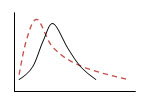
27. Is skew (dashed curve) a factor in driver response times?

Explanation

The correct answer suggests that skew is not a factor in driver response times unless the response time is so fast that the difference between the median and average is negligible. When the response time is higher than 1 1/4 seconds, it becomes normally distributed according to the Central Limit Theorem. This implies that skew is not a significant factor in driver response times in most cases.

Submit

28. Using the equation method in I.DRR for Response to a Path Intrusion, what is the average response time for a full braking response when responding to a hazard at a 15 degree eccentricity, at night, and on a straight, rural road?  The hazard is a pedestrian who was standing on the sidewalk before walking into the road.  Which PRT is closest to the manner in which drivers have responded?

Explanation

The average response time for a full braking response when responding to a hazard at a 15 degree eccentricity, at night, and on a straight, rural road is 2.4 sec. (+/- 0.9 sec.). This is the closest PRT (Pre-Reaction Time) to the manner in which drivers have responded in this scenario.

Submit

29. If during cross examination an attorney claims that you cannot determine a driver's response time because research subjects are more prepared, which of the following can you say?

Explanation

The correct answer is "All of the above." This means that all of the statements mentioned in the options are true. The method mentioned in the question considers anticipation and makes adjustments when necessary, considers the driving task and makes adjustments when necessary, considers experiment types from various settings, and also considers topography as a factor affecting response time.

Submit

30. If someone were to claim that response times are skewed, they would most likely be attempting to claim...

Explanation

The correct answer suggests that if someone claims that response times are skewed, they are most likely trying to argue that the average PRT estimate is too high. Skewness refers to the asymmetry of a distribution, indicating that the data is not evenly distributed around the mean. In this case, if response times are skewed, it implies that there are a significant number of slower response times, causing the average PRT estimate to be higher than expected.

Submit

31. A driver is traveling through an intersection when a vehicle moving the opposite direction slows to a stop and puts on its left directional signal.  There are pedestrians standing on the side of the road on the left and a pedestrian emerges from the sidewalk on the right and into the path of our driver's vehicle.  How many objects did the driver have to respond to?  The driver was intending to drive through the intersection but responded to the pedestrian emerging from the right by braking.

Explanation

The driver only had to respond to one object, which was the pedestrian emerging from the right. The other objects mentioned, such as the vehicle with the left directional signal and the pedestrians on the left side of the road, did not require a response from the driver in this scenario. Therefore, it can be concluded that this is a single stimulus event.

Submit

32. Drivers exhibit response times that may be reported accurately when using the path intrusion response time equations and A2B methods for path intrusions and what other type of crash scenario?

Explanation

Drivers faced with a head-on impact with a time to contact of 2.5 to 4.8 seconds have been shown to respond similarly to drivers faced with a path intrusion response. This means that their response times can be accurately reported using the path intrusion response time equations and A2B methods. In both scenarios, drivers need to quickly react to a potential collision, whether it is a vehicle or object coming from the side of the road or a head-on impact. Therefore, the same equations and methods can be used to measure their response times in both cases.

Submit

33. Many factors influence the gap that a driver will accept before pulling out.  If all else is equal, more drivers will pull out if the approaching vehicle's speed is slower (See Harrel & Spaulding).

Explanation

The explanation for the given answer, "False," is that according to the information provided, more drivers will actually pull out if the approaching vehicle's speed is slower. This means that the statement in the question, which suggests that more drivers will pull out if the approaching vehicle's speed is slower, is true. Therefore, the correct answer should be "True" instead of "False."

Submit

34. In the I.DRR program, Subject Vehicle making a turn refers to drivers negotiating a curve – and PRT increases by 0.26 sec.

Explanation

The statement is false because in the I.DRR program, Subject Vehicle making a turn does not refer to drivers negotiating a curve. Therefore, there is no increase in PRT by 0.26 sec when making a turn.

Submit

35. __________ is the first movement (i.e. foot from throttle) in response to a stimulus.

Explanation

The correct answer is "Reaction." In this context, the term "reaction" refers to the initial movement made by an individual in response to a stimulus. It implies that the person is taking action or responding to the given situation. The other options, "Transition" and "Comment," do not accurately describe the immediate physical response that is being referred to in the question.

Submit
×
Saved
Thank you for your feedback!
View My Results
Cancel
  • All
    All (35)
  • Unanswered
    Unanswered ()
  • Answered
    Answered ()
One of the primary reasons to reconstruct a crash is to determine if...
When responding to one object, response time remains relatively...
The longer a driver waits, and the denser the traffic, the shorter gap...
In the research discussed in class, when the responders knew the...
In the research discussed in class, drivers responded faster in closed...
Adjustment to Baseline refers to...
Which of the following is NOT a landmark from which to start a PRT...
In a path intrusion response scenario, what is a common eccentricity...
Who is responsible for the Subtractive Method?
Hovering refers to...
Adjustment to Baseline applies the concept of additive factors to...
If a side road driver accelerated from the stop line to impact in 3.8...
Who is responsible for the Additive Factors Method?
The fewer variables that are considered in our analysis, the greater...
To perform the adjustment to baseline technique, you may use any...
The faster the approach speed and closer to the intersection when the...
If a driver accelerated from a stop to a position at impact so his...
A Cut Off is a scenario involving a vehicle...
In the I.DRR program, you may make the eccentricity calculation boxes...
If a commercial vehicle has an air brake system that is associated...
A driver in the left of three lanes cuts across the highway and is...
Average PRT = 1.1 seconds and 95th percentile response is 1.75...
Time from 1st lateral movement of a same-direction-intruder to 1st...
When an intruder fails to stop at the stop line or analogous location,...
Drivers neutralize hazards by making corrective actions - an example...
Start up time is the time from when a driver last looks for oncoming...
Is skew (dashed curve) a factor in driver response times?
Using the equation method in I.DRR for Response to a Path Intrusion,...
If during cross examination an attorney claims that you cannot...
If someone were to claim that response times are skewed, they would...
A driver is traveling through an intersection when a vehicle moving...
Drivers exhibit response times that may be reported accurately when...
Many factors influence the gap that a driver will accept before...
In the I.DRR program, Subject Vehicle making a turn refers to drivers...
__________ is the first movement (i.e. foot from throttle) in response...
play-Mute sad happy unanswered_answer up-hover down-hover success oval cancel Check box square blue
Alert!