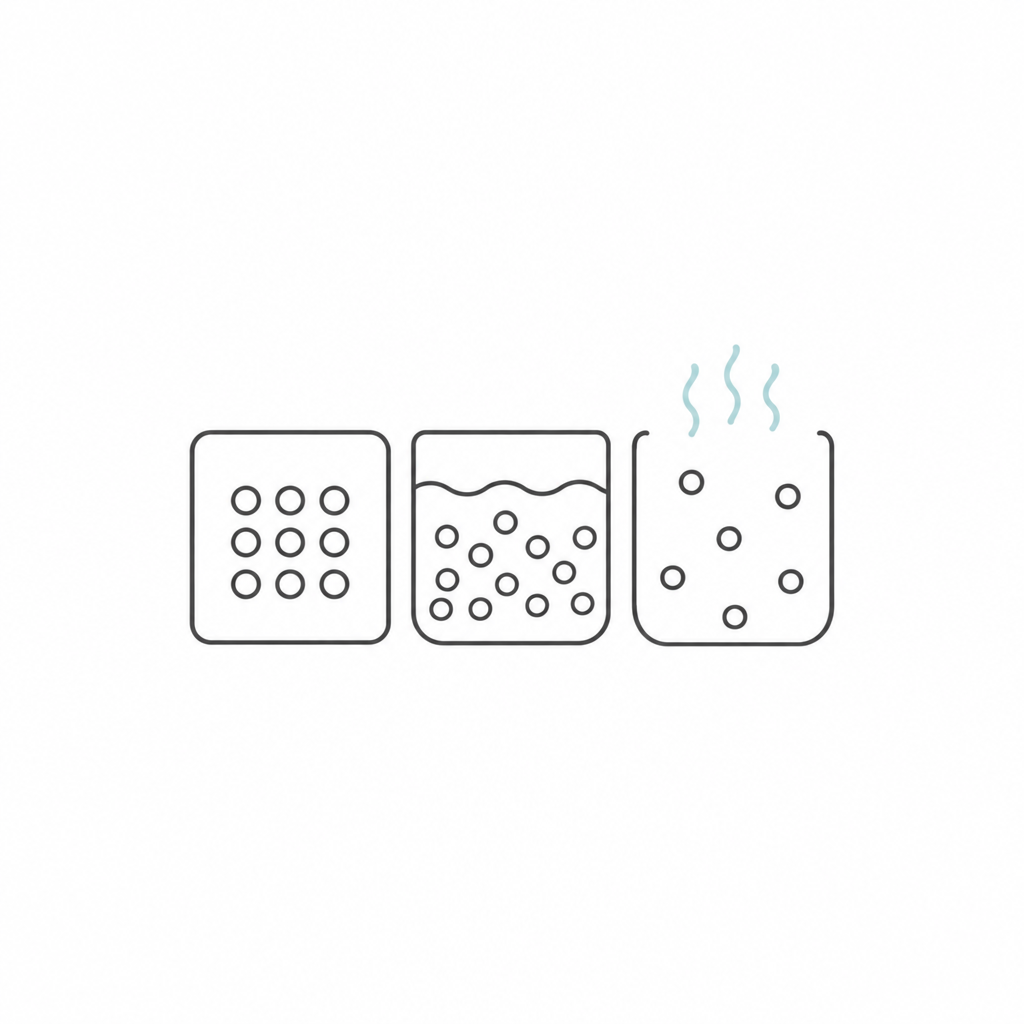
The Particle Model States of Matter

Reviewed by Editorial Team
The ProProfs editorial team is comprised of experienced subject matter experts. They've collectively created over 10,000 quizzes and lessons, serving over 100 million users. Our team includes in-house content moderators and subject matter experts, as well as a global network of rigorously trained contributors. All adhere to our comprehensive editorial guidelines, ensuring the delivery of high-quality content.
Learn about Our Editorial Process
| By Themes
T
Themes
Community Contributor
Quizzes Created: 3463 | Total Attempts: 1,248,268
| Questions: 25 | Updated: Nov 25, 2026
Please wait...
Question 1 / 25
🏆 Rank #-- ▾
0 %
0/100
Score 0/100

1. During boiling, bubbles of steam form all through the ____.

Explanation

During boiling, heat converts the liquid into steam throughout its volume, so bubbles form all through the liquid and rise to the surface.

Submit
Please wait...
About This Quiz
The Particle Model States Of Matter - Quiz

This resource explains how the particle model describes solids, liquids, and gases. It covers particle arrangement and movement, changes of state, diffusion, gas pressure, and the properties of matter. Reviewing these ideas helps learners connect particle behavior to what they observe in substances.

2. Which of the following are changes of state? (Select all that apply)

Submit

3. The properties of a substance depend on three things: what the particles are like, how the particles are ______, and how the particles ______.

Submit

4. Which of the following statements about evaporation is correct?

Submit

5. Match each state of matter to its particle arrangement.

Submit

6. Condensation can happen at any temperature below the boiling point.

Explanation

Vapor can condense into a liquid at temperatures below its boiling point when it loses heat and reaches saturation. The exact temperature at which condensation occurs also depends on pressure and the amount of vapor present.

Submit

7. Gas pressure is caused by collisions of particles with the ____.

Explanation

Gas particles move randomly and collide with the walls of their container. These collisions exert force on the walls, producing gas pressure.

Submit

8. What is a particle?

Explanation

A particle is a very small unit of matter, such as an atom or molecule. Materials are made up of these tiny particles.

Submit

9. Which of the following are properties of a liquid? (Select all that apply)

Explanation

Liquids have a fixed volume but no fixed shape, so they flow and take the shape of their container. Their particles are close together, making liquids very difficult to squash. Their particles are not very far apart.

Submit

10. If a substance is above its boiling point, it exists as a ____.

Explanation

Above its boiling point, a substance changes from a liquid into a gas.

Submit

11. Which state of matter is described as 'not dense at all' and 'flows very easily'?

Explanation

Gas particles are spread far apart, making gases much less dense than solids or liquids. They move freely, so gases flow easily and spread to fill their container.

Submit

12. What does the particle model help us explain?

Explanation

The particle model describes how particles are arranged and move in substances. This helps explain properties such as whether a substance is a solid, liquid, or gas, and how it behaves.

Submit

13. A mixture is made up of two or more pure substances that are chemically joined together.

Explanation

A mixture contains two or more substances that are physically combined, not chemically joined. Substances that are chemically joined form a compound.

Submit

14. What is the change of state from liquid to gas called when it occurs only at the boiling point?

Explanation

Boiling is the change from liquid to gas that occurs throughout the liquid at its boiling point. Evaporation can happen at the surface below the boiling point.

Submit

15. Which of the following correctly describes a solid?

Explanation

A solid keeps its own shape and volume because its particles are packed closely together and remain in fixed positions, though they can vibrate.

Submit

16. Match each keyword to its correct definition.

Submit

17. A liquid has a fixed volume but no fixed shape.

Explanation

A liquid keeps a nearly fixed volume but flows to take the shape of its container.

Submit

18. What is the term for the temperature at which a substance boils?

Explanation

The boiling point is the temperature at which a liquid changes into a gas throughout the substance.

Submit

19. An element is a substance that cannot be broken down into other substances and contains only one type of ____.

Explanation

An element contains only one kind of atom and cannot be chemically broken down into simpler substances.

Submit

20. Which state of matter is easy to squash (compress)?

Explanation

Gas is easy to compress because its particles are far apart, leaving plenty of empty space that can be squeezed together.

Submit

21. What is diffusion?

Explanation

Diffusion occurs when particles move randomly and spread from areas of higher concentration to areas of lower concentration. It happens in liquids and gases.

Submit

22. Boiling occurs only at the boiling point of a substance.

Explanation

Boiling occurs when a liquid’s vapor pressure equals the surrounding pressure. The temperature at which this happens is its boiling point, which can vary with pressure.

Submit

23. Evaporation can happen at ____.

Explanation

Evaporation can occur at any temperature because some liquid molecules have enough energy to escape from the surface into the air.

Submit

24. What happens to particles in a solid when it melts?

Explanation

When a solid is heated, its particles gain energy and vibrate faster. At the melting point, they can move away from their fixed positions and slide past one another, forming a liquid.

Submit

25. Which state of matter has no fixed shape and no fixed volume?

Explanation

Gas has neither a fixed shape nor a fixed volume. Its particles move freely and spread out to fill the available space in their container.

Submit
×
Saved
Thank you for your feedback!
View My Results
Cancel
  • All
    All (25)
  • Unanswered
    Unanswered ()
  • Answered
    Answered ()
During boiling, bubbles of steam form all through the ____.
Which of the following are changes of state? (Select all that apply)
The properties of a substance depend on three things: what the...
Which of the following statements about evaporation is correct?
Match each state of matter to its particle arrangement.
Condensation can happen at any temperature below the boiling point.
Gas pressure is caused by collisions of particles with the ____.
What is a particle?
Which of the following are properties of a liquid? (Select all that...
If a substance is above its boiling point, it exists as a ____.
Which state of matter is described as 'not dense at all' and 'flows...
What does the particle model help us explain?
A mixture is made up of two or more pure substances that are...
What is the change of state from liquid to gas called when it occurs...
Which of the following correctly describes a solid?
Match each keyword to its correct definition.
A liquid has a fixed volume but no fixed shape.
What is the term for the temperature at which a substance boils?
An element is a substance that cannot be broken down into other...
Which state of matter is easy to squash (compress)?
What is diffusion?
Boiling occurs only at the boiling point of a substance.
Evaporation can happen at ____.
What happens to particles in a solid when it melts?
Which state of matter has no fixed shape and no fixed volume?
play-Mute sad happy unanswered_answer up-hover down-hover success oval cancel Check box square blue
Alert!