Membrane Transport Mechanisms

Reviewed by Editorial Team
The ProProfs editorial team is comprised of experienced subject matter experts. They've collectively created over 10,000 quizzes and lessons, serving over 100 million users. Our team includes in-house content moderators and subject matter experts, as well as a global network of rigorously trained contributors. All adhere to our comprehensive editorial guidelines, ensuring the delivery of high-quality content.
Learn about Our Editorial Process
| By Alfredhook3
A
Alfredhook3
Community Contributor
Quizzes Created: 6173 | Total Attempts: 3,194,780
| Questions: 15 | Updated: Nov 18, 2026
Please wait...
Question 1 / 16
🏆 Rank #-- ▾
0 %
0/100
Score 0/100

1. Which of the following best explains why simple diffusion does not require energy?

Explanation

Simple diffusion is a passive process: molecules move naturally from an area of higher concentration to an area of lower concentration. Because this movement follows the concentration gradient, it does not require cellular energy such as ATP.

Submit
Please wait...
About This Quiz
Membrane Transport Mechanisms - Quiz

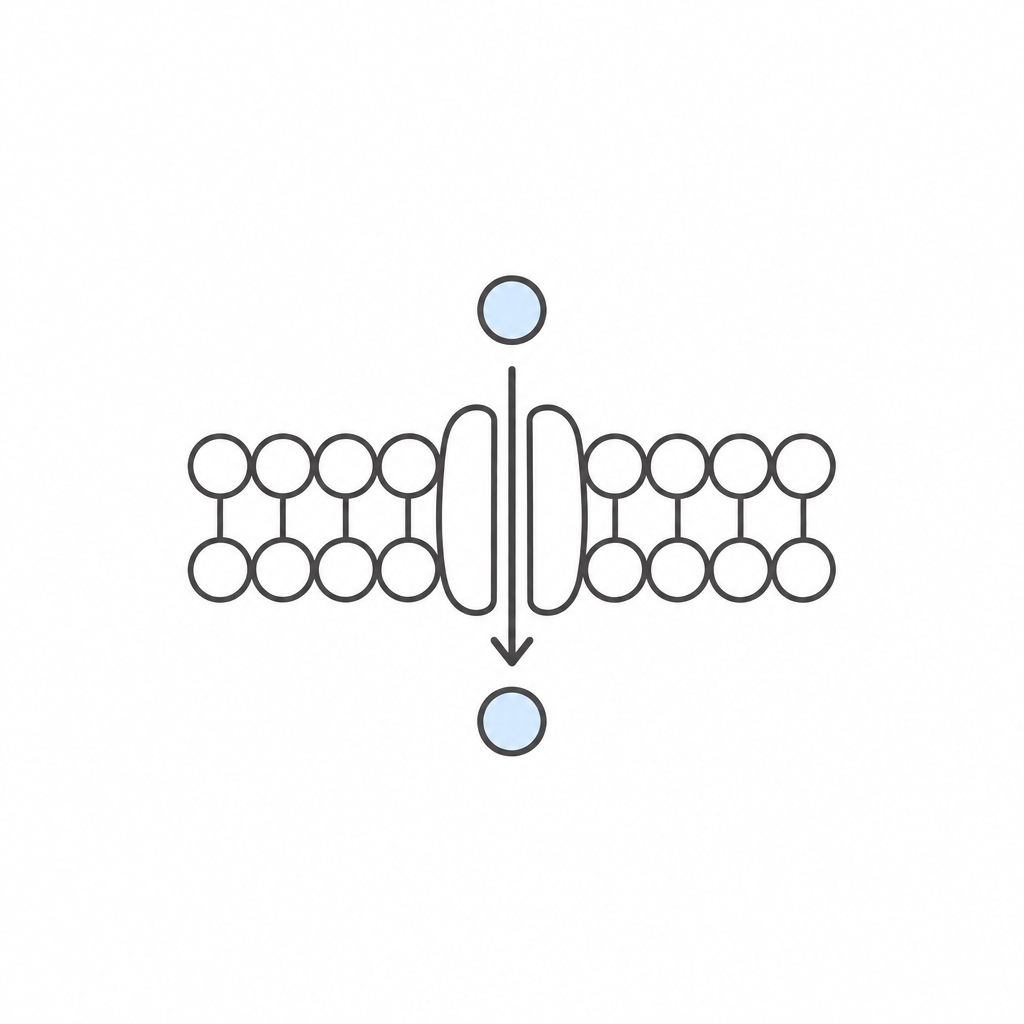
This quiz covers membrane transport mechanisms, including diffusion, transport proteins, ion pumps, electrochemical gradients, and gated channels. It helps learners understand how substances cross cell membranes and how these processes support cell function.

2.

What first name or nickname would you like us to use?

You may optionally provide this to label your report, leaderboard, or certificate.

2. What distinguishes facilitated diffusion from simple diffusion at the molecular level?

Explanation

Facilitated diffusion relies on membrane channels or carrier proteins to help specific solutes cross the membrane. Like simple diffusion, it moves substances down their concentration gradient and does not require ATP; simple diffusion occurs directly through the membrane.

Submit

3. How do channel proteins discriminate between different ions?

Explanation

Channel proteins select ions through the pore’s size and shape, as well as the arrangement of charged amino acids lining it. These features favor ions with compatible dimensions and electrical properties while excluding others.

Submit

4. The resting membrane potential of animal cells ranges from -20 to -200 mV. What does the negative sign indicate?

Explanation

The negative sign indicates that the inside of the cell has a lower electrical potential than the outside—in other words, the cell interior is more negatively charged relative to the exterior.

Submit

5. In the Na⁺-K⁺ ATPase cycle, what triggers the conformational change that ejects Na⁺ from the pump?

Explanation

ATP hydrolysis phosphorylates the Na⁺-K⁺ pump, causing it to shift from the inward-facing E1 state to the outward-facing E2 state. This conformational change lowers the pump’s affinity for Na⁺, releasing the ions outside the cell.

Submit

6. Why does the Na⁺-K⁺ pump account for approximately 30% of a cell's total ATP consumption?

Explanation

The Na⁺-K⁺ pump uses ATP to move Na⁺ out of the cell and K⁺ into it, against their electrochemical gradients. Because ions continually leak back across the membrane, the pump must operate constantly to preserve the concentration differences needed for membrane potential, cell volume, and normal cell function. This sustained energy demand accounts for a substantial share of cellular ATP use.

Submit

7. What is the key mechanistic difference between the Na⁺-K⁺ pump and the Ca²⁺ pump in terms of returning to their original conformation?

Explanation

The Na⁺-K⁺ pump returns toward its original conformation after extracellular K⁺ binds, triggering dephosphorylation. The Ca²⁺ pump can complete its conformational reset after releasing Ca²⁺ without binding another ion.

Submit

8. In the glucose-Na⁺ symport system, what would happen if Na⁺ were absent from the extracellular environment?

Explanation

Extracellular Na⁺ binding is required to trigger the transporter’s conformational change and carry glucose across the membrane. Without Na⁺, the transport cycle cannot proceed, so glucose transport is abolished.

Submit

9. How do plants, bacteria, and fungi regulate cytosolic pH differently from animal cells?

Explanation

Plants, bacteria, and fungi commonly use proton pumps to move H⁺ across membranes, creating electrochemical gradients that help regulate cytosolic pH and drive transport. Animal cells rely more heavily on sodium gradients established by Na⁺ pumps and use Na⁺-H⁺ exchangers to remove excess acidity.

Submit

10. What is the electrochemical gradient and how does it differ in its effect on charged versus uncharged molecules?

Explanation

An electrochemical gradient combines a solute’s concentration difference with the electrical potential across a membrane. Uncharged molecules respond only to their concentration gradient, whereas charged solutes (ions) are influenced by both concentration and electrical forces.

Submit

11. Which of the following correctly describes the functional difference between symport and antiport in gradient-driven pumps?

Explanation

Symport and antiport are both coupled transport mechanisms that use an electrochemical gradient to move solutes. In symport, the coupled solutes cross the membrane in the same direction; in antiport, they move in opposite directions.

Submit

12. Voltage-gated ion channels operate probabilistically. What does this mean for membrane signalling?

Explanation

Voltage-gated channels have a probability of opening that changes with membrane potential. As the voltage shifts, the fraction of open channels changes, adjusting ion flow and enabling graded membrane signalling.

Submit

13. Porins are found in outer mitochondrial and bacterial membranes but do NOT connect the environment directly to the cytosol. What is the functional implication of this?

Explanation

Porins form channels in the outer membrane, allowing many small molecules to reach the mitochondrial intermembrane space or bacterial periplasm. They do not cross the inner membrane, so entry into the cytosol remains regulated and cellular compartments stay distinct.

Submit

14. Why is Ca²⁺ concentration kept low in the cytosol under resting conditions?

Explanation

Cells maintain very low cytosolic Ca²⁺ so that a brief increase can act as a clear signal. When Ca²⁺ enters the cytosol or is released from internal stores, it activates processes such as muscle contraction and nerve-cell signalling. A low resting level makes these changes easy for the cell to detect and control.

Submit

15. A uniport passive transporter moves glucose down its concentration gradient. Which of the following scenarios would reverse the direction of glucose transport?

Explanation

A passive uniport transporter moves glucose down its concentration gradient and does not use ATP or depend on membrane voltage. If intracellular glucose becomes more concentrated than extracellular glucose, the gradient reverses, so glucose moves out of the cell.

Submit
×
Saved
Thank you for your feedback!
View My Results
Cancel
  • All
    All (15)
  • Unanswered
    Unanswered ()
  • Answered
    Answered ()
Which of the following best explains why simple diffusion does not...
What distinguishes facilitated diffusion from simple diffusion at the...
How do channel proteins discriminate between different ions?
The resting membrane potential of animal cells ranges from -20 to -200...
In the Na⁺-K⁺ ATPase cycle, what triggers the conformational...
Why does the Na⁺-K⁺ pump account for approximately 30% of a cell's...
What is the key mechanistic difference between the Na⁺-K⁺ pump and...
In the glucose-Na⁺ symport system, what would happen if Na⁺ were...
How do plants, bacteria, and fungi regulate cytosolic pH differently...
What is the electrochemical gradient and how does it differ in its...
Which of the following correctly describes the functional difference...
Voltage-gated ion channels operate probabilistically. What does this...
Porins are found in outer mitochondrial and bacterial membranes but do...
Why is Ca²⁺ concentration kept low in the cytosol under resting...
A uniport passive transporter moves glucose down its concentration...
play-Mute sad happy unanswered_answer up-hover down-hover success oval cancel Check box square blue
Alert!



