When I design a course or training program, my goal is more than just delivering content. I want to quickly see who can use what we just learned. That is where the real benefits of online quizzes show up.
Rather than waiting for a final exam and hoping everything made sense, I use short, focused quizzes to find out what people understand, what they are unsure about, and where they need more help. This quick feedback lets me adjust the course to improve learning.
In this article, I will explain how online quiz software works in daily use and show how quizzes can help in classrooms, universities, coaching, and employee training.
The goal is simple: to help you use quizzes as a practical tool that makes learning clearer, faster, and easier to manage, instead of just a one-time test.
How Online Quiz Software Works
Most quiz platforms follow the same basic flow. Once you understand that flow, the rest is just detail.
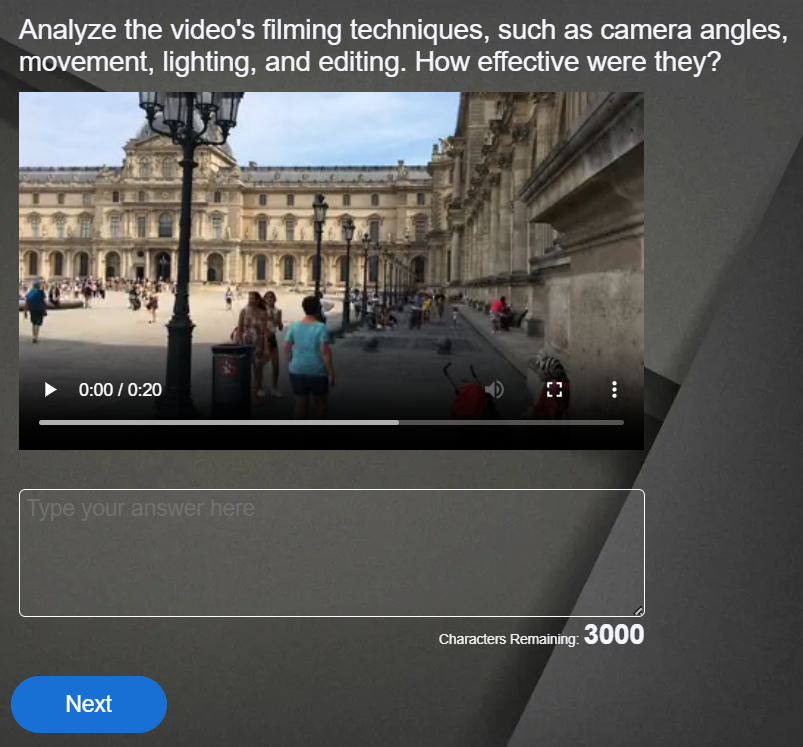
You start by writing questions in a browser. Common formats include multiple choice, true or false, short answer, matching, and simple scenario-based questions. Many tools let you attach images, audio clips, or short videos.
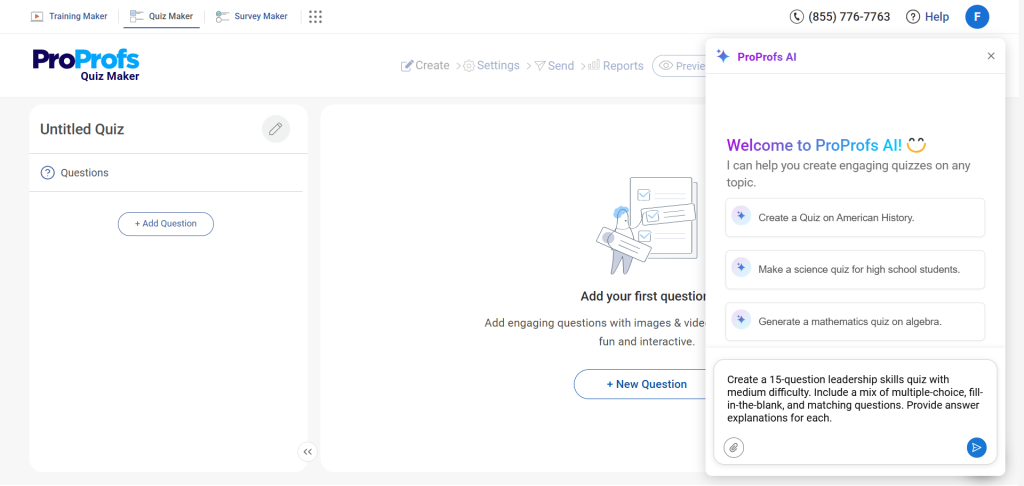
Increasingly, quiz makers also include AI assistants, so you can paste your lesson notes, upload slides, or add a policy document and get a draft set of questions in seconds, which you then review and refine.
Next, you decide how the quiz behaves. Typically you configure:
- Who can access it, and during what time window
- Whether there is a time limit
- How many attempts are allowed
- Whether questions appear in a fixed or random order
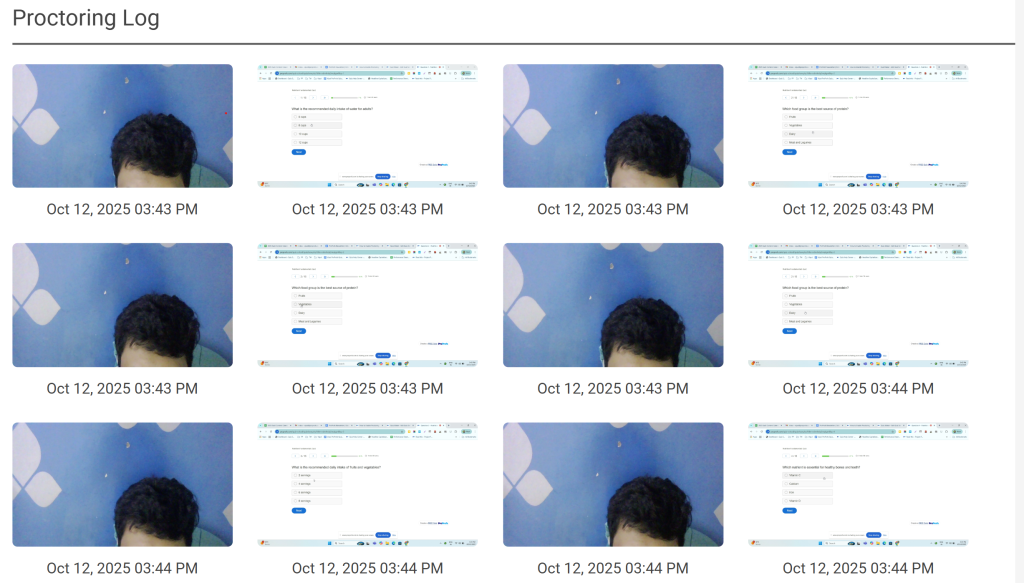
- Whether to enable proctoring options such as webcam/screen monitoring or tab-switching prevention
Many tools also let you store all your questions in an online question bank and have the system pull a different mix of questions for each attempt. This makes it easier to reuse and expand your content over time while reducing the chances of answer sharing.
Watch: From 15 Years of Paper Tests to Easy Digital Assessments | ProProfs Case Study
Benefits of Online Quizzes in Education
In education, your job is not just to cover content but to help students understand, remember, and apply it. The benefits of online quizzes here are mostly about visibility and timing. They let you see what is happening in learners’ heads while there is still time to do something about it.
Immediate Feedback for Learners
Traditional paper tests are slow. Students hand in their work, you mark it, and the results appear days or weeks later. By then, you have usually moved on.
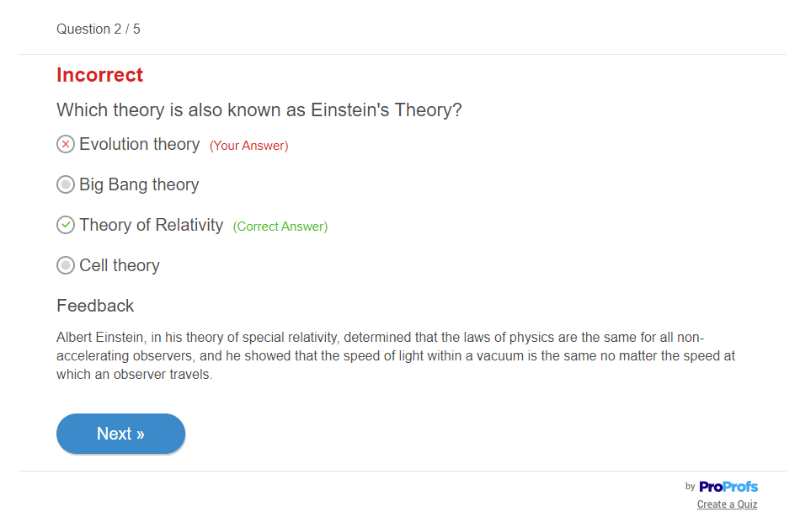
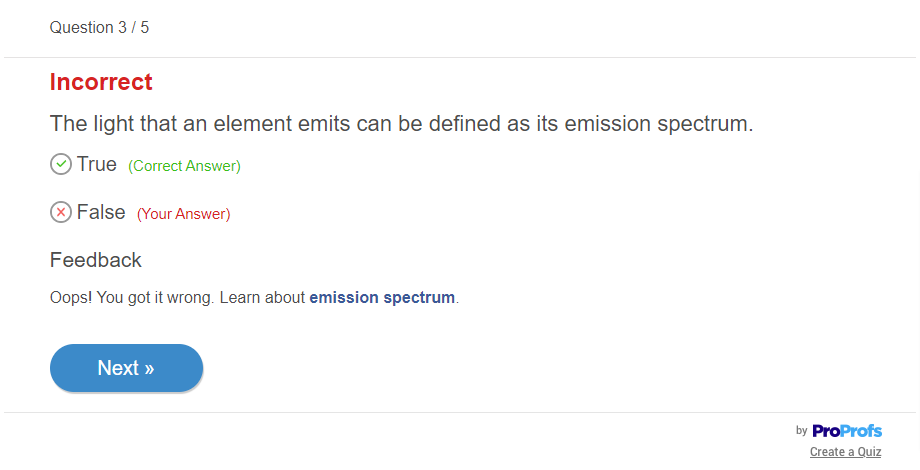
With an online quiz, a learner finishes a short set of questions, submits, and sees their score immediately. If each question includes a brief explanation, they also see why the correct option is correct and what idea the wrong options were built around.
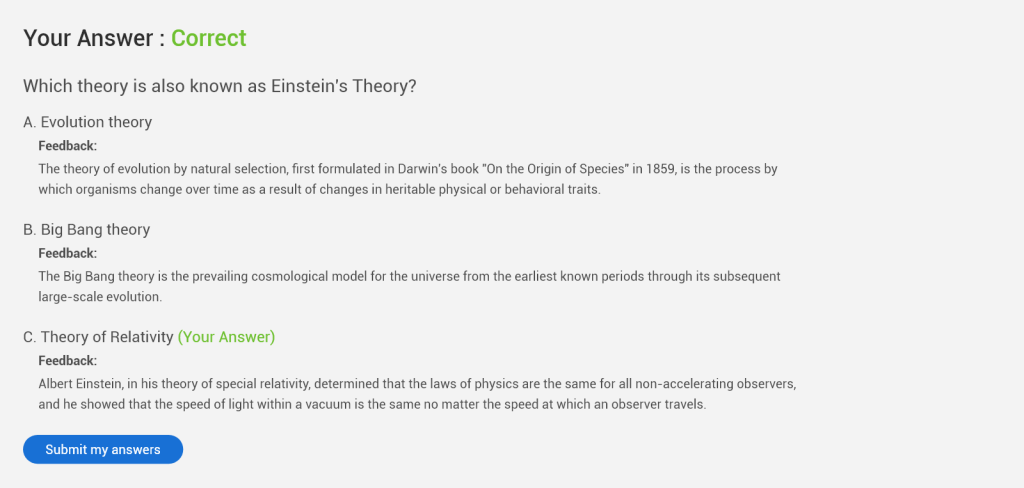
A student who realises on the same day that they misunderstood a step in a calculation or a core concept can correct it before it affects later topics. You see the same pattern and can decide whether you need a quick recap for everyone or focused help for a few students.
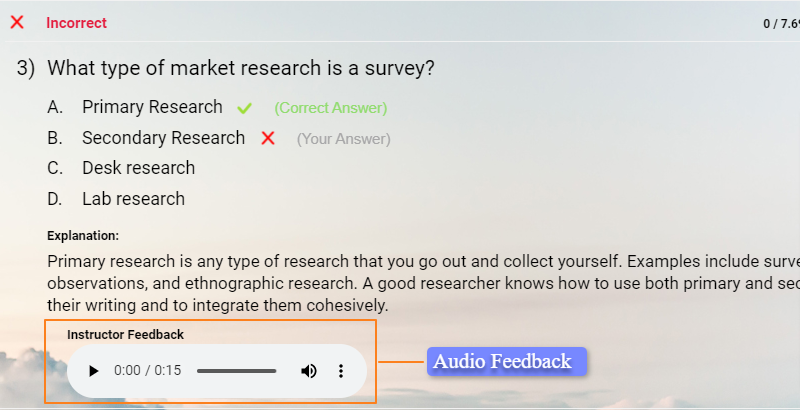
Watch: How Barry Hoffman, a New York math teacher, uses ProProfs’ instant feedback to boost retention
2. Clearer Insight Into Class Understanding
Good teaching decisions need evidence, not just a feeling that “the class seemed fine.” Short quizzes give you that evidence in a structured way.
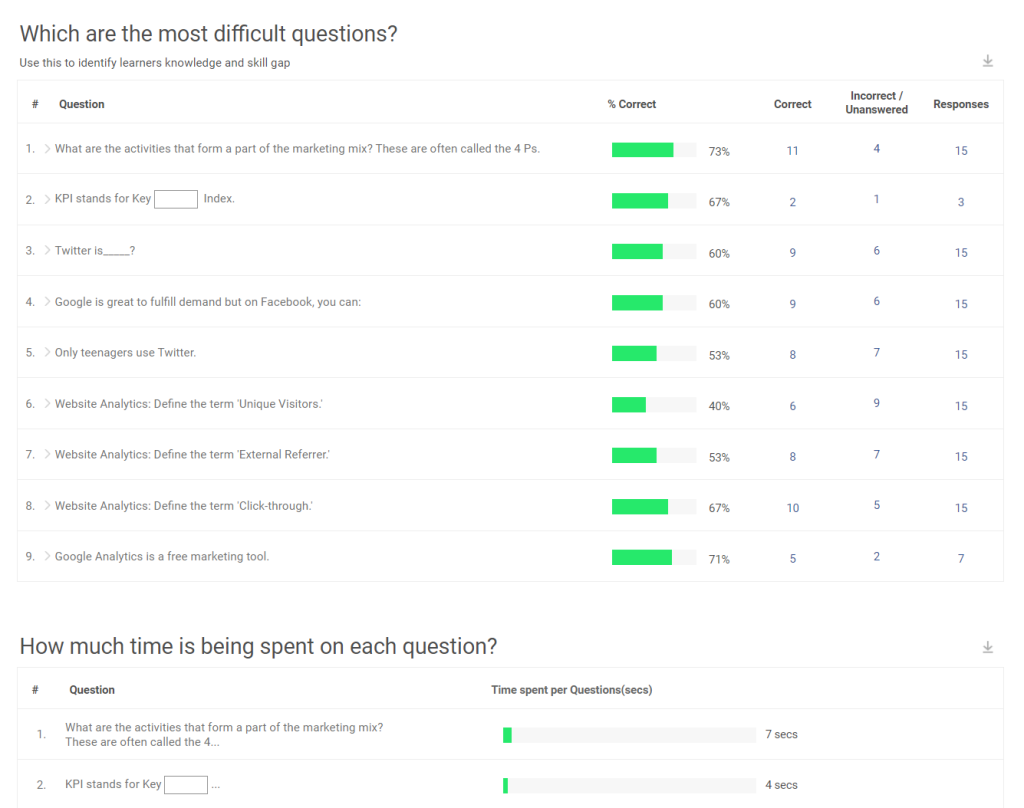
A simple pattern works well:
- A quick quiz at the start of a unit to see what learners already know
- A short mid-unit quiz to surface confusion early
- A final quiz on the core ideas at the end
You are not chasing perfect scores. You are looking for patterns. If many students miss the same question, the concept behind it needs another explanation or more practice. If one student’s scores drift down over several quizzes, that is your cue to step in before an end-of-term exam goes badly.
This is one of the practical benefits of online quizzes for teachers: vague impressions turn into specific signals you can act on.
Watch: How to Review Quiz Reports & Statistics
Many learners revise by rereading notes or highlighting pages. Those habits feel busy but do not always produce strong recall. Learning research keeps pointing to the same conclusion: memory improves when people actively retrieve information rather than just seeing it again.
Learners who are regularly tested on material tend to perform better later than those who only restudy it.
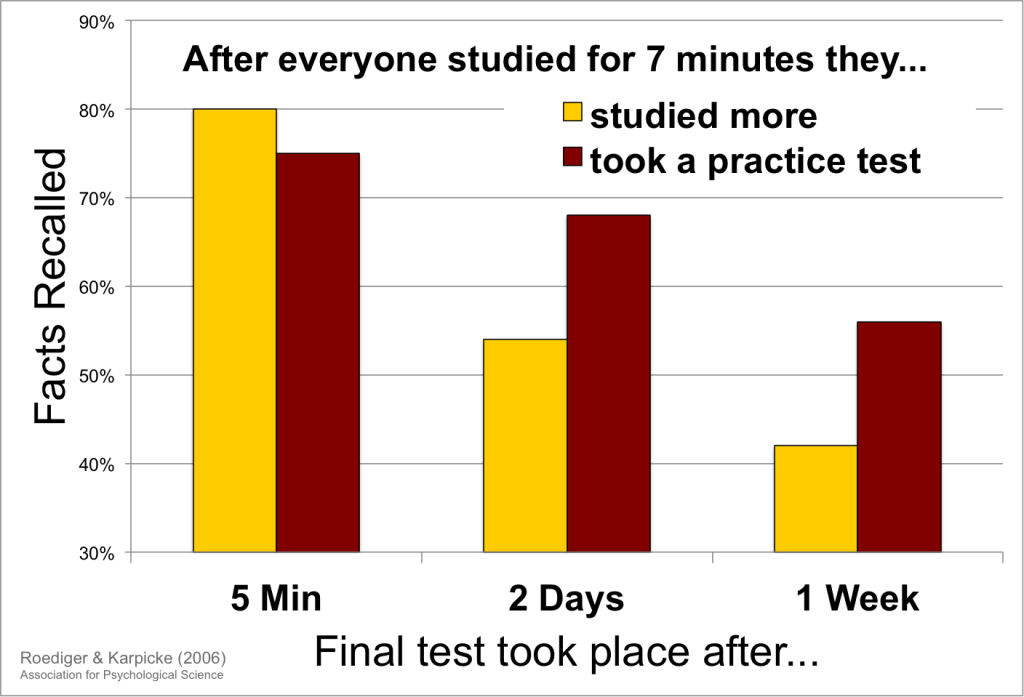
Image source: Roediger, H.L. & Karpicke, J.D. (2006)
Short quizzes are an easy way to build this retrieval practice into normal study. A weekly quiz can mix questions from the latest lesson with items from earlier in the term. The same idea might appear as a definition one week, a short scenario the next, and a labelled diagram later.
Online quizzes give you a practical way to bring that effect into your courses. Every quiz is both a check and a learning event, which is one of the most important benefits of online assessment in educational settings.
4. Low-Stress Practice Opportunities
High-stakes exams create pressure. When a lot depends on one grade, students focus on guessing what will be asked rather than facing what they do not yet understand.
Low-stakes online quizzes create a different space when you frame them as practice. If learners know they can retake a quiz and that early attempts are there to help them, they are more likely to answer honestly and engage with feedback.
You get a more accurate picture of their understanding because they are not protecting a mark. They get used to seeing mistakes as information rather than as a verdict. Over time, that shift in attitude becomes one of the quieter but powerful benefits of online quizzes.
5. Flexibility for Different Study Routines
Real students have complicated lives. Some work part-time, some commute long distances, some have family responsibilities, and some study across time zones.
Short, browser-based quizzes fit into this reality far better than a handful of long tests. A learner can complete a five-minute check on a phone during a break, on a laptop after a shift, or on a tablet at home.
Someone who misses a live session can watch the recording and then take the same quiz to check their understanding.
To make this genuinely helpful, quizzes should be:
- Short enough to finish in one sitting
- Focused on a narrow slice of content
- Clear and usable on smaller screens
Designed this way, they support different study routines instead of adding friction.
6. Tracking Progress Over Time
Once quiz results live in a digital system, they become more than one-off events. You can look across a term and see how understanding changes with reports and stats.
You might notice that scores on basic recall questions climb steadily while application questions stay flat. That suggests your explanations are landing, but students need more practice using concepts in new contexts.
You might see that every time a certain topic appears, results dip, which is a strong signal that you need different examples or a revised plan for that topic.
At the individual level, a gentle decline across several quizzes often appears long before a final exam goes wrong. That early warning lets you step in with extra support, different resources, or a conversation about study habits rather than waiting for a final failure.
7. Grading Automation
Frequent assessment is valuable, but your time is limited. Marking stacks of paper quizzes every week is hard to sustain.
With online quizzes, objective questions are scored automatically, and attempts are stored in one place. You still design the questions, set standards, and interpret results, but you do not have to do every calculation or keep every record by hand.
That makes it realistic to use short quizzes as a regular teaching tool instead of saving assessments for a small number of large exams. You get the benefits of online quizzes for visibility and learning without sacrificing your evenings to grading.
Benefits of Online Quizzes in Business
In a business, learning appears in onboarding, compliance, product and process training, and leadership development. The questions are practical: are people ready to do the job, are they following key rules, and are skills improving over time rather than only on training days?
Online quizzes give you simple, direct signals on all of these. They also support lead generation and hiring when you design them around real decisions instead of novelty.
1. More Reliable Employee Onboarding
Onboarding reports often look perfect. Every module is “complete,” every video is “viewed,” every checklist is “signed.” None of that proves that new hires can handle real situations.
Short quizzes tied to important topics give you a clearer view. After a product overview, you can ask which feature fits which customer problem. After a security module, you can test how they would respond to a suspicious email or data request.
From those results, you can see which areas landed and which need reinforcement. New hires know where to review. Managers can decide who is ready for more responsibility and who needs a slower ramp-up or extra coaching.
Watch: 4-Step System to Onboard & Train Your New Employees
2. Compliance Knowledge That Stays Current
Compliance training is often intense and infrequent. A single long course encourages people to sit through it once and then forget most of it.
Short quizzes spaced throughout the year work differently. A five-minute quiz every few weeks, built around realistic scenarios, keeps key rules active in people’s minds. Staff practice spotting issues and choosing proper actions rather than just reading policy text.
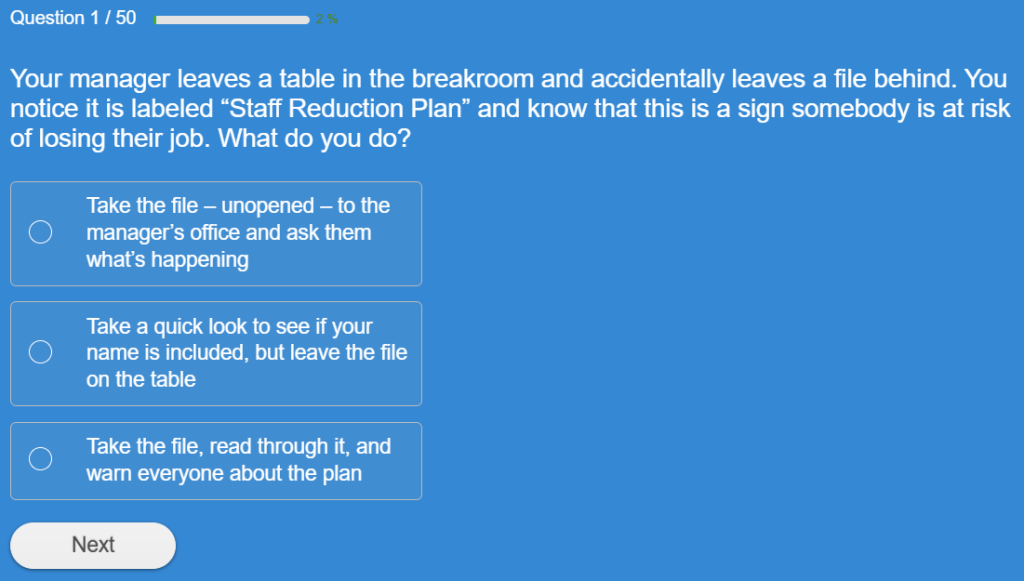
You also gain a more useful record than simple attendance logs. You can see who has recently demonstrated understanding of critical topics and where confusion is common. That makes follow-up training more focused and easier to defend.
3. Sharper Training Needs Analysis
Training budgets are limited, so you want to invest where they will have the most impact. Here, one of the biggest advantages of online assessment is the amount of data you get about actual skills and knowledge.
If you run short quizzes across teams before designing a training plan, patterns appear quickly:
- Topics where scores are consistently low across the organisation
- Specific teams or locations with weaker results
- Roles where only certain skills are missing
Instead of guessing or relying only on manager opinions, you base your training needs analysis on hard evidence from online quizzes and other assessments. That means you can target programs at real gaps, avoid unnecessary courses, and measure whether follow-up training actually closes those gaps.
Watch: How EASE Streamlined Workshop Assessments
4. Continued Skill Development After Training
Workshops and formal courses are visible milestones, but their impact fades if nothing follows them. Many teams leave a session with good intentions and then slide back into old habits.
Online quizzes help keep new skills alive. A week after training, you can send a short quiz that checks how well people can apply key ideas to everyday scenarios. Another quiz, a month later, shows what has stuck and what needs a nudge.
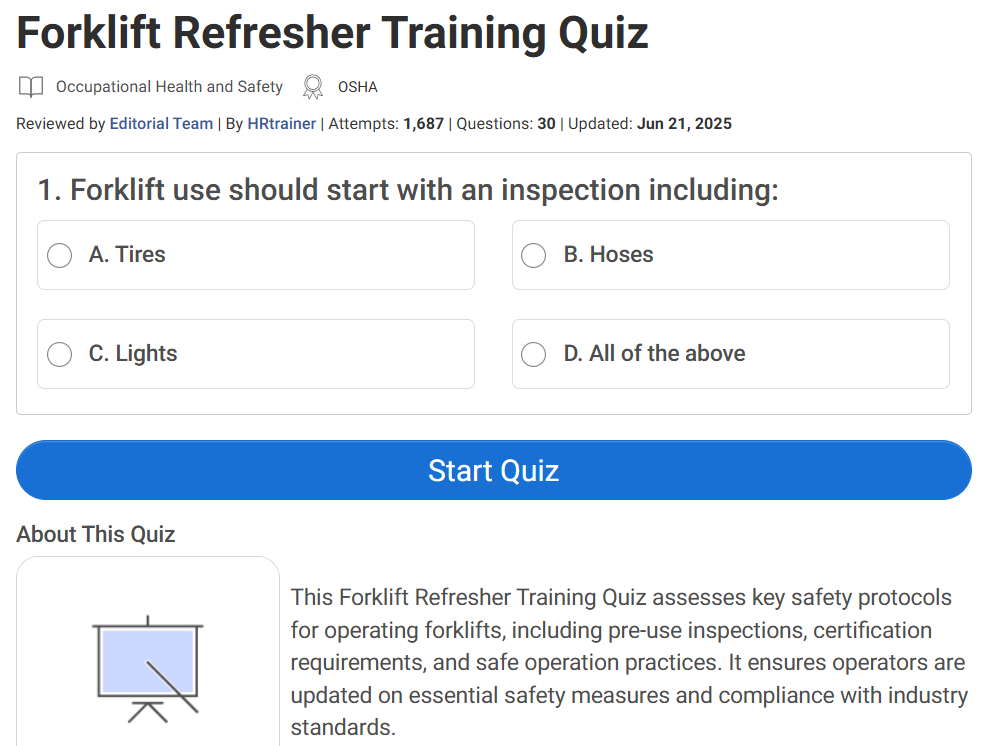
If results stay strong, that suggests both the training and the follow-up are working. If certain topics keep producing weak scores, you know exactly where to add refreshers, better job aids, or targeted coaching. In this way, the benefits of online quizzes extend into continuous development rather than one-off events.
5. Concrete Inputs for Coaching & Reviews
Performance reviews and coaching conversations can easily drift into vague comments like “improve communication” or “take more ownership.” Those are hard to turn into daily actions.
Scenario-based quizzes give you specific situations to talk about. A manager might answer questions about handling a team conflict, prioritising tasks under pressure, or giving tough feedback. Their choices show how they currently approach those challenges.
In a one-to-one conversation, you can walk through the scenarios together, ask why they chose a particular option, and explore alternatives. Feedback becomes concrete and linked to behaviour, which makes it easier to practice and measure over time.
6. Lead Generation With Real Value
Quizzes are common in marketing, but they do not have to be shallow engagement tricks. When they are designed as simple diagnostics, they can support lead generation while still being useful for the person taking them.
For example, a learning provider might publish a quiz called “Where Is Your Training Program Stuck?” The questions cover tools, content, adoption, and leadership support. At the end, the respondent gets a short summary of their situation and a few practical suggestions.
If you place an optional form in front of a detailed breakdown or downloadable resource, people who want more detail can share their email. You get leads enriched with context about their challenges, not just names on a list.
This is one of the quieter benefits of online quizzes for businesses: they can grow your pipeline in a way that still respects the user’s time.
7. Practical Screening in Hiring
Hiring often relies on CVs and interviews. These show experience and communication style, but not always how someone will handle everyday tasks.
Online quizzes add another lens. A support candidate might rank sample responses from most to least helpful. A sales candidate might choose the best next step in a stalled deal. A technical candidate might pick the likeliest cause of a simple failure based on a short description.
When you are running these assessments remotely, proctoring features such as screen monitoring, webcam capture, or browser lockdown help keep the process fair. They make it harder for candidates to look up answers or get live help, so you can trust that the results reflect their own skills.
These small assessments do not replace interviews, but they give you evidence of how candidates think about real work. That reduces guesswork and makes comparisons more grounded and fair.
Watch: How to Create a Video Interview Quiz
Turn Online Quizzes Into Real Learning Gains
Online quizzes are simple tools, but the benefits of online quizzes depend entirely on how you use the results. In classrooms, they bring faster feedback, clearer insight, and stronger long-term retention.
In organisations, they make onboarding more reliable, sharpen training needs analysis, keep compliance knowledge alive, and turn training into a measurable process rather than a one-off event.
You do not need a major rollout to start. Choose one course or training path, add a brief quiz at the start, another in the middle, and one at the end, then adjust based on what you learn.
If you want an easier way to run this loop, a platform like ProProfs Quiz Maker can handle question banks, delivery, scoring, and reporting and let you create quizzes quickly with AI so you spend less time wrestling with mechanics and more time using online quizzes to improve real learning outcomes.
Frequently Asked Questions

What makes an online quiz question genuinely useful for learning?
Useful questions check one clear idea, use simple language, and reflect real tasks or decisions learners might face. Avoid trick wording, focus on common misconceptions, and add brief explanations so each question teaches something instead of just scoring answers.
How can I handle cheating or AI-generated answers in online quizzes?
Shift from simple recall questions to applied, scenario-based ones that ask learners to choose or justify actions in context. Randomise questions, mix formats, and use quizzes mainly for practice and diagnosis, keeping high-stakes decisions tied to supervised tasks or projects.

Let ProProfs AI Build a Quiz

 We'd love your feedback!
What did you like & how can we make it even better?
 Thanks for your feedback!
 Ask Your Question
Have a question? Get expert help to make your decision easier.