

I’ve spent more time than I care to admit evaluating quiz and test creation tools, and the honest truth is: most of them are not built for what educators, trainers, and HR teams actually need. They are built for surveys with a grading checkbox. That is not the same thing.
If you are here, you probably already know the difference. You need a multiple-choice test maker that handles real assessment logic, not just “type a question, pick four answers, mark one correct.” You need anti-cheating controls, question banks, automated grading, and reporting that actually tells you something. Maybe you also need to stop paying for features you will never use while missing the one you desperately need.
This guide is for educators, L&D professionals, HR and recruiting teams, corporate trainers, and course creators who are done settling for tools that almost work.
What Is a Multiple-Choice Test Maker?
Unlike generic form builders or survey tools, a purpose-built multiple-choice test maker treats assessment as the primary use case. That means support for question banks, timed exams, partial scoring, and performance reports broken down by question, category, or learner, rather than a basic pie chart of overall scores.
The distinction matters more than it sounds. A survey tool can technically host a quiz. But without grading logic, question randomization, and audit-ready reporting, it will eventually hit a ceiling that a dedicated assessment platform was built to clear.
The 11 Best Multiple-Choice Test Maker Tools
I have evaluated these tools against what actually matters in real assessment workflows: question depth, anti-cheating controls, analytics quality, pricing honesty, and ease of use for non-technical teams. Here is what I found.
But if you are low on time, check this video out:
| Tool | Capterra Rating | Best For | AI Question Generation | Anti-Cheating / Proctoring | Question Types |
| ProProfs Quiz Maker | 4.5/5 | AI-powered, secure quizzes and assessments | Yes | Yes (webcam, browser lockdown, IP tracking) | 20+ |
| TestGorilla | 4.5/5 | Hiring and candidate screening | No | Yes (basic monitoring) | 10+ |
| Classtime | 4.7/5 | Real-time classroom assessments | No | No | 10+ |
| SpeedExam | 4.6/5 | Secure, high-stakes exams | No | Yes (webcam, browser lockdown, IP restrictions) | 8+ |
| Respondus | 4.2/5 | Online exam security and proctoring | No | Yes (webcam, browser lockdown) | N/A (no builder) |
| Testportal | 4.6/5 | AI-powered business assessments | Yes | Yes (webcam, browser lockdown) | 10+ |
| Google Forms / Microsoft Forms | 4.7/5 | Simple, free quizzes | No | No | 3 – 4 |
| Riddle | 4.8/5 | Marketing and lead-generation quizzes | No | No | 5+ |
| Typeform | 4.7/5 | Conversational, interactive quiz experiences | Yes (AI form builder) | No | 5+ |
| Quizgecko | N/A | AI-first quiz generation from documents and URLs | Yes | No | 4+ |
| ClassMarker | 4.5/5 | Professional online testing for business and education | No | No (randomization only) | 8+ |
1. ProProfs Quiz Maker – Best for AI-Powered, Secure Quizzes and Assessments
I have used ProProfs Quiz Maker across hiring workflows, employee compliance training, and classroom assessments, and the thing that separates it from most tools is how much it is actually built for assessment rather than retrofitted from a survey or form builder.
You are not fighting the platform to do what you need. It does what you need by default.
The AI quiz generator builds full assessments in seconds and converts documents (DOC, PDF, PPT), YouTube videos, uploaded videos, and webpages into quiz-ready content.

Let ProProfs AI Build a Quiz
You also get over 20+ question types, including interactive formats, image-based items, and video response questions, plus a library of over a million ready questions you can pull from directly.
Security is where ProProfs stands out against most competitors. Browser lockdown, IP tracking, webcam proctoring, screen proctoring, and question randomization are all built in. It also flags answers that show signs of being AI-generated, which catches a kind of dishonesty that lockdown and proctoring alone were never built to address. Question banks and pooling mean each attempt or test-taker gets a different set of questions, which is the practical standard for high-stakes certification and compliance exams. You can also set time limits per question or per quiz.
On the reporting side, you’re not stuck scrolling through raw data either. You can ask the AI a direct question, like which category candidates are consistently missing, and get the answer immediately instead of building the report yourself.
Pros:
- AI quiz generator that converts documents, videos, and webpages into assessments in seconds
- 20+ question types, including interactive, image-based, and video response formats
- Advanced anti-cheating: browser lockdown, webcam and screen proctoring, IP tracking, and randomization
- Question banks and pooling for different questions per attempt
- Reporting you can query directly, ask the AI which topics or test-takers need attention and get an instant answer
- Automated grading with configurable scoring rules, partial credit, passing criteria, and AI-scored essay or open-ended responses against your own rubric
- Instant feedback with explanations for every attempt
- Automated certification and recertification with branded certificates
Cons:
- No dark mode, which some users find uncomfortable during extended sessions
- Cloud-based only; no on-premise option
Pricing: Forever free for short quizzes and essential features. Paid plans start at $19.99/month for businesses, with K–12 pricing at $4/teacher/month or $0.25/student/month for schools and districts.
2. TestGorilla – Best for Hiring and Candidate Screening Tests
TestGorilla is built specifically for pre-employment assessments, making it a different kind of multiple-choice test maker than most on this list. Rather than starting with a blank canvas, you get a library of 400-plus scientifically validated test templates covering cognitive ability, role-specific skills, coding, and personality.
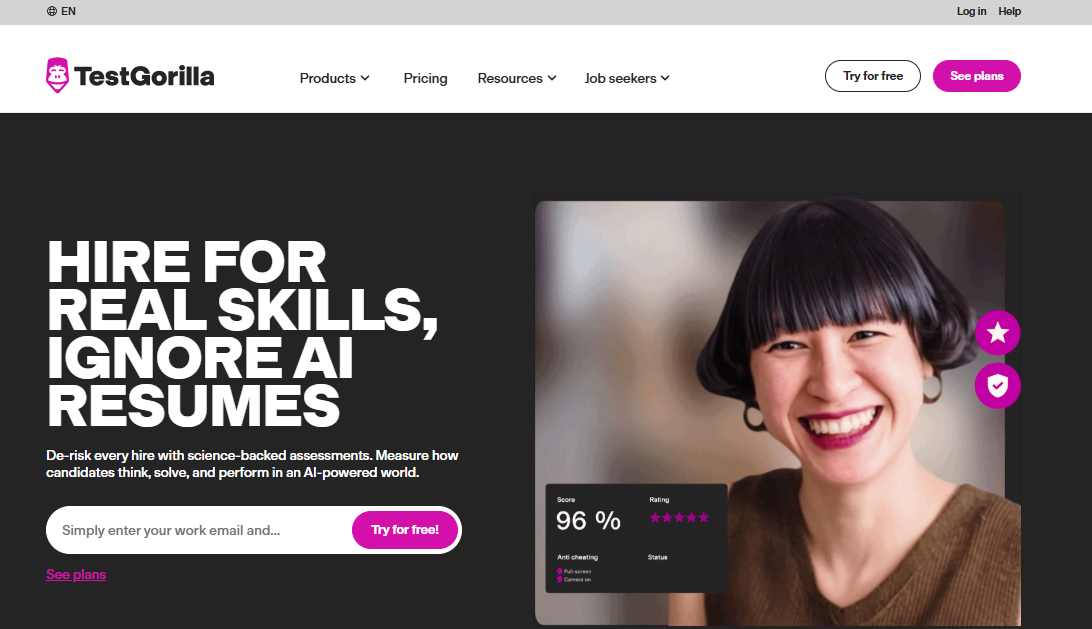
For recruiting teams replacing unstructured interviews with objective screening, it works well. Candidates get shareable links with no login required, auto-scoring ranks them automatically, and you can stack multiple tests into a single assessment flow. The depth of the question library is genuinely strong, particularly for technical and cognitive roles.
Where it falls short is customization. If your use case involves building your own assessments from scratch, or if you need training assessments rather than hiring assessments, TestGorilla is not designed for that. It is a focused tool that solves a specific problem very well.
Pros:
- 400+ validated test templates covering cognitive, skill-based, and role-specific assessments
- Automatic scoring and candidate ranking
- Shareable links with no candidate login required
- Designed specifically for pre-employment screening workflows
Cons:
- Limited custom question builder compared to general-purpose test makers
- Not well-suited for training, compliance, or classroom assessments
- Pricing scales with team size and can get expensive for larger recruiting teams
Pricing: Free plan available. Paid plans start at $75/month for small teams.
3. Classtime – Best for Real-Time Classroom Assessments
Classtime is purpose-built for the classroom, and it shows. The core differentiator is the live session format: teachers broadcast questions in real time while students answer on their devices, and results feed directly into the teacher’s dashboard as they happen. That immediacy is something most test makers cannot replicate because they are built for asynchronous assessments.
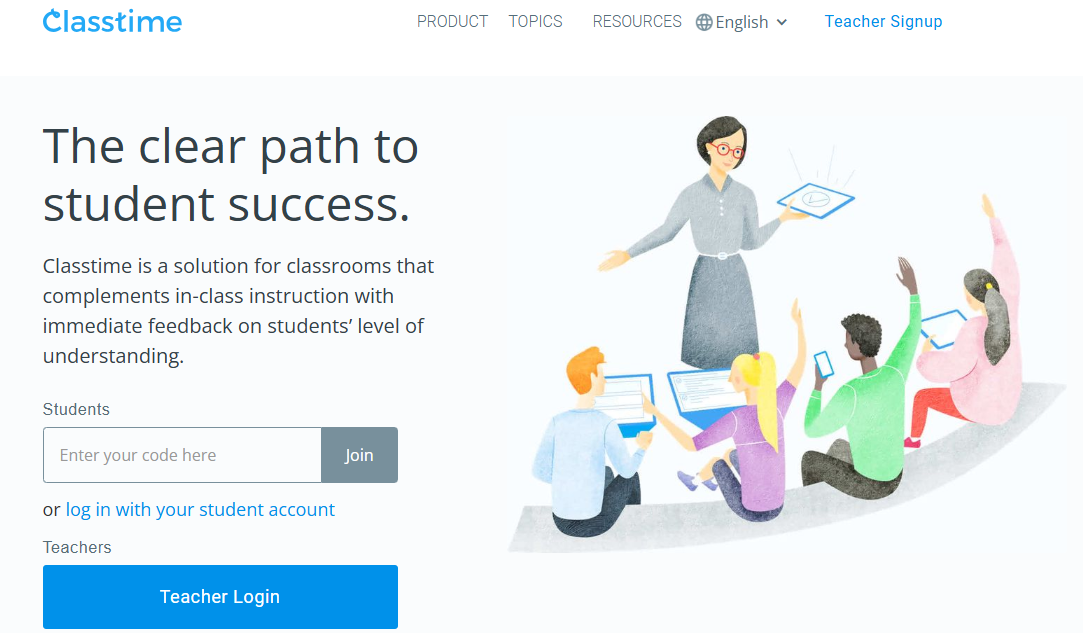
What I find genuinely useful about Classtime is the formative assessment angle. It is not just about grading; it is about spotting, in the moment, when a class collectively missed a concept. The class insights panel breaks down response patterns by question so you can decide on the fly whether to move on or re-teach.
It is a classroom tool, not a corporate tool. HR teams, L&D managers, and certification bodies will find it too narrow. But for K–12 and higher ed instructors who want real-time feedback loops integrated into their lessons, it is one of the cleaner solutions available.
Pros:
- Real-time session mode that mirrors live classroom pacing
- Class-level insights showing response patterns per question
- Student-paced and teacher-paced modes
- Clean, intuitive interface with minimal setup
Cons:
- Not built for asynchronous or self-paced assessment workflows
- Limited anti-cheating or proctoring capabilities
- Better suited to education than corporate training or HR use cases
Pricing: Free plan available. Pro plan starts at $9.99/month per teacher.
4. SpeedExam – Best for Secure, High-Stakes Exams
SpeedExam takes test security more seriously than most tools in this category, which is exactly what you need when the stakes are high. Browser lockdown, webcam proctoring, IP restrictions, and time-per-question controls are all standard, not add-ons. For certification bodies, licensing exams, and any organization running assessments where result integrity is non-negotiable, that baseline security posture matters.
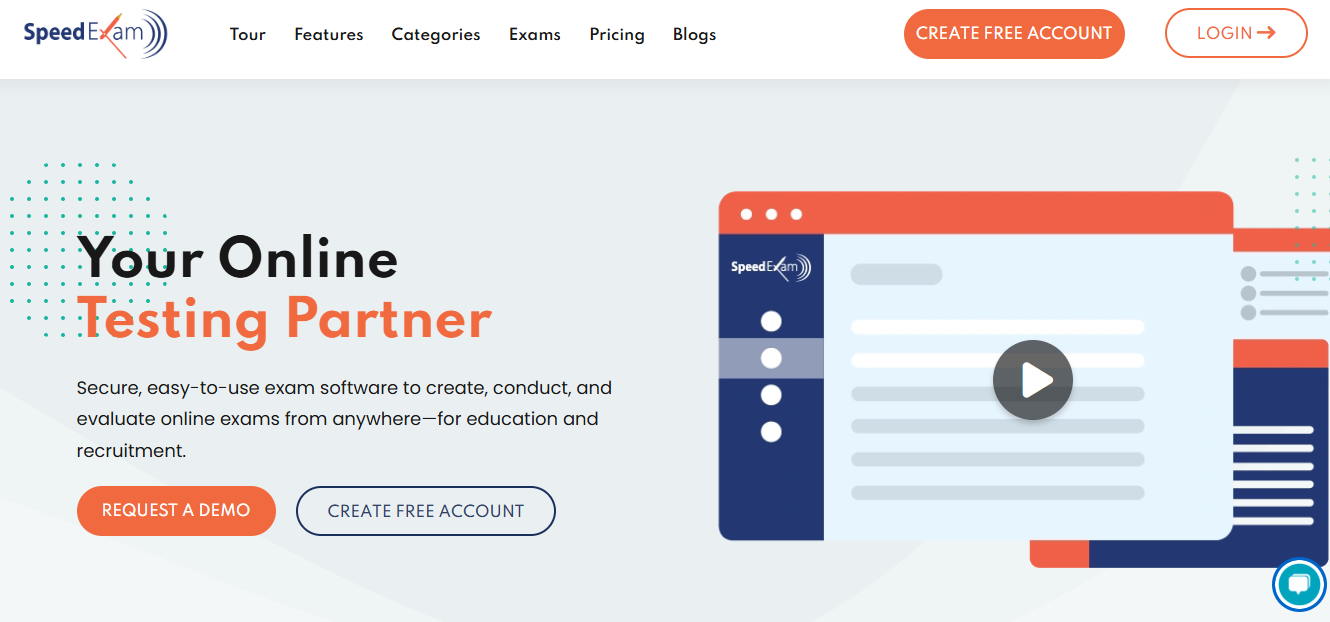
The platform supports large-scale concurrent testing, which makes it viable for organizations running exams across multiple locations simultaneously. Question randomization and pool-based delivery mean no two test-takers see the same paper, which is the practical standard for secure exam administration.
The trade-off is that SpeedExam is a specialist tool. If you also need a robust content creation workflow, AI question generation, or deep training analytics, you will quickly feel the limits. It does the exam security piece well. It is less impressive everywhere else.
Pros:
- Built-in webcam proctoring, browser lockdown, and IP restrictions
- Supports large-scale concurrent exam administration
- Question banks with randomization and pool-based delivery
- Time limits per question or per exam
Cons:
- Limited AI or content generation capabilities
- Less flexible for non-exam use cases like training or onboarding assessments
- Interface feels dated compared to newer platforms
Pricing: Plans start at $25/month. Enterprise pricing available on request.
5. Respondus – Best for Online Exam Security and Proctoring
Respondus is not a traditional quiz builder. It is a proctoring and exam security layer, most commonly used alongside an existing LMS such as Canvas, Blackboard, or Moodle rather than as a standalone assessment platform. The LockDown Browser is its flagship product: once students open an exam in Respondus, they cannot access other applications, tabs, or their clipboard until they submit.
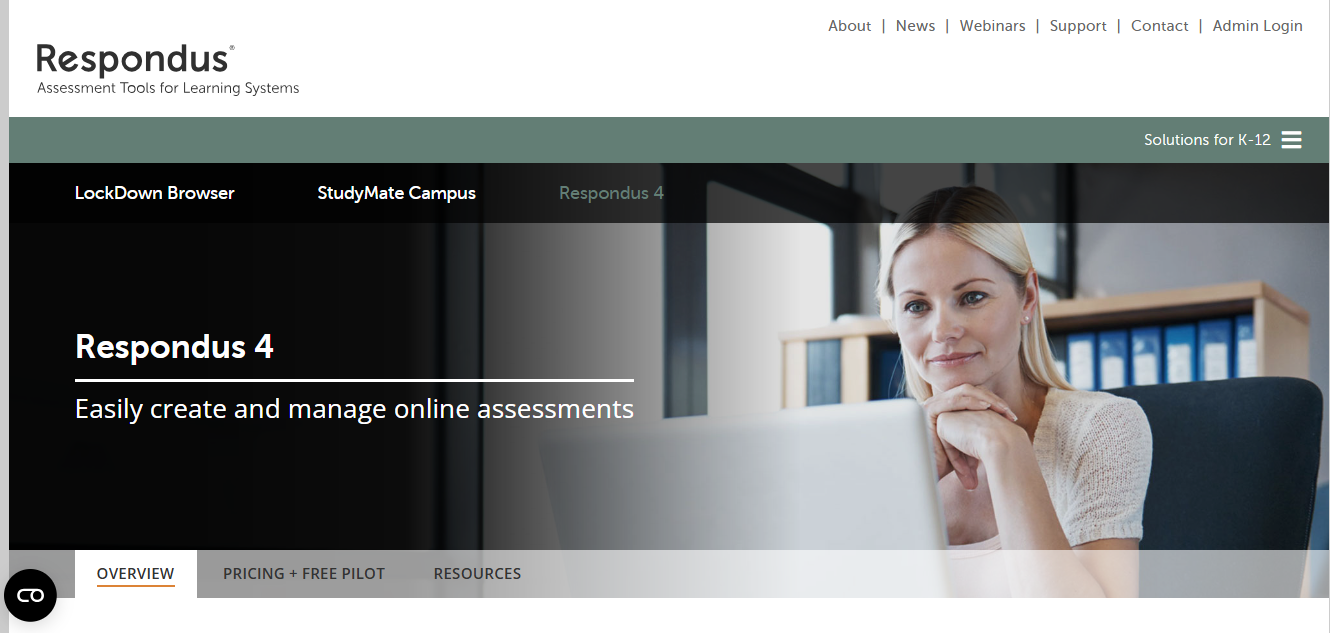
Monitor, its webcam proctoring add-on, records video and flags suspicious behavior for instructor review. For institutions already running exams through an LMS and needing to add a credible security layer without rebuilding their entire workflow, Respondus is the practical choice.
The limitation is obvious: Respondus does not create quizzes. If your institution does not already have an LMS in place, it is not a starting point. It is also institution-facing by design, which means corporate training teams or individual educators without an institutional LMS license will find it inaccessible.
Pros:
- LockDown Browser effectively prevents tab-switching, copy-paste, and application access during exams
- Webcam monitoring with automated flagging for instructor review
- Deep integration with major LMS platforms (Canvas, Blackboard, Moodle, D2L)
- Established reputation in higher education for exam integrity
Cons:
- Not a quiz builder; must be used alongside an existing LMS
- Requires institutional licensing; not accessible to individual educators or corporate teams
- Monitor (webcam proctoring) is a separate product with an additional cost
Pricing: Institutional pricing only; contact for a quote.
6. Testportal – Best for AI-Powered Business Assessments
Testportal positions itself toward the business end of the spectrum, which means it leans into features that matter for corporate training, HR assessments, and certification workflows rather than K–12 or formative classroom use. The AI question generator can generate multiple-choice questions from uploaded documents, significantly reducing content creation time for L&D teams working from existing training materials.
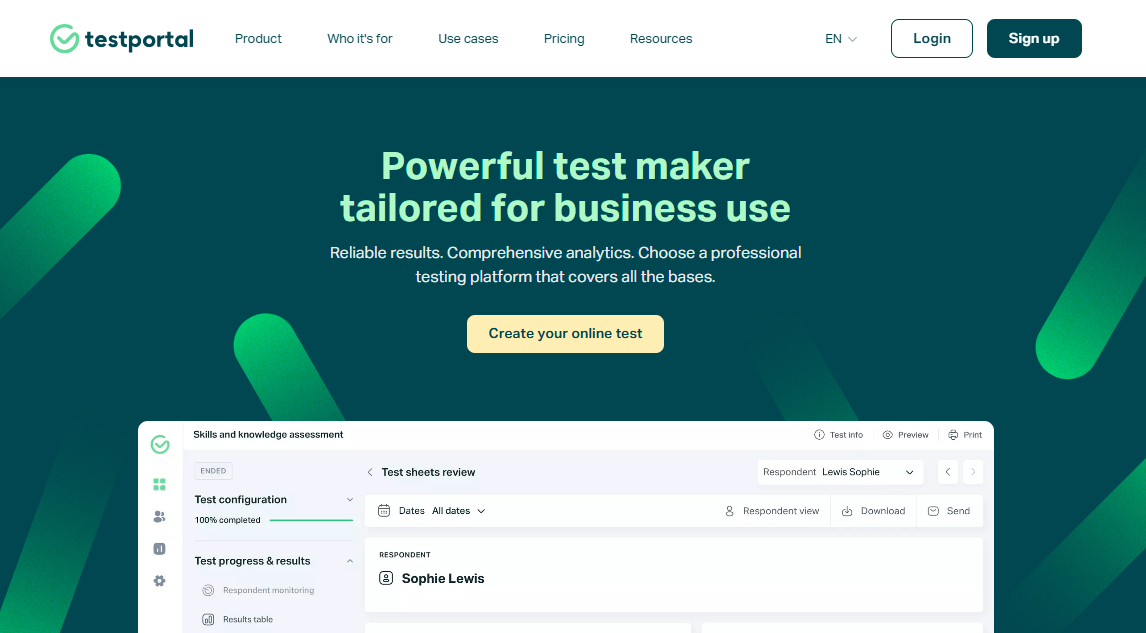
Anti-cheating controls include browser lockdown, webcam monitoring, IP restrictions, and randomization, which is a solid baseline for proctored business assessments. The platform also supports custom branding, which is a practical requirement for organizations that want assessments to look like they belong to the company rather than the tool.
The analytics layer is decent but not deep. You get overall score distributions, question-level performance data, and pass/fail reporting, which covers most business use cases. Teams that need category-level breakdowns or integration with an existing LMS may encounter some limits.
Pros:
- AI question generation from uploaded documents
- Anti-cheating controls, including browser lockdown and webcam monitoring
- Custom branding for white-labeled assessments
- Straightforward interface suited for non-technical HR and L&D teams
Cons:
- Analytics are solid, but not as granular as enterprise platforms
- Limited integration options with major LMS or HRIS systems
- Fewer question types than platforms like ProProfs Quiz Maker
Pricing: Free plan available. Paid plans start at $49/month.
7. Google Forms and Microsoft Forms – Best for Simple, Free Quizzes
These two belong on this list because they are genuinely useful in specific circumstances, not because they are the best multiple-choice test makers available. If you need to send a quick knowledge check to a small group, collect responses in a spreadsheet, and grade pass/fail without any security requirements, Google Forms or Microsoft Forms will get the job done in under ten minutes at zero cost.
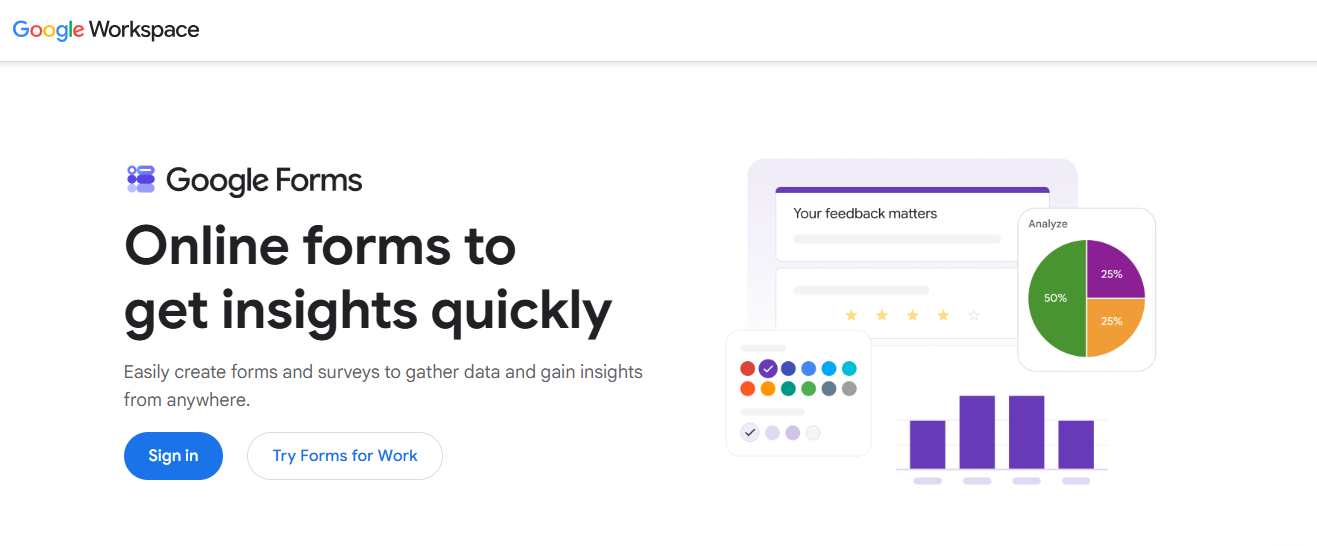
The ceiling is low, and you will hit it quickly. No question banks. No randomization. No proctoring. No advanced scoring logic. No branded certificates. Analytics are limited to basic response summaries. For anything beyond a simple, informal quiz, both platforms will start requiring workarounds that eventually take longer than just using a proper test maker.
They are worth knowing about as a free-tier option, especially for educators who need something immediately and have no budget. Just go in understanding what they cannot do.
Pros:
- Completely free with no usage limits
- Familiar interface; minimal learning curve
- Native integration with Google Workspace and Microsoft 365
- Instant response collection and basic summary charts
Cons:
- No question banks, randomization, or anti-cheating features
- No proctoring or assessment security of any kind
- Limited question types and no partial scoring
- Not viable for high-stakes, compliance, or large-scale assessments
Pricing: Free.
8. Riddle – Best for Marketing and Lead-Generation Quizzes
Riddle is on this list because it serves a real use case, just not the same one most readers of this guide have. If your goal is to embed a quiz on a landing page, collect lead data, segment your audience by quiz result, and trigger email automations based on responses, Riddle is purpose-built for exactly that workflow.
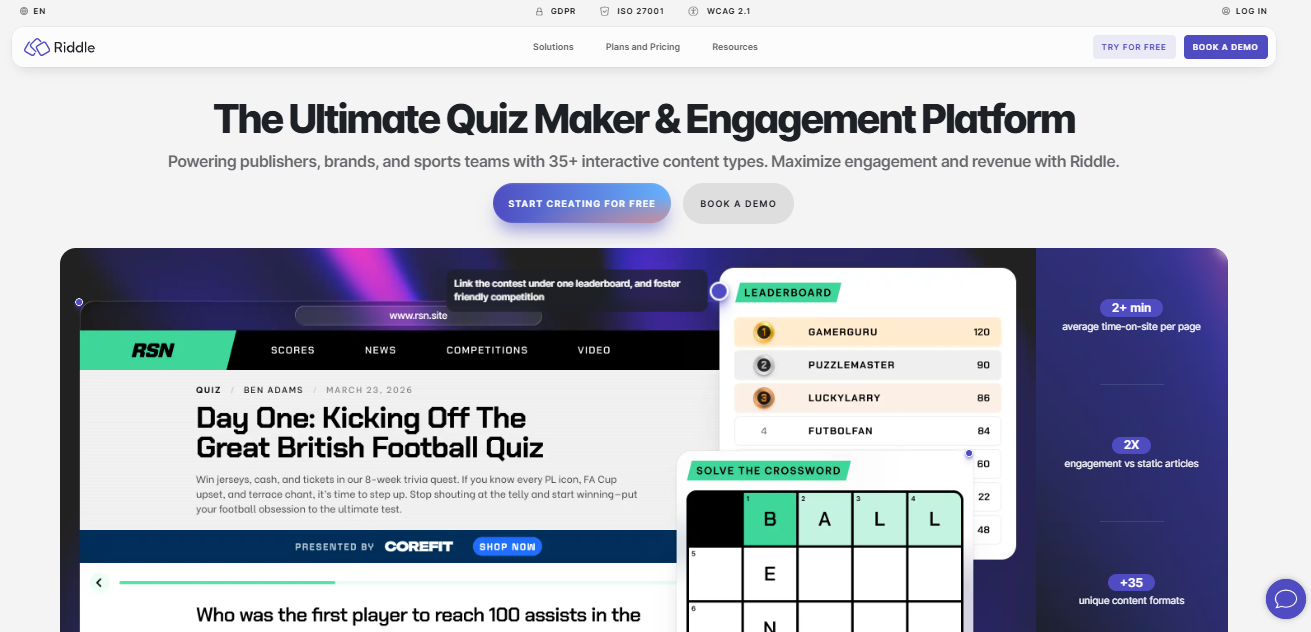
The quiz logic supports branching, personalized results pages, and direct integration with CRMs and marketing automation platforms like HubSpot, Mailchimp, and Salesforce. The interface is polished, and the embeds look clean on any site.
What Riddle is not: an assessment platform. There is no grading engine, no question bank, no proctoring, and no analytics built for learning outcomes. It is a lead-generation and audience-engagement tool that happens to use quiz formats. If you are an educator, trainer, or HR team, this is not your tool. If you are a marketer or course creator building a quiz-based lead funnel, it might be exactly what you need.
Pros:
- Quiz branching logic with personalized results pages
- Native CRM integrations (HubSpot, Salesforce, Mailchimp)
- Clean embed options for landing pages and websites
- Built specifically for marketing and lead generation workflows
Cons:
- Not a graded assessment platform; no scoring engine or question banks
- No learning analytics, proctoring, or compliance features
- Pricing is higher than it might seem for basic quiz-only use cases
Pricing: Plans start at $49/month.
9. Typeform – Best for Conversational, Interactive Quiz Experiences
Typeform’s core design idea is that one-question-at-a-time makes assessments feel less like a chore. It works. Completion rates are measurably higher with Typeform’s conversational format than with traditional form layouts, which is why it has built a significant following among course creators, marketers, and UX researchers who need respondents to stay engaged throughout.
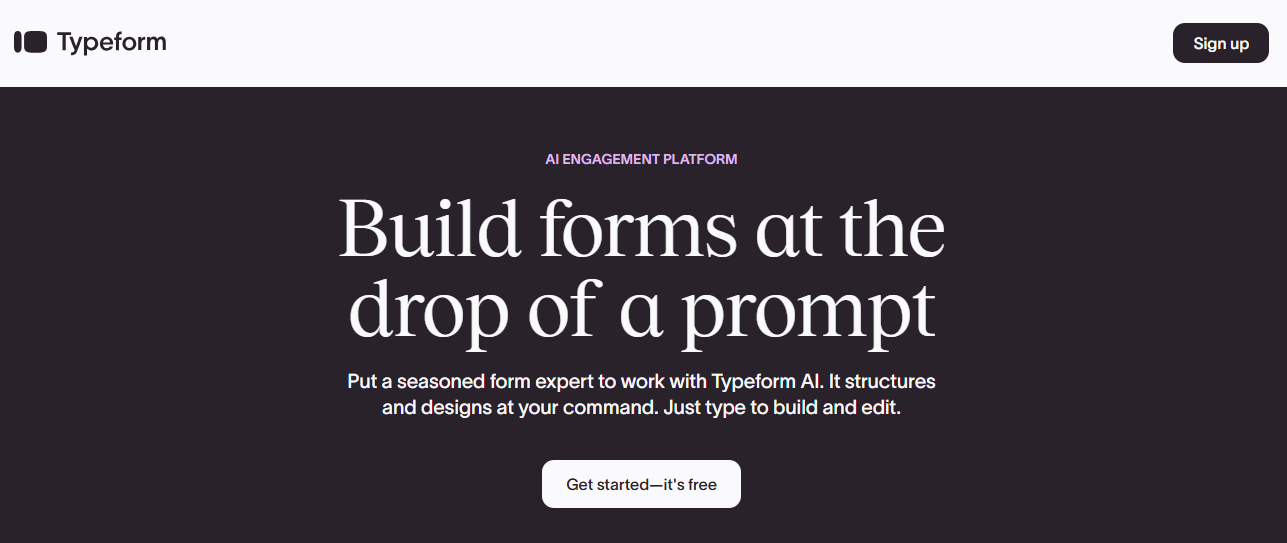
For creating multiple-choice tests, Typeform handles branching logic well. You can route respondents to different follow-up questions based on their answers, enabling more sophisticated quiz structures than most basic test makers allow. The AI form builder generates questions from a prompt, and the platform integrates natively with over 300 tools, including HubSpot, Salesforce, Mailchimp, and Google Sheets.
Where Typeform falls short for serious assessment use is the response-based pricing model. You pay more as more people take your quiz, which makes costs unpredictable at scale. There is also no grading engine built for high-stakes testing, no question banks, and no proctoring. It is an engagement-first tool, not an assessment-first one.
Pros:
- Conversational one-question-at-a-time format drives higher completion rates
- Branching logic for dynamic, personalized quiz flows
- AI form builder generates quizzes from a text prompt
- 300+ native integrations, including major CRMs and marketing platforms
- Polished, branded experience out of the box
Cons:
- Pricing scales with responses, which gets expensive quickly at volume
- No question banks, grading engine, or anti-cheating features
- Free plan caps at 10 responses per month, which is effectively unusable for real assessments
- Not designed for compliance, certification, or high-stakes testing
Pricing: Free plan available (10 responses/month). Paid plans start at $25/month (billed annually) for 100 responses, scaling up to $83/month for 10,000 responses.
10. Quizgecko – Best for AI-First Quiz Generation From Documents and URLs
Quizgecko is built around one core capability: paste in text, upload a file, drop in a URL, and it generates quiz questions instantly. For educators and trainers who already have materials and want to turn them into assessments without manually writing each question, this is a genuinely fast workflow. The AI handles multiple-choice, true/false, fill-in-the-blank, and short-answer formats, and a Chrome extension lets you generate quizzes from any webpage with a single click.
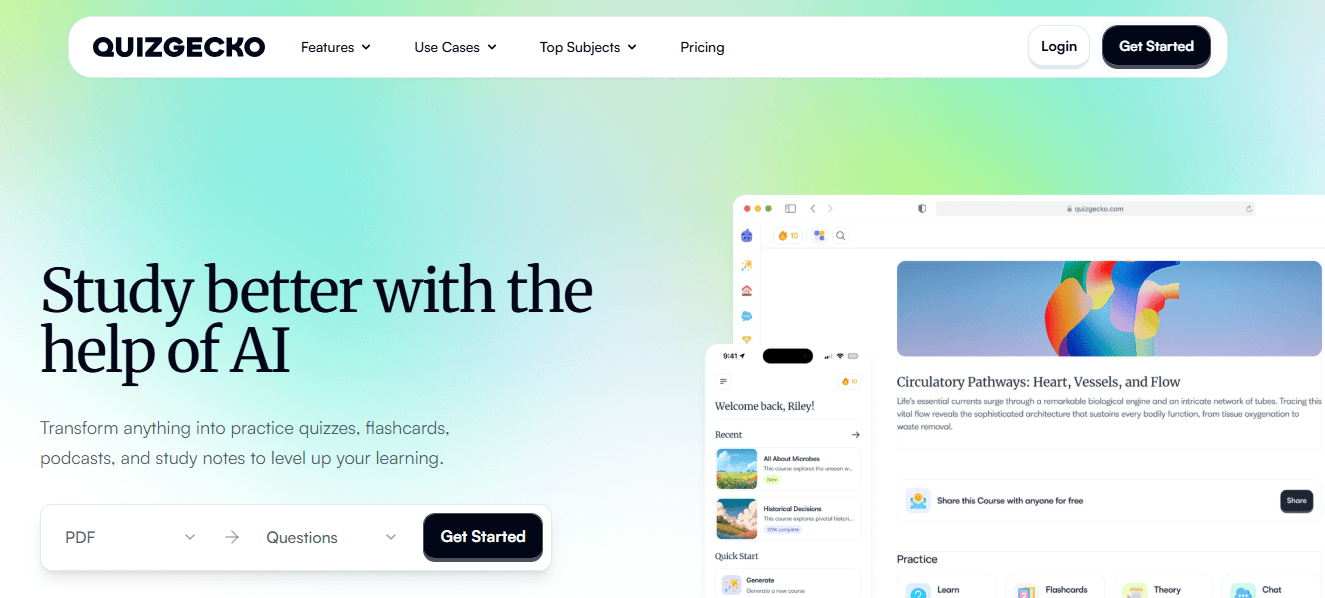
The platform supports sharing, basic reporting, LMS export, and certificate issuance, giving it a broader footprint than a simple question generator. The Student plan is aimed at individual learners, the Educator plan adds assignment creation and LMS export, and Business pricing is custom.
The trade-off is depth. Quizgecko is strong at content conversion and fast question creation. It is weaker on assessment security, analytics granularity, and enterprise-grade controls. If you need question banks with tagging, category-level reporting, or proctoring, you will feel the gaps. It earns its place as a speed tool for content-heavy educators, not as a comprehensive assessment platform.
Pros:
- Fast AI question generation from text, PDFs, URLs, YouTube videos, and uploaded documents
- Chrome extension for one-click quiz creation from any webpage
- Supports multiple question formats, including short answer
- Educator plan includes LMS export and assignment creation
- Free tier available for basic individual use
Cons:
- No proctoring, browser lockdown, or anti-cheating features
- Analytics are basic compared to dedicated assessment platforms
- Question quality from AI generation varies; output needs review before use in high-stakes contexts
- Not yet rated on Capterra; limited independent review data available
Pricing: Free plan available. Student plan at $16/month; Educator plan at $20/month (both with significant annual discounts). Business pricing is custom.
11. ClassMarker – Best for Professional Online Testing for Business and Education
ClassMarker occupies a clean middle ground that a lot of tools miss: it is purpose-built for professional online testing, priced accessibly, and genuinely usable by non-technical teams without a lengthy setup process. It serves both business and education contexts with separate plan tracks, which keeps pricing honest rather than forcing everyone onto a single tier designed for the largest customer.
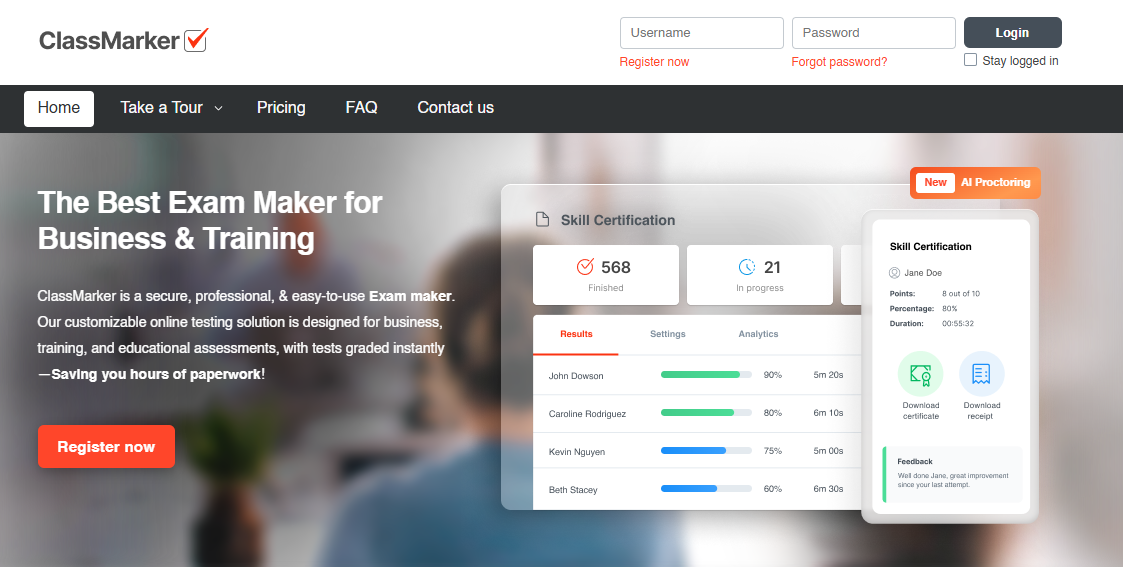
The feature set covers what most professional testing scenarios actually need: multiple-choice, true/false, short answer, matching, essay, and video question types; time limits per question or per test; question randomization; instant grading; detailed results by user, group, or category; and password-protected or public test access. You can embed tests directly into websites via webhook or API, which is useful for organizations that want assessments to live inside their own portals.
Where ClassMarker is lighter is AI-powered content creation, advanced proctoring, and deep analytics. There is no webcam monitoring, no browser lockdown, and no question bank AI. For organizations running unsupervised remote exams where integrity is genuinely critical, the security layer is not enough. But for structured professional testing with human oversight, it delivers reliability at a price that does not require an enterprise contract.
Pros:
- Separate pricing tracks for education and business with honest entry points
- Strong results reporting: by user, group, category, sortable and exportable
- Password-protected and public test options with embedded quiz support
- Multiple question types, including video, audio, and essay
- Tests thousands of simultaneous users without degradation
Cons:
- No webcam proctoring or browser lockdown for unsupervised remote exams
- No AI question generation
- Interface feels functional rather than modern compared to newer platforms
- Limited integrations beyond webhooks and API
Pricing: Free plan available. Education plans start at $19.95/month; Business plans start at $39.95/month.
My Top 3 Picks for Most Use Cases
Choosing a single multiple-choice test maker for every context is the wrong approach. Your context matters more than any ranking. That said, if I had to name the three that cover the most ground for educators, trainers, and HR teams, here is where I land.
ProProfs Quiz Maker is my first recommendation for anyone who needs the full stack: AI question generation, proctoring, question banks, automated grading, and compliance-ready reporting, all without needing a separate tool for each. It handles education, corporate training, HR screening, and certification workflows in a single platform. The free plan is genuinely useful, and the paid tiers scale without forcing you into enterprise contracts prematurely.
TestGorilla is the right call if your primary use case is structured pre-employment screening. Its validated test library and automatic candidate ranking are purpose-built for recruiting workflows, unlike general-purpose test makers.
Classtime earns its spot for classroom educators who want live, real-time assessment rather than asynchronous tests. For formative assessment integrated into active lessons, nothing on this list does it more cleanly.
How I Evaluated These Multiple-Choice Test Maker Tools
I looked at nine tools against the criteria that actually matter in real-world assessment workflows. Not just feature checklists.
Question depth: Can the tool generate or support scenario-based, image-based, and reasoning questions, or only basic recall questions? Most tools claim “20+ question types” and then deliver variations of the same multiple-choice format.
AI quality: For tools with AI generation, I evaluated whether the output was usable or required heavy editing. There is a real gap between tools that produce quiz-ready content and those that produce a starting point that still needs significant work.
Anti-cheating capabilities: Browser lockdown, webcam proctoring, randomization, and IP tracking are table stakes for any organization running assessments in unsupervised environments. I treated the absence of these as a meaningful limitation, not a minor gap.
Pricing honesty: Several tools in this space offer a free tier that becomes restrictive once you reach real-world user volume or quiz volume. I noted where the freemium model has teeth that will affect your workflow.
Analytics depth: Does the reporting tell you something actionable (question-level performance, category breakdowns, attempt trends) or just total scores? The difference determines whether you can actually improve your assessments over time.
Ease of use for non-technical users: A platform that requires a dedicated admin to build and maintain assessments is a hidden cost. I weighted usability for the HR manager or educator who is not a software power user.
What to Look for in a Multiple-Choice Test Maker
Before committing to any platform, there are a few things worth clarifying for your specific context.
Does It Handle Your Question Complexity?
The default assumption is that multiple-choice questions are simple. For basic knowledge checks, they are. But if your assessments need scenario-based questions, partial credit, mandatory answer flows, or image-based items, most tools will disappoint you. Check whether the platform supports the actual question formats you use before anything else.
Is the Free Plan Actually Useful?
The pricing frustration cited most consistently in educator and trainer communities is the bait-and-switch: a tool markets itself as free, you build your assessment library in it, and then you hit a wall at 50 responses or 10 quizzes. Before committing any time to building a platform, test the free tier against your actual volume requirements.
Can It Scale When You Need It To?
Running assessments for 30 students is a different problem than running them for 3,000 test-takers at once. Some platforms handle scale natively. Others start degrading at higher concurrency. If you expect significant volume growth, verify the platform’s technical limits before you are mid-exam and watching the system slow down.
Does It Integrate With What You Already Use?
An isolated quiz tool that lives outside your LMS, HRIS, or CRM creates more work, not less. At a minimum, look for SCORM compatibility, CSV export, or API access. The best platforms also offer native integrations with Salesforce, Microsoft Dynamics, or major LMS platforms, so results live where your team already works.
Stop Settling for Tools That Almost Work
The real cost of the wrong multiple-choice test maker is not the subscription fee. It is the hours you spend working around its limits: manually grading what should be auto-graded, rebuilding assessments every cycle because there is no question bank, or apologizing for result integrity issues because there was no proctoring. Those costs are invisible until they compound.
The tools on this list cover a wide range of use cases, but if I were choosing one platform to grow with across hiring, training, and compliance assessments, I would start with ProProfs Quiz Maker. It is the only option here that handles the full workflow without forcing you to stitch together multiple tools to cover the gaps. The free plan is real enough to validate whether it fits your context before you spend a dollar.
Pick the platform that matches your actual assessment depth, not just the one with the best landing page.
Frequently Asked Questions
What is the best free multiple-choice test maker?
ProProfs Quiz Maker offers the most capable free tier for assessment use cases, including question banks, automated grading, and basic analytics. Google Forms and Microsoft Forms are completely free but lack grading depth, randomization, and anti-cheating features needed for formal assessments.
Can I use a multiple-choice test maker for employee training assessments?
Yes. Tools like ProProfs Quiz Maker are purpose-built for this, with automated grading, role-based assignment, compliance tracking, and certificate generation. Survey tools or form builders are technically designed for simple checks, but they will not provide the audit trail or reporting that compliance assessments require.
Which multiple-choice test maker is best for preventing cheating?
ProProfs Quiz Maker, SpeedExam, and Respondus are the strongest options for anti-cheating. Look specifically for browser lockdown, webcam proctoring, IP tracking, and question randomization from banks. Not all platforms include these features natively.
Can AI generate multiple-choice questions for me?
Yes, several platforms on this list include AI-generated questions. ProProfs Quiz Maker and Testportal both generate questions from uploaded documents. The quality varies, so test the output before relying on it for high-stakes assessments.
What is the difference between a quiz maker and a multiple-choice test maker?
The terms are often used interchangeably, but purpose-built test makers include grading engines, question banks, proctoring, and analytics that quiz makers (and especially survey tools) typically do not. If assessment integrity and actionable results matter, the distinction is real.
Is Google Forms good enough for making multiple-choice tests?
For low-stakes informal checks, yes. For anything that requires randomization, anti-cheating measures, detailed analytics, or question banks, it will hit its ceiling quickly. It is a free starting point, not a serious assessment platform.
How do I choose the right multiple-choice test maker for my organization?
Start with your question complexity requirements and your anti-cheating needs. Those two filters eliminate most tools that would otherwise waste your setup time. Then check whether the free tier covers your actual volume before building anything in it.
What question types do the best multiple-choice test makers support?
Beyond standard single-answer multiple-choice, look for multiple-select, true/false, image-based, drag-and-drop, scenario-based, and partial-credit options. ProProfs Quiz Maker supports 20+ question types, including video response and interactive formats.
Let ProProfs AI Build a Quiz

 We'd love your feedback!
What did you like & how can we make it even better?
 Thanks for your feedback!
 Ask Your Question
Have a question? Get expert help to make your decision easier.