Microbial Identification and Antibiotic Sensitivity Quiz

Reviewed by Editorial Team
The ProProfs editorial team is comprised of experienced subject matter experts. They've collectively created over 10,000 quizzes and lessons, serving over 100 million users. Our team includes in-house content moderators and subject matter experts, as well as a global network of rigorously trained contributors. All adhere to our comprehensive editorial guidelines, ensuring the delivery of high-quality content.
Learn about Our Editorial Process
| By Thames
T
Thames
Community Contributor
Quizzes Created: 8156 | Total Attempts: 9,588,805
| Questions: 15 | Updated: Dec 1, 2025
Please wait...
Question 1 / 16
🏆 Rank #--
Score 0/100

1. What test result and what MO typically indicate staphylococcus?

Explanation

Staphylococcus is characterized by being catalase positive and coagulase positive. This combination of test results distinguishes it from other bacteria like streptococcus, pseudomonas, and enterococcus.

Submit
Please wait...
About This Quiz
Microbial Identification and Antibiotic Sensitivity Quiz - Quiz

Explore the essentials of microbial identification and antibiotic sensitivity in 'Mbio Pract 2'. This exercise enhances your understanding of microbiological techniques, crucial for professionals in clinical and research settings, fostering skills in microbial culture handling and analysis.

2.

What first name or nickname would you like us to use?

You may optionally provide this to label your report, leaderboard, or certificate.

2. Which test is positive when the result is 6.5 NaClYellow?

Explanation

In the given question, the positive test result is indicated by the presence of NaClYellow at a concentration of 6.5. Any other combination of substance and color with different concentrations would result in a negative test outcome.

Submit

3. What type of hemolysis is characterized by incomplete lysis of red blood cells and results in a greenish discoloration of the agar?

Explanation

Alpha hemolysis is characterized by partial lysis of red blood cells, creating a greenish discoloration on blood agar. Beta hemolysis results in complete lysis of red blood cells and a clear zone around the bacterial colony, while Gamma hemolysis shows no hemolysis. Delta hemolysis is not a recognized type of hemolysis.

Submit

4. Which organism shows growth on Blood Agar Plate?

Explanation

Blood Agar Plate is a general-purpose agar plate on which many bacteria can grow, but Serratia is known for its characteristic red pigment production on BAP.

Submit

5. Which microorganism grows on which agar?

Explanation

Different microorganisms have specific growth requirements, leading to their preferential growth on certain types of agar. In this case, Serratia is known to grow on Eosin Methylene Blue (EMB) agar, while the incorrect answers represent different combinations of microorganisms and agar types that do not typically support their growth.

Submit

6. What type of hemolysis causes complete hemolysis of red blood cells, leaving a clear zone around the bacterial colony?

Explanation

Beta hemolysis is characterized by complete hemolysis of red blood cells, resulting in a clear zone around the bacterial colony on blood agar plates. Alpha hemolysis causes partial hemolysis, creating a greenish discoloration of the agar. Gamma hemolysis does not cause any hemolysis, while Delta hemolysis is not a recognized type of hemolysis.

Submit

7. What organism shows growth on Blood Agar Plate (BAP)?

Explanation

Bacillus is a gram-positive bacterium that can grow on Blood Agar Plate due to its ability to produce hemolysins. Escherichia coli is a gram-negative bacterium, Staphylococcus aureus shows growth on Mannitol Salt Agar, and Pseudomonas aeruginosa is commonly found on MacConkey Agar.

Submit

8. What test is this? Which MO is susceptible?

Explanation

The correct answer states that the test is for Bactrin A and the susceptible microorganism is GAS. The incorrect answers provide examples of other tests and their corresponding susceptible or resistant microorganisms.

Submit

9. Which organism appears as Chromobacterium on BAP?

Explanation

The correct answer is Chromobacterium, as it is a specific organism that appears as a characteristic morphology on Blood Agar Plate (BAP). Escherichia coli, Staphylococcus aureus, and Pseudomonas aeruginosa are other common bacteria that may not necessarily present as Chromobacterium on BAP.

Submit

10. Which microorganism shows creamy-white colonies with beta-hemolysis on blood agar plate?

Explanation

Streptococcus pyogenes is known for producing creamy-white colonies with beta-hemolysis on blood agar plates, while the other three listed microorganisms do not exhibit this specific characteristic.

Submit

11. Which MO is this and what is a significant characteristic of this colony?

Explanation

Yersinia typically forms colonies with a characteristic bulls eye appearance, while Escherichia coli exhibits green metallic sheen colonies, Staphylococcus aureus forms yellow colonies, and Clostridium difficile forms swarming colonies.

Submit

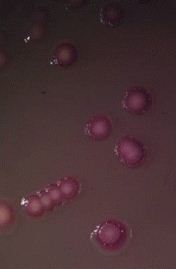
12. Which MO's appear pink-or are lactose fermenters on this agar?

Explanation

Gram- lactose fermenters like Escherichia coli, Klebsiella, and Enterococcus exhibit pink color on this agar due to their ability to ferment lactose. Staphylococcus aureus, Pseudomonas aeruginosa, and Clostridium difficile are not lactose fermenters and would not appear pink on this agar.

Submit

13. Which microorganism is commonly used in genetic engineering and biotechnology?

Explanation

E. coli is a commonly used bacteria in genetic engineering and biotechnology due to its fast growth rate and well-understood genetics. Staphylococcus aureus, Saccharomyces cerevisiae, and Mycobacterium tuberculosis are not commonly used in these fields.

Submit

14. Which microorganism shows growth on both Blood Agar Plate (BAP) and MacConkey Agar (MAC)?

Explanation

Enterococci are known to grow on both Blood Agar Plate (BAP) and MacConkey Agar (MAC) due to their ability to tolerate different environmental conditions. In contrast, Escherichia coli is a coliform that grows on MacConkey Agar but not on BAP, Staphylococcus aureus typically grow on BAP but not on MAC, and Pseudomonas aeruginosa grows on BAP but not on MAC.

Submit

15. Which bacteria genus does the abbreviation 'MO' stand for?

Explanation

The abbreviation 'MO' stands for Flavobacterium, not Escherichia, Streptococcus, or Pseudomonas.

Submit
×
Saved
Thank you for your feedback!
View My Results
Cancel
  • All
    All (15)
  • Unanswered
    Unanswered ()
  • Answered
    Answered ()
What test result and what MO typically indicate staphylococcus?
Which test is positive when the result is 6.5 NaClYellow?
What type of hemolysis is characterized by incomplete lysis of red...
Which organism shows growth on Blood Agar Plate?
Which microorganism grows on which agar?
What type of hemolysis causes complete hemolysis of red blood cells,...
What organism shows growth on Blood Agar Plate (BAP)?
What test is this? Which MO is susceptible?
Which organism appears as Chromobacterium on BAP?
Which microorganism shows creamy-white colonies with beta-hemolysis on...
Which MO is this and what is a significant characteristic of this...
Which MO's appear pink-or are lactose fermenters on this agar?
Which microorganism is commonly used in genetic engineering and...
Which microorganism shows growth on both Blood Agar Plate (BAP) and...
Which bacteria genus does the abbreviation 'MO' stand for?
play-Mute sad happy unanswered_answer up-hover down-hover success oval cancel Check box square blue
Alert!