Exploring the Anatomy and Biology of Turbellaria and Trematoda

  • 9th Grade,
  • 10th Grade,
  • 11th Grade,
  • 12th Grade
  • NGSS
Reviewed by Editorial Team
The ProProfs editorial team is comprised of experienced subject matter experts. They've collectively created over 10,000 quizzes and lessons, serving over 100 million users. Our team includes in-house content moderators and subject matter experts, as well as a global network of rigorously trained contributors. All adhere to our comprehensive editorial guidelines, ensuring the delivery of high-quality content.
Learn about Our Editorial Process
| By Thames
T
Thames
Community Contributor
Quizzes Created: 8156 | Total Attempts: 9,588,805
| Attempts: 12 | Questions: 23 | Updated: Jan 20, 2026
Please wait...
Question 1 / 24
🏆 Rank #--
Score 0/100

1. Which group lacks an anus

Explanation

Flatworms lack a circulatory system due to their thin bodies, which allow diffusion to meet metabolic needs. This structural simplicity is efficient for small, flattened organisms but limits body size and activity.

Submit
Please wait...
About This Quiz
Exploring The Anatomy and Biology Of Turbellaria and Trematoda - Quiz

Explore the diverse world of bilateral flatworms in this focused study. Learn to identify different types by appearance and characteristics, enhancing your understanding of their biological and ecological roles.

2.

What first name or nickname would you like us to use?

You may optionally provide this to label your report, leaderboard, or certificate.

2. Which structure aids attachment in parasites

Explanation

Suckers and hooks allow parasitic flatworms to anchor securely within hosts. These structures prevent dislodgement and ensure access to nutrients. Their presence reflects adaptation to parasitic lifestyles.

Submit

3. Which group shows direct life cycle

Explanation

Monogenea exhibit direct life cycles, eliminating the need for intermediate hosts. This increases transmission efficiency and reduces dependence on ecological complexity.

Submit

4. What feature separates Neodermata

Explanation

The syncytial tegument of Neodermata protects parasites from host enzymes and immune responses. It also aids nutrient absorption, enhancing parasitic success.

Submit

5. Which system is absent in flatworms

Explanation

Flatworms lack a circulatory system, relying on diffusion through their body surface and gastrovascular cavity. This limitation explains their flattened morphology and absence of complex organs.

Submit

6. What best describes the body plan of Turbellaria Dugesia

Explanation

Turbellaria Dugesia exhibit a branched gastrovascular cavity that increases surface area for digestion and nutrient distribution. The muscular pharynx enables food intake by protrusion. Nerve cords appear as paired white circles in cross section, showing centralized nervous control. This plan differs from segmented or exoskeleton-bearing animals and reflects adaptation to free-living flatworm physiology.

Submit

7. How does feeding occur in Dugesia

Explanation

Dugesia feed using a mid-ventral mouth connected to a muscular, protrusible pharynx. The pharynx extends outward to enzymes-softened prey, enabling extracellular digestion. Food is then distributed through the branched gastrovascular cavity. The absence of an anus requires undigested material to exit through the same opening, reflecting an incomplete digestive system.

Submit

8. Which structure forms the excretory system in Dugesia

Explanation

Flame cells function through ciliary motion that drives waste fluids into tubules, maintaining osmotic balance. This protonephridial system is efficient for small, flat-bodied organisms lacking circulatory systems. The branching tubules increase surface area, allowing effective waste removal through diffusion and ciliary propulsion without complex organs.

Submit

9. How does Dugesia primarily reproduce

Explanation

Dugesia primarily reproduce asexually via transverse fission, where fragments regenerate missing parts. This method allows rapid population increase without mates. Sexual reproduction occurs rarely and involves cross-fertilization. Regeneration ability is supported by abundant stem cells, making fission an efficient and dominant reproductive strategy.

Submit

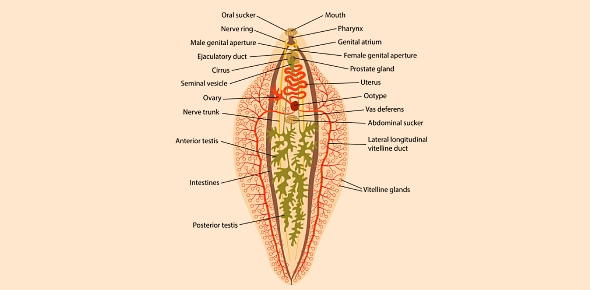
10. What defines Trematoda Diagenea body plan

Explanation

Trematoda Diagenea possess a leaf-shaped parasitic body adapted for internal environments. Oral and ventral suckers allow attachment to host tissues. The absence of cilia and dominance of reproductive organs reflect parasitic specialization. Their branched gastrovascular cavity supports nutrient absorption within host systems.

Submit

11. How do Trematoda Diagenea feed

Explanation

Feeding in Trematoda occurs through an oral sucker that surrounds the mouth, leading to a muscular pharynx and bifurcated caeca. These blind-ending structures distribute nutrients throughout the body. This system supports parasitic feeding without an anus, relying on diffusion and host-derived nutrients.

Submit

12. What excretory system occurs in Trematoda

Explanation

The protonephridial system in Trematoda includes flame cells and lateral excretory trunks that merge into a bladder. This setup regulates osmotic balance in parasitic environments. Flame cell cilia drive waste fluids, compensating for the lack of a circulatory system and maintaining internal stability.

Submit

13. How do Trematoda reproduce

Explanation

Trematoda reproduction involves complex hermaphroditic systems. Cross-fertilization is common, enhancing genetic diversity, though self-fertilization may occur. Fertilized eggs accumulate in a coiled uterus and are released into the environment, continuing the parasite’s multi-stage life cycle.

Submit

14. What distinguishes Monogenea

Explanation

Monogenea are ectoparasites primarily of fish, characterized by posterior hooks and anchors for firm attachment. Unlike Trematoda, they possess a direct life cycle and only one oral sucker. These adaptations allow efficient host attachment without intermediate hosts.

Submit

15. What is the Monogenea life cycle

Explanation

Monogenea have a direct life cycle involving a single host. Eggs hatch into free-swimming larvae that attach to the same species. This simplifies transmission and contrasts with Trematoda and Cestoda, which require intermediate hosts.

Submit

16. What describes Cestoda body plan

Explanation

Cestoda are ribbon-like tapeworms composed of repeating proglottids. The anterior scolex anchors the worm to the host intestine using hooks and suckers. Each proglottid contains reproductive organs, maximizing reproductive output within parasitic environments.

Submit

17. How do Cestoda handle excretion

Explanation

Excretion in Cestoda occurs via flame bulbs connected to longitudinal excretory vessels. These structures remove metabolic waste and regulate water balance. The system compensates for the absence of specialized organs and supports survival within host intestines.

Submit

18. What is true about Cestoda reproduction

Explanation

Cestoda are hermaphrodites, with each proglottid containing both male and female organs. Younger proglottids near the scolex mature as they move posteriorly. This arrangement maximizes reproductive efficiency and ensures continuous egg production.

Submit

19. What defines Acoelomorpha

Explanation

Acoelomorpha lack a true coelom and possess a simple body organization. Their solid body plan distinguishes them from coelomate and pseudocoelomate animals. This simplicity reflects early bilaterian evolution rather than toxicity or segmentation.

Submit

20. What characterizes Polycladida

Explanation

Polycladida are marine flatworms with flattened bodies, numerous eyes, and highly branched intestines. The plicate pharynx aids feeding, while branched diverticula enhance digestion. These traits support active predatory lifestyles in marine habitats.

Submit

21. What defines Phylum Nemertea

Explanation

Nemerteans possess a unique eversible proboscis used for prey capture. Their dorsoventrally flattened bodies and closed circulatory system differentiate them from flatworms. Classification into Anopla and Enopla depends on proboscis armament and mouth position.

Submit

22. Least common ancestor of Monogenea and Cestoda

Explanation

Cercomeromorphia represents the shared ancestral lineage of Monogenea and Cestoda. This group evolved specialized attachment structures and parasitic traits, distinguishing them from free-living flatworms and establishing evolutionary relationships within Neodermata.

Submit

23. Least common ancestor of Trematoda and Cercomeromorphia

Explanation

Neodermata unites Trematoda and Cercomeromorphia through shared parasitic adaptations, including a syncytial tegument. This feature replaces ciliated epidermis and enhances host interaction, marking a key evolutionary transition.

Submit
×
Saved
Thank you for your feedback!
View My Results
Cancel
  • All
    All (23)
  • Unanswered
    Unanswered ()
  • Answered
    Answered ()
Which group lacks an anus
Which structure aids attachment in parasites
Which group shows direct life cycle
What feature separates Neodermata
Which system is absent in flatworms
What best describes the body plan of Turbellaria Dugesia
How does feeding occur in Dugesia
Which structure forms the excretory system in Dugesia
How does Dugesia primarily reproduce
What defines Trematoda Diagenea body plan
How do Trematoda Diagenea feed
What excretory system occurs in Trematoda
How do Trematoda reproduce
What distinguishes Monogenea
What is the Monogenea life cycle
What describes Cestoda body plan
How do Cestoda handle excretion
What is true about Cestoda reproduction
What defines Acoelomorpha
What characterizes Polycladida
What defines Phylum Nemertea
Least common ancestor of Monogenea and Cestoda
Least common ancestor of Trematoda and Cercomeromorphia
play-Mute sad happy unanswered_answer up-hover down-hover success oval cancel Check box square blue
Alert!



