Understanding Graph Behaviors: Intervals, Maxima, and Minima Quiz

  • 8th Grade,
  • 9th Grade,
  • 10th Grade
  • CCSS
Reviewed by Editorial Team
The ProProfs editorial team is comprised of experienced subject matter experts. They've collectively created over 10,000 quizzes and lessons, serving over 100 million users. Our team includes in-house content moderators and subject matter experts, as well as a global network of rigorously trained contributors. All adhere to our comprehensive editorial guidelines, ensuring the delivery of high-quality content.
Learn about Our Editorial Process
| By Thames
T
Thames
Community Contributor
Quizzes Created: 7387 | Total Attempts: 9,527,791
| Questions: 12 | Updated: Nov 3, 2025
Please wait...
Question 1 / 12
0 %
0/100
Score 0/100
1) What is a relative minimum?

Explanation

A relative minimum refers to the lowest point within a specific region or interval. It is not necessarily the overall lowest point in the entire dataset or graph, but rather the lowest point within a local area.

Submit
Please wait...
About This Quiz
Understanding Graph Behaviors: Intervals, Maxima, And Minima Quiz - Quiz

Designed for enhancing mathematical understanding, 'Math Chapter 2 Test 2' assesses key concepts and problem-solving skills. This quiz is ideal for learners looking to improve their grasp of fundamental math principles, relevant to academic progress and everyday applications.

2)
You may optionally provide this to label your report, leaderboard, or certificate.
2) What is a relative maximum?

Explanation

A relative maximum is defined as the highest point in a region, similar to the peak of a hill. It is not the lowest point (valley), midpoint, or the point with the smallest value.

Submit
3) How is the domain of f/g different from f+g, f-g, or fg?

Explanation

The domain of a fraction f/g excludes any numbers where the denominator g is equal to 0 to avoid division by zero errors. This restriction does not apply to addition, subtraction, or multiplication of functions.

Submit
4) When identifying the intervals for increasing, decreasing, and constant, which variables do we focus on?

Explanation

When identifying intervals for increasing, decreasing, and constant, we focus on the x's because we observe changes from left to right on the x-axis. The y-axis is used to represent the function's output, while x-axis represents its input which helps determine the function's behavior.

Submit
5) When is a graph increasing?

Explanation

In mathematics, a graph is considered increasing when the curve is rising or moving upwards as you move from left to right. This indicates growth or positive change in the values represented by the graph.

Submit
6) When is a graph decreasing?

Explanation

In mathematics, a graph is considered decreasing when the plotted line or curve is falling from left to right. This indicates a decrease in the dependent variable as the independent variable increases.

Submit
7) What is the correct sentence for Relative Maximum/Minimum?

Explanation

The correct sentence structure for expressing Relative Maximum/Minimum includes specifying the type (maximum/minimum), the y-value, and the x-value at which it occurs.

Submit
8) What is the equation of the graph represented by a straight line passing through the origin?

Explanation

The correct equation for a straight line passing through the origin is y = mx, where m is the slope. In this case, m = 1, so the equation is y = x.

Submit
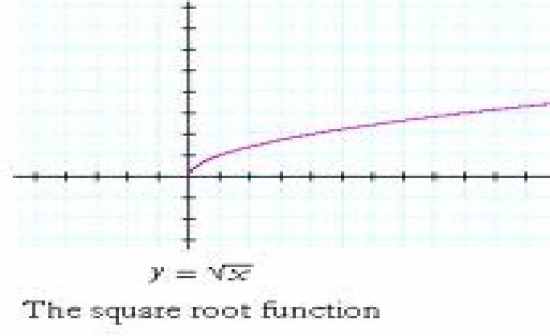
9) What is the equation of the graph shown?

Explanation

The correct equation for the graph is y = √x, where y represents the square root of x. The other options do not represent the graph shown accurately.

Submit
10) What is the equation for the graph of a hyperbola?

Explanation

The correct equation for a hyperbola is y = 1/x, as it represents the inverse variation relationship between x and y values. The incorrect options do not correspond to the characteristics of a hyperbola graph.

Submit
11) How do you find the solution for (f g) (#) when is addition, subtraction, multiplication, or division?

Explanation

To find the solution for (f g) (#), it is essential to find f(#) and g(#) before performing the specified operation on the two obtained answers. This step-wise approach ensures accurate calculation based on the given operations.

Submit
12) How do you evaluate (fog)(#)?

Explanation

When evaluating (fog)(#), you need to find g(#) first and then substitute that value into f to obtain the answer. This involves finding the composition of the two functions in the correct order.

Submit
×
Saved
Thank you for your feedback!
View My Results
Cancel
  • All
    All (12)
  • Unanswered
    Unanswered ()
  • Answered
    Answered ()
What is a relative minimum?
What is a relative maximum?
How is the domain of f/g different from f+g, f-g, or fg?
When identifying the intervals for increasing, decreasing, and...
When is a graph increasing?
When is a graph decreasing?
What is the correct sentence for Relative Maximum/Minimum?
What is the equation of the graph represented by a straight line...
What is the equation of the graph shown?
What is the equation for the graph of a hyperbola?
How do you find the solution for (f g) (#) when is addition,...
How do you evaluate (fog)(#)?
Alert!

Advertisement


