Exploring Ancient Egyptian Art and Architecture

Reviewed by Editorial Team
The ProProfs editorial team is comprised of experienced subject matter experts. They've collectively created over 10,000 quizzes and lessons, serving over 100 million users. Our team includes in-house content moderators and subject matter experts, as well as a global network of rigorously trained contributors. All adhere to our comprehensive editorial guidelines, ensuring the delivery of high-quality content.
Learn about Our Editorial Process
| By Thames
T
Thames
Community Contributor
Quizzes Created: 8157 | Total Attempts: 9,569,759
| Attempts: 11 | Questions: 10 | Updated: Nov 10, 2025
Please wait...
Question 1 / 11
🏆 Rank #--
Score 0/100
1. Find the artifact from the Early Dynastic period (c. 3000–2600 BCE) that depicts the symbolic union of upper and lower Egypt and is thought to have been used for ceremonial eye makeup.

Explanation

The Narmer Palette is a significant artifact from ancient Egypt that depicts the unification of upper and lower Egypt, along with the slaying of enemies. It dates back to the Early Dynastic period and is thought to have been used for ceremonial eye makeup.

Submit
Please wait...
About This Quiz
Exploring Ancient Egyptian Art and Architecture - Quiz

Explore the rich tapestry of Egyptian Art in this focused study. Delve into the symbolic and functional roles of art in ancient Egypt, enhancing your understanding of cultural expressions and historical contexts. Ideal for students and enthusiasts eager to deepen their knowledge of art history.

2.
You may optionally provide this to label your report, leaderboard, or certificate.
2. Identify the architectural achievement that showcases ingenious calculations and constructions, considered the pinnacle of Egyptian achievements.  

Explanation

The Great Pyramids of Egypt, built during the Old Kingdom, are a testament to ancient Egyptian engineering and architectural prowess. These pyramids are considered one of the most remarkable achievements in history.

Submit
3. Identify the ancient monument located in Egypt during the Old Kingdom period of 2600-2200 BCE at Giza.

Explanation

The Great Sphinx is a massive limestone statue with the body of a lion and the head of a pharaoh, believed to represent the pharaoh Khafre. It is located in Giza, Egypt and was built during the Old Kingdom period around 2600-2200 BCE.

Submit
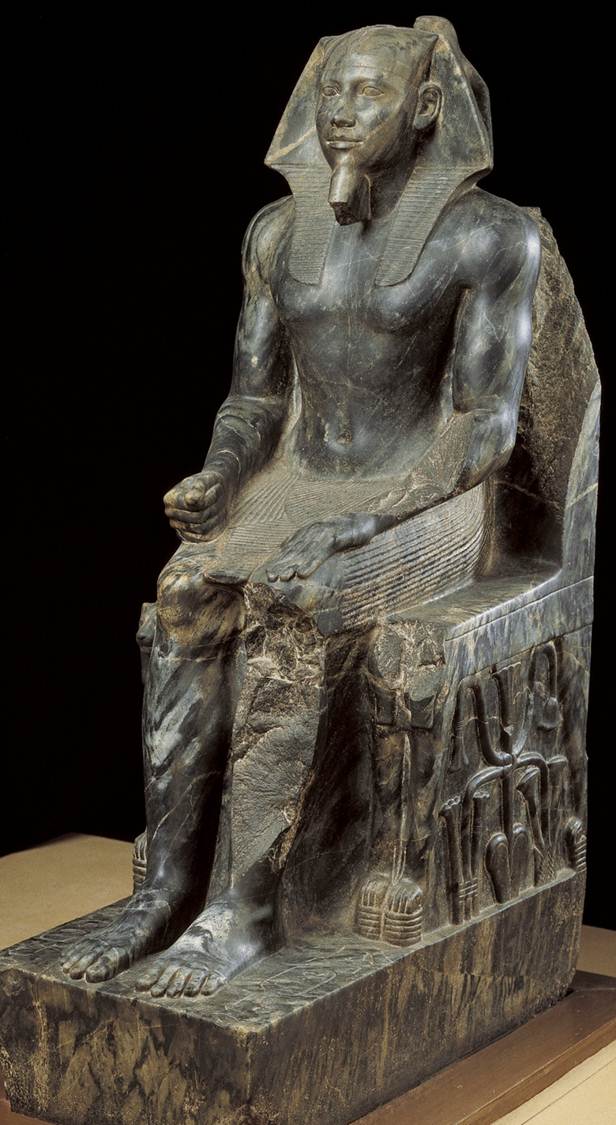
4. Identify the sculpture described below.

Explanation

The correct answer is King Khafre; Egypt, Old Kingdom, c. 2600-2200 BCE. The description provided emphasizes the features and symbolism of the sculpture, representing male power, divinity, and regal authority.

Submit
5.
Which figure shows a non-royal, naturalistic Egyptian subject with human emotion?

Explanation

The individual described in the passage is not depicted in an active posture of walking or running, but rather in a seated position as indicated by the term 'Seated' in the correct answer.

Submit
6. Identify the artwork which displays a hierarchic scale and depicts Ti as the tallest composite figure, surrounded by servants and animals such as hippos and foxes, from the Egyptian Old Kingdom period.

Explanation

The correct answer describes the artwork 'Watching Hippopotamus Hunt' in the Tomb of Ti during the Egyptian Old Kingdom period, showcasing a hierarchic scale with Ti as the central figure surrounded by servants and animals.

Submit
7. Identify the material used for King Khafre’s statue that symbolizes strength, divinity, and permanence.

Explanation

King Khafre’s statue, made of diorite, embodies endurance and divinity through its material choice. Diorite’s extreme hardness symbolizes eternal stability and cosmic permanence, traits vital to pharaonic ideology. The reflective surface enhances visual symbolism, mirroring the eternal life promised to the king. Quarrying and transporting this stone from distant Nubia required precise planning and advanced tools. The material’s durability ensured Khafre’s eternal image remained intact within his mortuary temple. The Egyptians’ deliberate use of diorite underscores their mathematical precision, logistical coordination, and metaphysical belief that permanence in art equaled immortality in spirit and divine kingship.

Submit
8. Identify the artifact that provided the key to deciphering Egyptian hieroglyphics, discovered in 1799.

Explanation

The Rosetta Stone, discovered in 1799, became the linguistic key to unlocking ancient Egyptian hieroglyphs. Inscribed in three scripts—hieroglyphic, demotic, and Greek—it recorded a decree honoring King Ptolemy V. Scholars like Jean-François Champollion used it to compare symbols systematically, leading to the decipherment of Egyptian writing. The stone’s significance extends beyond translation—it revealed Egypt’s political and cultural fusion under Greek rule. Its creation represents calculated communication across social hierarchies and languages. This breakthrough revived understanding of Egypt’s religious, administrative, and artistic records, bridging millennia of lost knowledge and redefining the study of ancient civilizations.

Submit
9. Identify the primary purpose of Egyptian pyramids during the Old Kingdom period.

Explanation

The Egyptian pyramids served as monumental tombs ensuring the pharaoh’s divine transition to the afterlife. Their geometric precision and orientation toward the cardinal points symbolize cosmic balance. Inside, burial chambers contained treasures, texts, and ritual goods vital for eternal life. Priests performed perpetual offerings to sustain the king’s ka (spirit). The design mirrored Egyptian cosmology—the pyramid’s shape linked the earth to the sun’s ascent. This architectural form unified mathematics, religion, and power, illustrating how engineering excellence reflected metaphysical beliefs. The pyramids weren’t mere tombs but eternal engines of rebirth anchoring royal immortality within the cosmic order.

Submit
10. Identify the god represented as a falcon protecting the pharaoh’s head in the statue of King Khafre.

Explanation

In the statue of King Khafre, the falcon god Horus positioned behind the pharaoh’s head symbolizes divine protection and legitimacy. Horus, representing kingship and the sky, embodies the pharaoh’s role as the earthly manifestation of divine rule. This iconographic placement fuses human and divine realms, ensuring the king’s eternal guardianship. The artistic precision reflects theological depth—Horus’ wings encircle Khafre’s crown, uniting spiritual power with temporal authority. This deliberate composition reinforces the belief that the pharaoh’s rule was cosmic destiny. The alignment of god and king in form and purpose illustrates Egypt’s calculated fusion of art, religion, and politics.

Submit
×
Saved
Thank you for your feedback!
View My Results
Cancel
  • All
    All (10)
  • Unanswered
    Unanswered ()
  • Answered
    Answered ()
Find the artifact from the Early Dynastic period (c. 3000–2600 BCE)...
Identify the architectural achievement that showcases ingenious...
Identify the ancient monument located in Egypt during the Old Kingdom...
Identify the sculpture described below.
Which figure shows a non-royal, naturalistic Egyptian subject with...
Identify the artwork which displays a hierarchic scale and depicts Ti...
Identify the material used for King Khafre’s statue that symbolizes...
Identify the artifact that provided the key to deciphering Egyptian...
Identify the primary purpose of Egyptian pyramids during the Old...
Identify the god represented as a falcon protecting the pharaoh’s...
play-Mute sad happy unanswered_answer up-hover down-hover success oval cancel Check box square blue
Alert!