Light Bouncing Back The Law of Reflection Quiz

  • 6th Grade
Reviewed by Editorial Team
The ProProfs editorial team is comprised of experienced subject matter experts. They've collectively created over 10,000 quizzes and lessons, serving over 100 million users. Our team includes in-house content moderators and subject matter experts, as well as a global network of rigorously trained contributors. All adhere to our comprehensive editorial guidelines, ensuring the delivery of high-quality content.
Learn about Our Editorial Process
| By Surajit
S
Surajit
Community Contributor
Quizzes Created: 10017 | Total Attempts: 9,652,179
| Attempts: 13 | Questions: 15 | Updated: Mar 6, 2026
Please wait...
Question 1 / 15
🏆 Rank #--
0 %
0/100
Score 0/100

1. According to the Law of Reflection, if light hits a mirror at a 30-degree angle, at what angle will it bounce off?

Explanation

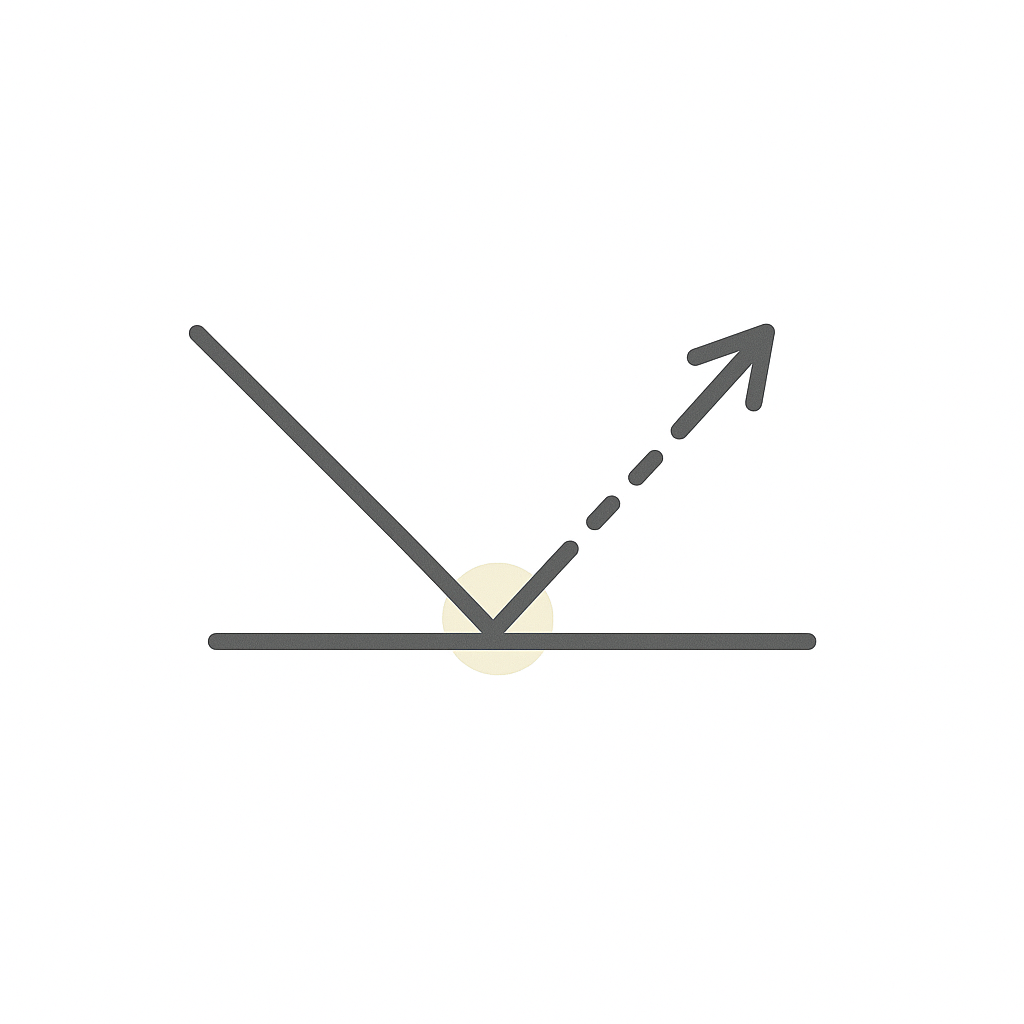
The Law of Reflection states that the angle of incidence is always equal to the angle of reflection. This means that if a ray of light arrives at a specific angle relative to the surface normal, it must depart at that exact same angle. This mathematical relationship allows scientists to predict exactly where light will travel after hitting a surface.

Submit
Please wait...
About This Quiz
Light Bouncing Back The Law Of Reflection Quiz - Quiz

This assessment explores the law of reflection, focusing on how light bounces off surfaces. It evaluates understanding of key concepts like angles of incidence and reflection, which are fundamental in physics. Engaging with this material enhances learners' comprehension of optical behaviors and their applications in real-world scenarios.

2. The "normal" line used to measure angles of reflection is a physical line drawn on every mirror.

Explanation

The normal is an imaginary line used by scientists to simplify the measurement of light paths. It is drawn mathematically perpendicular, or at a 90-degree angle, to the surface of the mirror at the exact point where the light ray hits. While it is not a real physical mark, it is essential for calculating the angles of incoming and outgoing light.

Submit

3. The light ray that travels toward a reflective surface is known as the ________ ray.

Explanation

The term used for the "incoming" light is the incident ray. This ray originates from a light source or another object and moves in a straight path until it strikes a surface. Identifying the incident ray is the first step in applying the laws of physics to determine how that light will behave once it makes contact with a material.

Submit

4. Where are the angles of incidence and reflection measured from?

Explanation

In physics, angles are not measured from the flat surface of the mirror itself. Instead, they are measured from the imaginary normal line that stands straight up from the surface. This standard measurement practice ensures that calculations remain consistent regardless of how the mirror is tilted or positioned, allowing for accurate predictions of light behavior.

Submit

5. Which of the following must be true for the Law of Reflection to apply?

Explanation

The Law of Reflection is a fundamental rule stating that the angle of arrival equals the angle of departure. For this to be observed clearly, the light must travel in straight lines. While reflection happens on all surfaces, the specific mathematical "law" is most easily demonstrated when light follows these straight paths and obeys the equal-angle rule upon hitting a boundary.

Submit

6. If the angle between the incident ray and the reflected ray is 80 degrees, what is the angle of incidence?

Explanation

Since the Law of Reflection dictates that the incident and reflected angles are equal, the total space between the two rays is simply double the value of one angle. By dividing the total 80-degree spread by two, we find that the light arrived at 40 degrees and departed at 40 degrees relative to the normal line.

Submit

7. The Law of Reflection applies to both smooth mirrors and rough surfaces like a piece of paper.

Explanation

Even though a rough surface scatters light in many directions, the Law of Reflection still applies to every individual microscopic point on that surface. The reason the reflection looks scattered is that the "normal" line points in a different direction at every tiny bump. The physical law remains constant, but the uneven surface changes the overall direction of the light.

Submit

8. A mirror with a flat surface that produces an upright image of the same size is called a ________ mirror.

Explanation

A plane mirror is a perfectly flat reflective surface. Because it is flat, all the normal lines are parallel to each other. This causes all the light rays from an object to reflect in an organized way, resulting in an image that looks exactly like the original object in terms of size and shape, though it appears reversed.

Submit

9. What happens to the angle of reflection if the angle of incidence is increased?

Explanation

Because the angle of reflection is always equal to the angle of incidence, they change in unison. If you tilt a flashlight so the incoming light hits a mirror at a steeper angle, the light bouncing off will also shift to that same steeper angle. This direct relationship is the core principle of how reflective surfaces manipulate light paths.

Submit

10. Which of these are types of reflection described by scientists?

Explanation

Specular reflection occurs on smooth surfaces like mirrors, where light bounces in one clear direction. Diffuse reflection occurs on rough surfaces, where light is scattered in many directions. Both of these follow the basic rules of reflection, but the texture of the material determines whether we see a clear image or just the color of the object.

Submit

11. In a diagram of reflection, what does the "point of incidence" represent?

Explanation

The point of incidence is the specific location on a surface where the incoming light ray makes contact. This is the most important spot in a reflection diagram because it is where the imaginary normal line is drawn. All measurements for the incoming and outgoing angles are centered around this specific point.

Submit

12. Light waves change speed when they reflect off a mirror.

Explanation

Reflection involves light bouncing off a surface and staying within the same medium, such as air. Since the medium does not change, the speed of the light wave remains constant. Speed changes only occur during refraction, which is when light enters a new material like moving from air into water or glass.

Submit

13. When you see your reflection in a pool of water, the water surface is acting as a ________.

Explanation

A calm water surface is smooth enough to allow for specular reflection. It behaves like a mirror because the surface is flat at a microscopic level, allowing light rays to bounce back to your eyes in an organized way. This allows you to see a clear image of yourself or the sky reflected on the surface of the pond.

Submit

14. Why can't you see a clear image of yourself in a brick wall?

Explanation

While a brick wall reflects light, it does so through diffuse reflection. The surface is full of tiny bumps and holes, which causes the normal lines to point in millions of different directions. Consequently, the light rays scatter everywhere rather than reflecting back in the organized pattern required for your eyes to form a clear image.

Submit

15. Which of the following are true about the reflected ray?

Explanation

Once a light ray hits a surface at the point of incidence, the reflected ray begins its path moving away from the material. According to the geometry of reflection, the reflected ray always exits on the opposite side of the imaginary normal line from where the incident ray arrived, maintaining the equal-angle relationship.

Submit
×
Saved
Thank you for your feedback!
View My Results
Cancel
  • All
    All (15)
  • Unanswered
    Unanswered ()
  • Answered
    Answered ()
According to the Law of Reflection, if light hits a mirror at a...
The "normal" line used to measure angles of reflection is a physical...
The light ray that travels toward a reflective surface is known as the...
Where are the angles of incidence and reflection measured from?
Which of the following must be true for the Law of Reflection to...
If the angle between the incident ray and the reflected ray is 80...
The Law of Reflection applies to both smooth mirrors and rough...
A mirror with a flat surface that produces an upright image of the...
What happens to the angle of reflection if the angle of incidence is...
Which of these are types of reflection described by scientists?
In a diagram of reflection, what does the "point of incidence"...
Light waves change speed when they reflect off a mirror.
When you see your reflection in a pool of water, the water surface is...
Why can't you see a clear image of yourself in a brick wall?
Which of the following are true about the reflected ray?
play-Mute sad happy unanswered_answer up-hover down-hover success oval cancel Check box square blue
Alert!



