Advanced Respiratory Disorders and Pathophysiology Quiz

Reviewed by Editorial Team
The ProProfs editorial team is comprised of experienced subject matter experts. They've collectively created over 10,000 quizzes and lessons, serving over 100 million users. Our team includes in-house content moderators and subject matter experts, as well as a global network of rigorously trained contributors. All adhere to our comprehensive editorial guidelines, ensuring the delivery of high-quality content.
Learn about Our Editorial Process
| By Thames
T
Thames
Community Contributor
Quizzes Created: 8156 | Total Attempts: 9,588,805
| Attempts: 13 | Questions: 25 | Updated: Aug 4, 2025
Please wait...
Question 1 / 26
🏆 Rank #--
Score 0/100

1. Which type of asthma is usually precipitated by aspirin?

Explanation

Aspirin-induced asthma is typically associated with INTRINSIC Asthma, not the other types mentioned.

Submit
Please wait...
About This Quiz
Advanced Respiratory Disorders and Pathophysiology Quiz - Quiz

This educational activity focuses on the pathology of respiratory systems, aiming to enhance understanding of diseases affecting this critical body system. It is designed for learners seeking to improve diagnostic skills and apply knowledge in clinical or academic settings.

2.

What first name or nickname would you like us to use?

You may optionally provide this to label your report, leaderboard, or certificate.

2. Asthma with eosinophilia is likely what type of asthma?

Explanation

Asthma with eosinophilia typically indicates an allergic response, leading to extrinsic (allergic) asthma. Intrinsic (Non-Allergic) asthma is not commonly associated with eosinophilia. Mixed asthma may have various triggers but eosinophilia would point more towards an allergic component. Exercise-induced asthma is triggered by physical activity and may not necessarily involve eosinophilia.

Submit

3. In Primary pulmonary hypertension, decreased apoptosis is associated with what cells?

Explanation

Primary pulmonary hypertension is characterized by decreased apoptosis of endothelial cells and smooth muscle cells in arterioles, leading to vascular remodeling and increased pulmonary vascular resistance.

Submit

4. What are the effects of ARDS on Pulmonary capillary permeability, PCWP, Lung compliance, and V/Q mismatch?

Explanation

ARDS leads to increased pulmonary capillary permeability causing exudation of fluid into the alveoli. PCWP is typically normal in ARDS. The exudated fluid results in increased V/Q mismatch, increased work of breathing, and decreased lung compliance. These effects are due to diffuse alveolar damage.

Submit

5. Patient presents with Petechial rash, Hypoxemia, Neurologic abnormalities after suffering long bone/pelvic fractures, what is the early histopathologic finding associated with his condition? How could this patient develop ARDS?

Submit

6. Why can the pancreatic duct be lined with Squamous epithelium instead of Low-columnar mucus secreting epithelium?

Explanation

The pancreatic duct being lined with Squamous epithelium instead of Low-columnar mucus secreting epithelium is likely due to a lack of Vitamin A, as explained in the correct answer. The other three options are not related to the mechanism of squamous metaplasia in this context.

Submit

7. Why is the maxillary sinus most commonly affected by Rhinosinusitis?

Explanation

The maxillary sinus is most commonly affected by Rhinosinusitis due to its anatomical position and the difficulty in draining fluids out of it.

Submit

8. Most likely cause of rhinosinusitis?

Explanation

Rhinosinusitis is most commonly caused by viral infections, with Streptococcus pneumoniae being a possible cause only after viral infections.

Submit

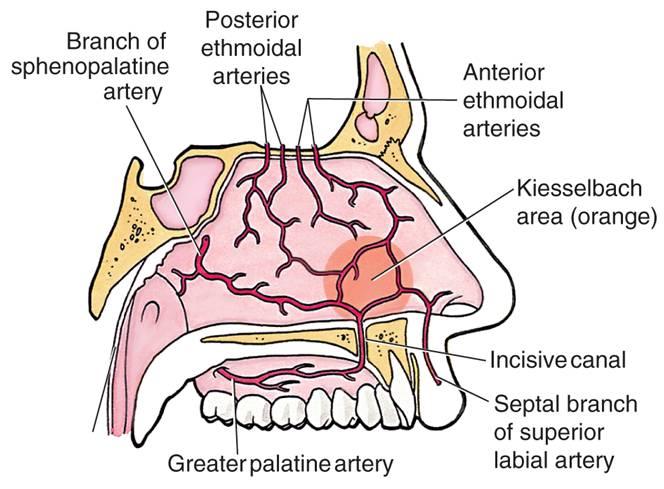
9. Which vessels are most likely involved in a patient who presents with Epistaxis, and which vessel can be responsible for a fatal bleed?

Explanation

Epistaxis is commonly due to damage to vessels in the anterior segment of the nostril, while fatal bleeds usually involve vessels in the posterior segment and the SPHENOPALATINE artery. Nasal Angiofibromas and Allergic rhinitis are more common causes of epistaxis due to vessel damage.

Submit

10. What is field cancerization and what is its significance?

Explanation

Field cancerization refers to the concept that a carcinogen affects a specific area (the 'field') in a way that increases the chance of developing multiple independent cancers. It is not limited to skin cancers and has a significant impact on cancer risk.

Submit

11. What are the likely viral causes of oropharyngeal cancer vs nasopharyngeal cancer?

Submit

12. What genetic condition increases the risk of Pulmonary embolism due to a mutation that leads to Factor V being resistant to degradation by proteins C and S?

Explanation

The Factor V Leiden mutation leads to a hypercoagulable state by increasing production of thrombin, resulting in higher risk of DVT and subsequent Pulmonary embolism.

Submit

13. Most common sites of origin of pulmonary emboli?

Explanation

Pulmonary emboli typically originate from the lower extremities, specifically the femoral veins. The thrombi that lead to pulmonary embolism form in the proximal deep veins of the calves and thighs, and rarely from other locations such as the carotid arteries, basilar artery, or splenic vein.

Submit

14. Why is knowing Lines of Zahn important in forensic medicine?

Explanation

Understanding Lines of Zahn can provide critical insights into the timing and nature of thrombus formation, crucial information in forensic investigations regarding cause of death.

Submit

15. After central line placement patient develops tachypnea, hypoxemia and respiratory alkalosis, this is an example of what type of emboli?

Explanation

Air emboli are commonly associated with central line placement due to the introduction of air into the bloodstream. This can lead to symptoms such as tachypnea, hypoxemia, and respiratory alkalosis. Other types of emboli mentioned as incorrect answers have different etiologies and presentations.

Submit

16. Why are FRC and TLC increased in COPD?

Explanation

In COPD, air trapping leads to an increase in the residual volume (RV), which in turn increases the functional residual capacity (FRC) and total lung capacity (TLC).

Submit

17. What happens to DLCO during emphysema and why?

Submit

18. How can one important concept help you understand all physical findings in emphysema?

Explanation

Understanding that patients with emphysema have difficulty exhaling air and experience hyperinflation in their lungs is crucial in interpreting their physical findings, such as a flattened diaphragm, increased AP diameter, and increased lung lucency on imaging.

Submit

19. Why do patients with Chronic bronchitis have Cyanosis and Secondary Polycythemia?

Explanation

Cyanosis and Secondary Polycythemia in patients with Chronic bronchitis are specifically due to the obstructive nature of the disease leading to decreased oxygenation of tissues and compensatory responses to hypoxia.

Submit

20. Which of the following conditions is characterized by digital Clubbing, HEMOPTYSIS, recurrent infections, and purulent sputum with a decreased FEV1/FVC ratio?

Explanation

Manifestations such as digital Clubbing, HEMOPTYSIS, recurrent infections, and purulent sputum with a decreased FEV1/FVC ratio are indicative of bronchiectasis, not asthma, pulmonary hypertension, or tuberculosis.

Submit

21. Female with scleroderma shows signs of right sided heart failure and S2 sound is louder (Accentuated PULMONARY Component) than normal, likely first vessels involved in lungs? Cell/Cytokine that plays major role?

Explanation

The correct answer is PULMONARY HYPERTENSION because it is the first blood vessels involved in the lungs in scleroderma-related right sided heart failure. The other options are incorrect as they do not align with the presentation and pathophysiology described in the question and correct answer.

Submit

22. Major basic protein is released from EOSINOPHILS and functions to kill helminths(by disrupting their OUTER membranes), this particular protein is also involved in bronchial damage of which type of asthma?

Submit

23. What is SRS-A?

Explanation

SRS-A, or slow-reacting substance of anaphylaxis, is a mixture of leukotrienes contained within granules of mast cells and basophils. It is involved in allergic reactions and inflammatory responses.

Submit

24. What is the difference between Ghon complex and Ranke complex in tuberculosis?

Explanation

Ghon complex typically involves walled-off foci in mid to lower lobes of the lung with adjacent lymph node involvement, potentially leading to reactivation of TB. In contrast, Ranke complex results from complete clearance of bacteria and formation of scar tissue, without the risk of reactivation.

Submit

25. Why is primary spontaneous pneumothorax more common in Young, Tall, thin males?

Submit
×
Saved
Thank you for your feedback!
View My Results
Cancel
  • All
    All (25)
  • Unanswered
    Unanswered ()
  • Answered
    Answered ()
Which type of asthma is usually precipitated by aspirin?
Asthma with eosinophilia is likely what type of asthma?
In Primary pulmonary hypertension, decreased apoptosis is associated...
What are the effects of ARDS on Pulmonary capillary permeability,...
Patient presents with Petechial rash, Hypoxemia, Neurologic...
Why can the pancreatic duct be lined with Squamous epithelium instead...
Why is the maxillary sinus most commonly affected by Rhinosinusitis?
Most likely cause of rhinosinusitis?
Which vessels are most likely involved in a patient who presents with...
What is field cancerization and what is its significance?
What are the likely viral causes of oropharyngeal cancer vs...
What genetic condition increases the risk of Pulmonary embolism due to...
Most common sites of origin of pulmonary emboli?
Why is knowing Lines of Zahn important in forensic medicine?
After central line placement patient develops tachypnea, hypoxemia and...
Why are FRC and TLC increased in COPD?
What happens to DLCO during emphysema and why?
How can one important concept help you understand all physical...
Why do patients with Chronic bronchitis have Cyanosis and Secondary...
Which of the following conditions is characterized by digital...
Female with scleroderma shows signs of right sided heart failure and...
Major basic protein is released from EOSINOPHILS and functions to kill...
What is SRS-A?
What is the difference between Ghon complex and Ranke complex in...
Why is primary spontaneous pneumothorax more common in Young, Tall,...
play-Mute sad happy unanswered_answer up-hover down-hover success oval cancel Check box square blue
Alert!