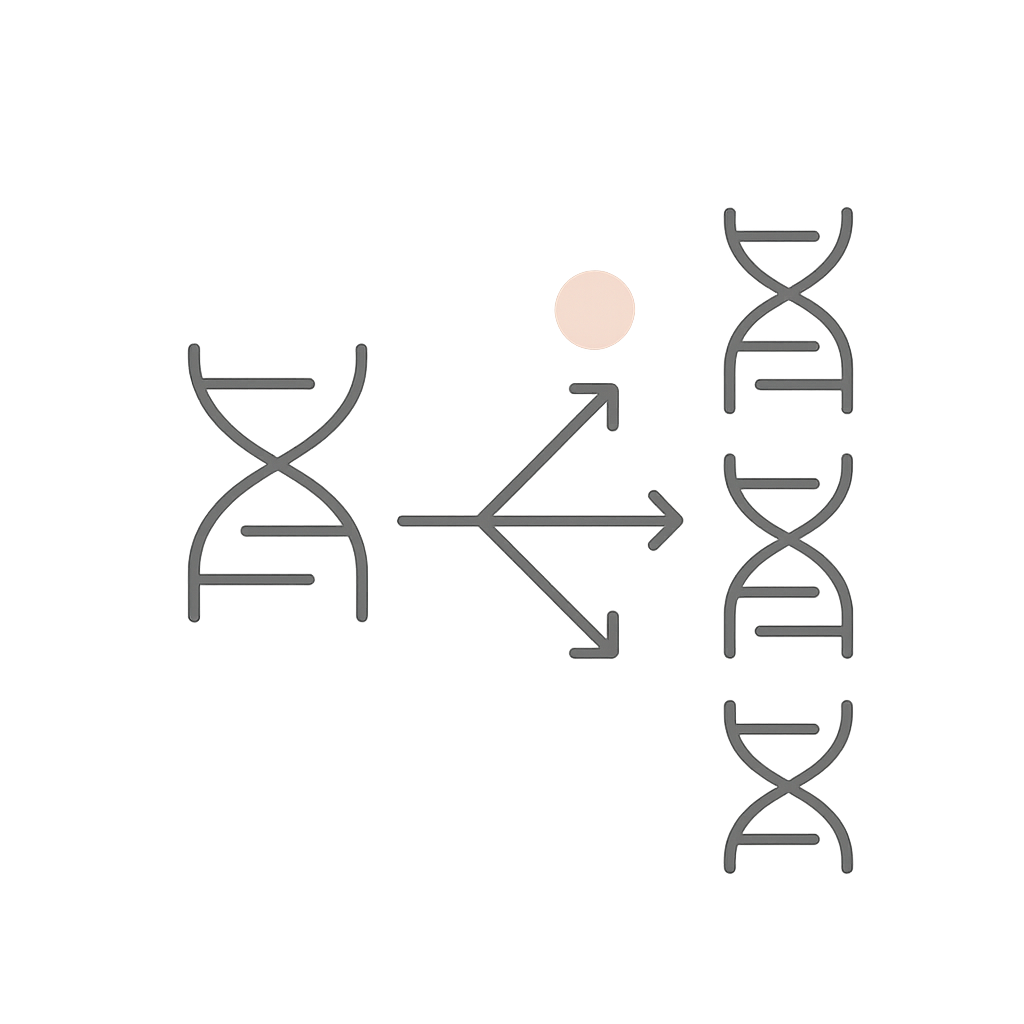
DNA Multiplication: How PCR Works

  • 11th Grade
Reviewed by Editorial Team
The ProProfs editorial team is comprised of experienced subject matter experts. They've collectively created over 10,000 quizzes and lessons, serving over 100 million users. Our team includes in-house content moderators and subject matter experts, as well as a global network of rigorously trained contributors. All adhere to our comprehensive editorial guidelines, ensuring the delivery of high-quality content.
Learn about Our Editorial Process
| By Thames
T
Thames
Community Contributor
Quizzes Created: 9273 | Total Attempts: 9,636,263
| Questions: 20 | Updated: Mar 8, 2026
Please wait...
Question 1 / 21
🏆 Rank #--
0 %
0/100
Score 0/100

1. What mathematical pattern describes the increase in DNA copies during a successful PCR run?

Explanation

If each cycle of PCR doubles the number of DNA molecules from the previous cycle, then the population grows by a power of 2. If growth follows the formula 2^n, then it is defined as exponential growth.

Submit
Please wait...
About This Quiz
DNA Multiplication: How PCR Works - Quiz

Thirty cycles of heating and cooling. One target sequence. Over a billion identical copies. The mathematics behind how PCR works is what makes it one of the most powerful amplification tools ever developed. Each cycle doubles the number of target DNA molecules, producing exponential growth that transforms a vanishingly small... see morestarting sample into enough material to analyze, sequence, or visualize. How well do you understand the exponential kinetics of PCR amplification, the role of the thermal cycler in automating the process, and the factors that can reduce efficiency and cause amplification to plateau before reaching theoretical maximum yield? see less

2.

What first name or nickname would you like us to use?

You may optionally provide this to label your report, leaderboard, or certificate.

2. Understanding how pcr works requires knowing that the amount of DNA remains constant throughout the 30 cycles.

Explanation

If the goal of PCR is amplification, then the total amount of DNA must increase. If the reaction works correctly, then the number of target sequences doubles every few minutes, making the statement false.

Submit

3. The automated laboratory equipment used to rapidly change temperatures during PCR is called a ______ ______.

Explanation

If the PCR process requires precise heating and cooling phases to be repeated many times, then a machine must automate these shifts. If that machine cycles through thermal states, then it is a thermal cycler.

Submit

4. Which of the following are essential biological or chemical "ingredients" for how pcr works in a laboratory?

Explanation

If you are building DNA, then you need a template, building blocks (dNTPs), a starting point (primers), and a heat-stable enzyme (Taq). Since ribosomes build proteins rather than DNA, they are not part of the PCR ingredients.

Submit

5. Why is the "Denaturation" step performed at such a high temperature (typically 95 degrees Celsius)?

Explanation

If DNA is a double helix held together by hydrogen bonds, then those bonds must be broken to access the code. If high thermal energy vibrates the molecules until the strands separate, then 95 degrees Celsius is the required temperature for denaturation.

Submit

6. A critical part of how pcr works is the "Annealing" step, where the temperature is lowered to allow primers to bind.

Explanation

If the strands are separated at high heat, then they must be cooled slightly to allow new bonds to form. If the primers find their complementary sequences at this lower temperature, then annealing has occurred.

Submit

7. The heat-stable enzyme used in PCR was originally isolated from the bacterium ______ ______.

Explanation

If the enzyme must survive repeated heating to 95 degrees Celsius, then it must come from an extremophile. If that organism lives in hot springs, then it is Thermus aquaticus, the source of Taq.

Submit

8. In the context of how pcr works, what is the role of the "Extension" step?

Explanation

If the primers have landed on the single strands, then a builder is needed to complete the sequence. If Taq polymerase adds dNTPs to the 3-prime end of the primer, then it is extending the strand to create a double helix.

Submit

9. Which of the following temperatures are correctly matched to their phase in a standard PCR cycle?

Explanation

If the double helix needs to unzip, then 95°C is used. If primers need to land, then a cooler 55°C is used. If the enzyme works best at its optimal heat, then 72°C is used for extension.

Submit

10. The theory behind how pcr works suggests that after 3 cycles starting with one molecule, you would have 8 molecules.

Explanation

If the growth formula is 2^n and n represents the number of cycles, then 2 to the power of 3 equals 8. Therefore, the math supports the existence of 8 copies after 3 rounds.

Submit

11. The building blocks of DNA that Taq polymerase uses to construct new strands are known as ______.

Explanation

If the enzyme is synthesizing a polynucleotide, then it requires individual nucleotides with three phosphates. If these are the specific deoxy-versions for DNA, then they are dNTPs.

Submit

12. How does the specificity of how pcr works allow scientists to target only one gene out of the entire genome?

Explanation

If a genome has billions of bases, then you need a specific "search" tool. If primers are engineered to be complementary to only one specific sequence, then the polymerase will only build DNA starting at that exact gene location.

Submit

13. What happens to the speed of the DNA amplification as a thermal cycler progresses through 40 cycles?

Explanation

If resources like dNTPs and active enzymes are finite, then the reaction cannot double forever. If the components are exhausted or degraded, then the growth curve will eventually level off in a "plateau" phase.

Submit

14. The process of how pcr works is so efficient that it can amplify DNA from a single skin cell or drop of blood.

Explanation

If the exponential doubling (2^40) creates trillions of copies, then even a tiny starting amount is enough to produce a visible result. If this sensitivity is high, then PCR is a valid tool for forensic science.

Submit

15. During the annealing phase of PCR, the primers form ______ bonds with the template DNA.

Explanation

If the primers are binding to complementary bases (A with T, C with G) without sharing electrons, then they are using weak electrostatic attractions. If these are the bonds used, then they are hydrogen bonds.

Submit

16. Why is the buffer solution important for how pcr works inside the tube?

Explanation

If enzymes are sensitive to their environment, then the chemical conditions must be stable. If the buffer regulates the acidity and provides magnesium ions for the polymerase, then it ensures the enzyme functions correctly.

Submit

17. Which factors could cause the "Exponential Growth" of PCR to fail in a thermal cycler?

Explanation

If the primers don't fit or the heat prevents them from landing, the reaction stops. If chemicals block the enzyme or materials run out, growth fails. However, having "too much" DNA usually doesn't stop the reaction.

Submit

18. The inventor of how pcr works, Kary Mullis, won a Nobel Prize for this discovery.

Explanation

If the invention of PCR revolutionized molecular biology by allowing easy DNA copying, then it is considered a major scientific achievement. If Kary Mullis received the Nobel Prize in Chemistry in 1993, then the statement is true.

Submit

19. In the PCR process, DNA is always synthesized in the ______-prime to ______-prime direction.

Explanation

If DNA polymerase can only add new nucleotides to a free 3-hydroxyl group, then the chain must grow starting from the 5 end. Therefore, the direction of synthesis is strictly 5 to 3.

Submit

20. Which of the following is a primary real-world application of how pcr works?

Explanation

If PCR can take a tiny, invisible amount of DNA and make it large enough to analyze, then it is perfect for identifying people. If forensic scientists use this to match a suspect to evidence, then it is a primary application.

Submit
×
Saved
Thank you for your feedback!
View My Results
Cancel
  • All
    All (20)
  • Unanswered
    Unanswered ()
  • Answered
    Answered ()
What mathematical pattern describes the increase in DNA copies during...
Understanding how pcr works requires knowing that the amount of DNA...
The automated laboratory equipment used to rapidly change temperatures...
Which of the following are essential biological or chemical...
Why is the "Denaturation" step performed at such a high temperature...
A critical part of how pcr works is the "Annealing" step, where the...
The heat-stable enzyme used in PCR was originally isolated from the...
In the context of how pcr works, what is the role of the "Extension"...
Which of the following temperatures are correctly matched to their...
The theory behind how pcr works suggests that after 3 cycles starting...
The building blocks of DNA that Taq polymerase uses to construct new...
How does the specificity of how pcr works allow scientists to target...
What happens to the speed of the DNA amplification as a thermal cycler...
The process of how pcr works is so efficient that it can amplify DNA...
During the annealing phase of PCR, the primers form ______ bonds with...
Why is the buffer solution important for how pcr works inside the...
Which factors could cause the "Exponential Growth" of PCR to fail in a...
The inventor of how pcr works, Kary Mullis, won a Nobel Prize for this...
In the PCR process, DNA is always synthesized in the ______-prime to...
Which of the following is a primary real-world application of how pcr...
play-Mute sad happy unanswered_answer up-hover down-hover success oval cancel Check box square blue
Alert!



