


Your training completion rate is 94%. Your employees forgot 80% of it by Friday.
That gap is the employee engagement problem nobody talks about. While most guides on how to improve employee engagement focus on perks, pulse surveys, and pizza Fridays, the real disengagement crisis is happening inside your training programs.
People are clicking through compliance modules on autopilot, gaming quizzes by trial and error, and mentally checking out before the certificate loads. Tools like ProProfs Quiz Maker exist precisely because completion data alone never tells you whether anyone actually learned anything.
This guide is about fixing that, with strategies and metrics that go beyond the obvious.
Who This Guide Is For
Keep reading if any of the following describes your situation:
- HR managers at mid-size companies, trying to move engagement metrics past the low 20s without adding another perks program that nobody asked for
- L&D managers whose training programs show 100% completion and zero behavioral change three months later
- Compliance officers who know their annual training is a checkbox exercise and want a structural fix, not a cosmetic one
- Onboarding specialists who have watched talented new hires mentally check out in their first 30 days because the onboarding felt like a paperwork marathon
- Training managers who have been asked to prove training ROI with nothing but a completion report and are tired of the conversation
What Is Employee Engagement?
Employee engagement is the degree to which employees are psychologically invested in their work, their team, and their organization’s goals. It is not the same as job satisfaction. A satisfied employee may be content with their pay and perks while contributing the minimum required. An engaged employee brings discretionary effort, doing more than required because they genuinely care about the outcome.
Gallup’s research, which spans more than 112,000 business units across 276 organizations and 54 industries, identifies three types of employees:
- Engaged (21% globally in 2025): Psychologically invested. Bring energy and innovation. Go beyond their job description.
- Not engaged (62%): Present but not invested. Doing enough to keep the job but nothing more.
- Actively disengaged (17%): Unhappy and actively undermining their organizations.
That 21% figure comes directly from Gallup’s State of the Global Workplace 2025 report. The combined cost of the remaining 79% in lost productivity, higher turnover, absenteeism, and quality problems amounts to roughly $10 trillion per year, or 9% of global GDP.
Why Employee Engagement Drops in Training Programs
The engagement crisis in corporate training is not a mystery. Talk to any HR or L&D professional long enough, and you will hear the same complaints, described in almost identical language.
The Click-Through Culture Problem
Employees have learned to complete training without engaging with it. They click through slides at maximum speed, select answers by trial and error, and forget 90% of the content within a week.
One compliance manager described it precisely: “The employee who breezes through every module in 11 minutes and scores 100%, because they click the right answer without reading the question.”
The Checkbox Exercise Dynamic
When training feels mandatory and disconnected from real work, employees treat it as a compliance obligation rather than a growth opportunity. A finance professional captured the sentiment bluntly: “No one has ever said: you know what’s fun? Sitting through a compliance training. I’d just rather watch paint dry.”
This is not cynicism. It is a rational response to training that is generic, preachy, and visibly designed for legal cover rather than actual learning.
One-Size-Fits-All Content Kills Relevance
Generic training that does not differentiate by role or experience level is an immediate disengagement trigger. It treats someone with ten years in data privacy the same as a new hire who has never heard the term. When content is not relevant, the brain files it under “not for me” and stops paying attention.
Completion Is Measured; Learning Is Not
This is the structural problem at the root of everything else. When the only metric is completion rate, the system is optimized for completion, not learning, not retention, not behavior change. As one L&D professional put it: “Completions don’t equal competency. If your LMS can’t link learning to outcomes, you’ll never get leadership buy-in.”
The research confirms this. SkillUp Online research found that 74% of training administrators report employees forget what they learned within a month. The training box gets ticked. The behavior does not change.
Training Fatigue Is Real and Cumulative
Module 1 of 14 is the moment a learner’s engagement starts to collapse. When employees are assigned long-form courses covering GDPR, harassment prevention, and cybersecurity in a single sitting, cognitive overload is not a risk.
It is a certainty. L&D professionals describe “bombarding employees with an overwhelming amount of information” as one of the most common design mistakes in corporate training.
Key Data Point: According to LinkedIn Learning’s 2024 Workplace Learning Report, 90% of organizations cite learning as their #1 retention strategy, yet only 32% of employees are satisfied with their company’s L&D programs. The gap between investment and experience is enormous.
How to Improve Employee Engagement With Strategies That Work
Employee engagement does not collapse overnight. It erodes gradually, through training that feels pointless, feedback that goes nowhere, and work that never connects to anything larger.
The strategies below target each of those pressure points specifically.
1. Use AI to Audit Gaps and Build Your First Quiz Before Anything Else
Before buying a new platform, running another survey, or rolling out a recognition initiative, most HR teams skip the most valuable first step: finding out what employees actually know right now, not what they were told in the last training cycle.
The traditional approach to this is a manual audit. Talk to managers. Review completion reports. Schedule focus groups. It takes weeks and produces opinions, not data.
The AI-powered approach takes minutes and produces evidence.
Modern quiz platforms with AI quiz generation can turn an existing policy document, a training video, a compliance PDF, or even a webpage into a fully structured knowledge assessment in seconds. You upload the material. The AI reads it, identifies the key concepts, and generates questions across multiple formats, including scenario-based, multiple choice, and true/false, calibrated to different difficulty levels. No instructional designer required. No week-long authoring process.

Let ProProfs AI Build a Quiz
This matters at the very start of any engagement initiative because you cannot fix what you have not measured. The five engagement fundamentals every organization should verify before launching anything new:
- Clear expectations: Do employees know what success looks like in their role, beyond the job description?
- Right knowledge baseline: Do they actually understand the policies, processes, and product details their role requires?
- Relevant content: Does the training they have received match their actual job function and experience level?
- Recognition tied to learning: Has anyone acknowledged their training performance specifically, not just their output?
- A manager who treats training as development: Not as an admin checkbox, but as a signal about where the employee wants to grow?
A 10-question AI-generated knowledge check on any of these areas, built in under five minutes, gives you a factual baseline. You are not guessing whether employees understood last quarter’s compliance training. You are looking at per-question accuracy rates, time-on-question, and category-level performance and seeing exactly where the gaps are.
Beyond question creation, advanced AI quiz platforms now handle the entire assessment lifecycle. AI grading with custom rubrics evaluates open-ended responses consistently, removing the manual burden that often prevents teams from using scenario-based or descriptive questions at scale.
AI question import allows you to instantly convert existing question banks, documents, or legacy quizzes into structured assessments without rework. AI-labeled analytics automatically categorize responses by skill, topic, or competency, giving you deeper insight into not just what employees got wrong, but why they struggled.
Together, these capabilities turn a simple knowledge check into a fully automated, insight-driven evaluation system that is practical even in high-compliance environments.
What this first AI-powered audit tells you:
- Which topics have genuine knowledge gaps, versus which have low engagement because the content is irrelevant
- Which employees are already strong and do not need the foundational module, freeing them from content that insults their experience level
- Which question categories does the team struggle with consistently, so your redesign effort goes to the right place
- Whether your existing quizzes are actually measuring comprehension or just rewarding pattern recognition, by comparing new AI-generated scenario questions against your legacy recall questions on the same topic
No engagement program built on broken or unknown foundations produces results. The AI-generated knowledge check is the diagnostic that tells you what is actually broken before you spend time and budget trying to fix the wrong thing.
Start here: Pick your most recent compliance or onboarding training module. Upload the source document or paste the URL into an AI quiz generator. Generate a 10-question assessment with a mix of scenario-based and factual questions. Send it to a cohort of five to ten employees who completed the original training. Review the results before your next L&D planning meeting. What you find will change the priorities on that meeting’s agenda.
Create Your First Employee Engagement Quiz Using AI
2. Train Managers on Development Conversations, Not Just Performance Conversations
The manager is where most engagement initiatives go to die. Not because managers are poor performers, but because organizations train managers to evaluate performance and almost never train them to develop people. Those are different skills, and the second one is the one that actually drives engagement.
A manager who holds a genuine 30-minute quarterly conversation asking an employee where they want to be in two years, which skills they want to build, and what is getting in their way will outperform any recognition software deployed. That conversation signals something no platform can replicate: someone with real authority over my career actually cares about where it goes.
What separates managers who build engaged teams from those who do not:
- They ask about goals, not just deliverables. “What do you want to get better at this month?” is a different conversation than “How is the project coming along?”
- They connect daily tasks to growth. “I gave you this account specifically because it will stretch your negotiation skills” lands differently than a task assignment with no context
- They follow up on the last conversation. If a manager asked about a development goal last month and does not mention it again, the employee registers that it was not real
- They treat training completion as a development signal, not an admin task. When an employee finishes a certification, the engaged manager asks: “What was the most useful thing you took from that? Where do you want to apply it?”
Start here: Give every manager a one-on-one template with three fixed questions at the top of every meeting: What went well this week? What got in your way? What do you want to get better at? The third question, asked consistently and followed up on, does more for engagement than almost any HR initiative.
3. Make Recognition Specific Enough to Be Repeatable
Generic recognition does not change behavior. “Great job this quarter,” tells an employee they did something acceptable. It gives them no information about what to do again. The recognition that actually drives engagement names the exact behavior, the impact it had, and the value it reflects.
The difference in practice:
Generic: “Nice work on the client presentation.”
Specific: “The way you anticipated the procurement objection before they raised it saved 20 minutes and probably the contract. That kind of preparation is exactly what we need on the renewal calls.”
The second version is something the employee can act on. They know what to repeat. They know why it mattered. And they know they are seen.
This applies directly to training performance. When an employee passes a difficult certification, scores in the top tier on a compliance assessment, or improves their quiz score significantly across retries, call it out publicly and specifically. “You scored in the top 10% on the data privacy assessment.
That matters because you are moving into the project where you will be handling customer data directly.” Recognition tied to learning achievement creates a reinforcement loop that makes the next training feel worth doing.
Start here: Before your next team meeting, identify one specific thing one team member did well this week. Write the behavior, the impact, and the value before you say it out loud. That 90-second preparation is the difference between recognition that lands and recognition that gets forgotten.
4. Close the Feedback Loop Visibly and Fast
The fastest way to kill future survey participation is to run a survey and do nothing visible with the results. Employees who took 10 minutes to tell you honestly what is broken will not do it again if nothing changes.
The problem is usually not that organizations ignore feedback. It is that the action cycle takes so long that the connection between input and response becomes invisible.
The fix is speed and specificity. A practical feedback loop that actually builds trust:
- Run shorter surveys more frequently. Five to eight questions monthly beats 40 questions annually. Shorter surveys get higher completion rates and faster action cycles
- Share results back within two weeks, including the uncomfortable parts. Employees who can see their own data reported back to them trust the process significantly more
- Commit publicly to two to three specific changes based on what you heard. Not “we will review your feedback.” Specific: “We will redesign the onboarding documentation for the compliance section by the end of the month.”
- Report back on those commitments in the next cycle. “We heard you. Here is what we changed. Tell us if it helped.” That loop, done consistently, is what makes employees believe their input actually matters
- Use quiz data as a feedback channel. Question-level error rates, time-on-quiz anomalies, and low pass rates are the training program’s way of telling you something is broken. Treating those signals as feedback rather than performance data changes how you respond to them
Start here: After your next pulse survey, send a one-paragraph “Here is what we heard and here is what we are doing about it” message to the team within 10 business days. Do this once, and watch participation in the following survey go up.
Create Your First Employee Engagement Quiz Now
5. Connect Training Content Explicitly to Why It Matters
Compliance training completion rates improve measurably when employees understand why a regulation exists, not just what it requires. Most training opens with the policy. The version that drives engagement opens with the consequence: a real case, a plausible scenario, or a harm the regulation was designed to prevent.
This principle applies to every training type:
- Compliance training: Lead with the real-world consequence, then introduce the regulation as the solution to that specific problem
- Product training: Lead with the customer problem the product solves, not the list of features
- Process training: Lead with what goes wrong when the process is skipped, not the steps of the process itself
- Onboarding content: Lead with how this role connects to what the organization is actually trying to accomplish
Start here: Open your three most-used training modules. Find the “why this matters in your actual job” moment in each one. If it is missing or buried after several screens, move it to the first screen. That single change will improve both completion rates and first-attempt quiz scores.
6. Replace Annual Training Events With Continuous Short Quizzes
Most organizations treat training as an event. Onboarding week. Annual compliance day. Quarterly skills workshop. Employees sit through a block of content, complete a final quiz, and receive a certificate.
By the following Monday, most of it is already fading. This is not a motivation problem. It is a memory problem. The brain discards information it has no reason to retrieve again.
What a continuous quiz architecture looks like in practice:
- Break existing annual content into monthly micro-units, each covering one concept or decision scenario rather than a full topic area
- Deliver a short knowledge check after every unit, timed to arrive 48 to 72 hours after the content, not immediately. That gap is where the retrieval effect is strongest
- Schedule recurring quiz rounds on high-stakes compliance topics, not just at recertification time. Quarterly recall quizzes on the same material produce compounding retention gains
- Track improvement over time, not just pass/fail at a single point. An employee who scores 62% in January and 88% in April has learned something. An employee who scores 90% instantly every time may be doing something else entirely
- Use the quiz schedule as the training calendar, not a supplement to it. When the quiz is the mechanism, content delivery, reinforcement, and measurement happen in one motion
Start here: Pick one annual training topic. Break it into four short modules of roughly five minutes each. Schedule one per month with a follow-up five-question quiz. Compare retention at month four against your last annual assessment result. The difference will make the case for the format shift without any additional argument.
7. Design Quizzes That Require Thinking, Not Pattern Recognition
Most corporate quizzes do not test knowledge. They test whether an employee can match a phrase from the training slides to an answer option that uses the same words. That is pattern recognition, not comprehension. An employee can score 100% on a quiz like this without having learned anything meaningful, and many do.
The proof is simple: if an employee who skipped the training can guess the answers from the options alone, the quiz is not measuring understanding. It measures whether people can read.
The fix is scenario-based questions. The difference in practice:
| Pattern Recognition Question | Scenario-Based Question |
|---|---|
| According to policy, expense reports must be submitted within how many days? | You submitted an expense report from last month’s conference. Your manager approved it, but finance flagged it as outside the submission window. What is the correct next step? |
| What does GDPR stand for? | A customer calls asking why they received a marketing email. They say they never gave consent. What is your first required action under data protection policy? |
| Which of the following is a phishing indicator? | You receive an email from your IT department asking you to click a link and verify your login. The sender address shows “it-support@company-helpdesk.net”. What do you do? |
Scenario-based questions matter for engagement as much as they matter for learning. Pattern-recognition quizzes feel insulting to experienced professionals. They signal that the quiz was designed to generate a pass, not test real understanding. Scenario-based quizzes signal the opposite: the organization cares whether employees can actually apply this.
Start here: Take your current highest-stakes compliance quiz and rewrite three questions as scenarios using the format in the table above. Run the rewritten version with the next cohort. Compare time-on-quiz with the previous version. A longer time means people are actually reading and thinking. That is the signal that the quiz is working.
8. Use Question Banks and Randomization to Eliminate Answer Sharing
In most organizations, compliance quiz answers circulate within hours of the quiz going live. A colleague passes, takes a screenshot of the questions and answers, and shares it in the team chat. By the end of the day, the quiz had been completed by 90% of the organization, but learned by approximately none of them.
This is not a culture problem. It is a design problem. When every employee receives the same 10 questions in the same order, the incentive to share answers is higher than the incentive to engage with the content. The fix is structural.
How a question bank and randomization system work:
- Build a bank of at least 40 to 50 questions covering the full topic area, not just the 10 or 15 that will appear in any given quiz
- Set each quiz to draw a randomized subset from the bank, 12 to 15 questions per attempt, so no two employees receive the same quiz
- Randomize question order within each quiz, not just the question selection. The same question appearing in a different position breaks pattern-based guessing
- Randomize answer options within each question so the correct answer is not always in the same position
- Change the active bank periodically. A bank refreshed every six months stays ahead of any answers that have circulated informally
The result: sharing answers becomes pointless because the questions an employee received are not the questions their colleague will see. Repeat attempts feel genuinely different, which also eliminates the “retry until I eliminate the wrong answers” behavior that undermines training integrity on fixed quizzes.
A quiz tool with built-in skill assessment management and per-quiz randomization rules handles all of this automatically. Build the bank once, set the rules, and every subsequent delivery manages the variability without any manual intervention.
Start here: For your next compliance quiz, build a bank of at least 30 questions and configure each quiz to draw 10 randomly. Send a one-line note to the team: “Questions are randomized, so each person gets a different quiz.” Watch the answer-sharing dynamic in the team chat change immediately.
Create Your First Employee Engagement Quiz Now
9. Build Onboarding Around Knowledge Milestones, Not Information Delivery
The standard onboarding model has a structural flaw: it is designed to deliver information, not to verify that information was absorbed. Day one is a document stack. Week one is a video series. Month one is a series of meetings.
By the end of month one, the new hire has received an enormous amount of information and has no reliable signal about what they retained. The manager has no signal either. Both find out when something goes wrong on the job.
A milestone-based quiz architecture fixes this. Short, focused knowledge checks tied to specific onboarding milestones do two things simultaneously: they give the new hire honest, immediate feedback on where they stand, and they give the manager early data to act on before small gaps become real problems.
A practical 90-day onboarding quiz architecture:
- Week 1 (10 questions): Culture, values, and role expectations. Purpose: establish that this is a learning environment, not an information-delivery exercise, and catch any fundamental misunderstandings about the role before they calcify
- Week 3 (15 to 20 questions, randomized from a bank): Role-specific product or process knowledge. Purpose: identify where the new hire is strong and where they need more depth before client or customer exposure
- Day 60 (10 to 15 questions, scenario-based): Compliance and process application. Purpose: test whether the new hire can apply policies to realistic situations they have now actually encountered, not just recognize policy text
- Day 90 (10 questions): Practical application covering situations the employee has faced in their first three months. Purpose: confirm knowledge-to-practice transfer before the formal review
The quiz at each milestone takes under 10 minutes. The output is a report that the manager can use in the next one-on-one. A new hire who scores 90% on product knowledge but 55% on data handling procedures is showing exactly where to focus development attention in month two, before a compliance issue surfaces in month three.
The quiz here is not a test. It is a navigation tool. For the new hire, it answers the question they are often too anxious to ask: “Am I getting this?” For the manager, it replaces guesswork with data.
Start here: Replace your current 90-day check-in conversation with a 10-question quiz delivered the afternoon before the meeting. Review the results together during the check-in. The conversation will be more specific, more useful, and more honest than any open-ended “how are you settling in?” discussion.
10. Automate the Admin So Training Actually Happens
Training completion rates are highly sensitive to friction. Not content quality, not quiz difficulty, not even relevance. Friction.
How many clicks does it take to find the course? Whether the reminder arrived when the employee was at their desk or on their phone during a commute. Whether the deadline appeared in their calendar or only in an email, they missed it.
Most organizations leave all of this friction in place and then wonder why completion rates stagnate. HR sends a reminder email on Monday. Half the team sees it on Tuesday. A third clicks through Thursday. The deadline passes, and someone has to manually identify and chase the remaining 30%.
Every manual step in the training delivery chain is a completion risk. A map of the typical manual process:
- Identify who needs which training (manual, often involving spreadsheet lookups)
- Create and send the assignment (manual email or LMS action per cohort)
- Send reminders as the deadline approaches (manual, usually forgotten under other priorities)
- Follow up individually with non-completers (manual, time-consuming, creates resentment)
- Generate and send certificates on completion (manual or semi-automated at best)
- Notify managers of incomplete team members (manual, if it happens at all)
- Track completion for audit purposes (manual aggregation from multiple sources)
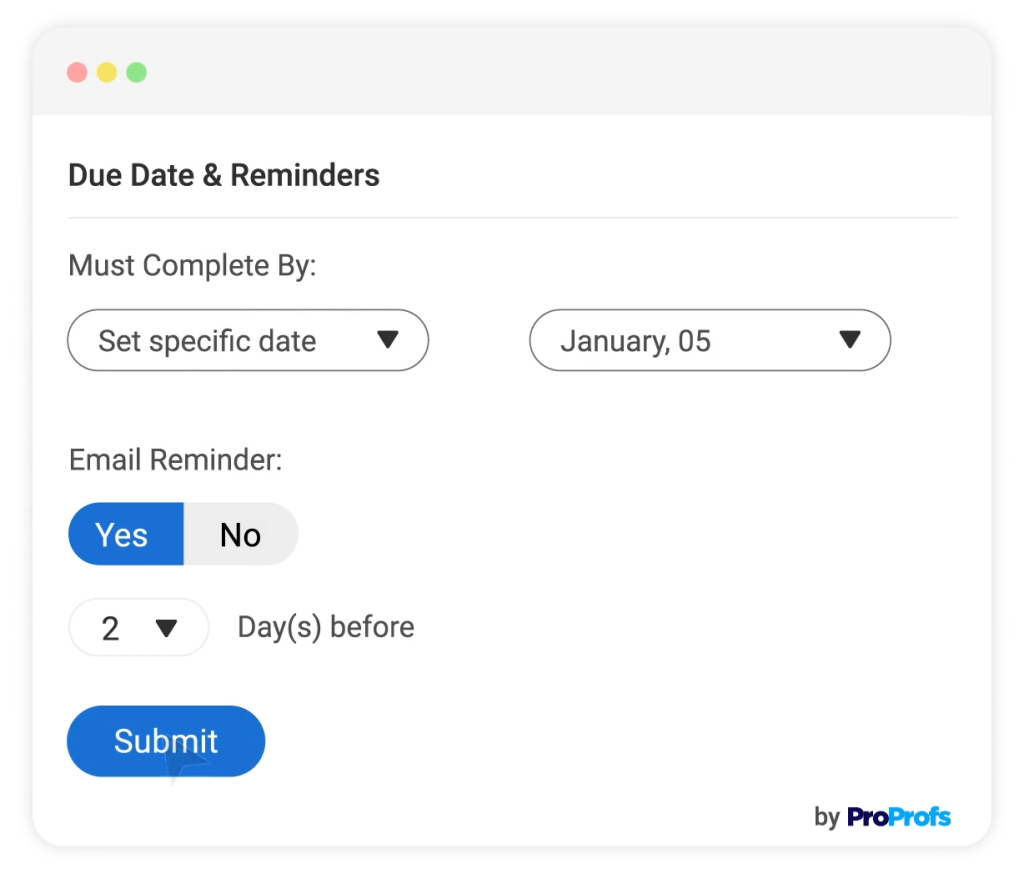
Each of those steps is a point where something falls through. Automation removes the failure points, not just the workload.
Start here: Map every manual step between “we need to assign this training” and “we know who completed it and how they scored.” Count them. Every step is a completion risk. Identify the two highest-friction points and check whether your current platform can automate them this week.
11. Use Quiz Analytics to Find Knowledge Gaps, Not Just Completion Gaps
Completion reports tell you who finished. They tell you almost nothing about whether anything was learned, where the team is consistently getting things wrong, or which employees are clicking through too fast to be engaging with the content.
Question-level analytics tell you all of this. And they tell you things you cannot get from any other source:
- When 60% of your team answers the same question incorrectly on the first attempt, you have found a content gap. The problem is in your training, not your employees
- When an employee completes a 15-question quiz in four minutes, you have found a disengagement pattern worth a direct conversation
- When someone retries a failed quiz voluntarily and improves their score by 20 points, you have found someone who is genuinely motivated to learn, worth recognizing publicly
- When a team’s average score on one specific category is 20 points lower than every other category, you have found your next curriculum redesign priority without needing a focus group or a survey
- When scores on the same topic improve significantly after a format change from policy recall to scenario-based questions, you have found direct evidence that the question design was the problem, not the audience
Start here: Pull the question-level report from your last major training assessment. Sort questions by correct-answer rate, lowest first. The three questions at the bottom of that list are your immediate redesign priority. Fix those before touching anything else in the curriculum.
Here’s a quick video I recorded to help you get started:
12. Turn Quiz Results Into Team Conversations
The most underused engagement mechanism in corporate training is the debrief. Employees complete quizzes individually, receive their scores individually, and move on.
The team never discusses what the quiz revealed, which questions were genuinely hard, or how the concepts map to work they are actually doing together.
A 10-minute structured team debrief after a quiz does more for retention and real-world application than almost any individual reinforcement activity. The research on the 70-20-10 learning model is clear: 20% of what adults retain comes from social interaction and peer learning. Corporate training almost entirely neglects that 20%.
What makes a debrief work:
- Do not review the correct answers. That is a lecture, not a conversation
- Open with the question that surprised people most. “Which question did you find most unexpected?” gets honest responses and reveals where assumptions and reality diverge
- Ask for real-world connections. “Has anyone actually faced a situation where this came up? What did you do?” connects the abstract assessment to the work people actually do
- Surface the questions the group got wrong most often. Not to shame anyone, but to open a discussion about why that concept is difficult and what the right mental model is
- Use shared quiz performance as a team development signal. If a whole team scores low on the same category, that is a team development conversation, not an individual performance conversation
This also creates a natural recognition opportunity. The employee who scored highest on a difficult assessment can be asked to share how they thought about the hardest question. That is peer teaching, which is the highest-retention activity on the ICAP engagement model, and it creates visible acknowledgment without a formal recognition program.
Team Engagement Activities That Reinforce Training
The debrief is just the beginning. The most effective staff engagement ideas around training turn quiz results into recurring team rituals, not one-off reviews. Three activities that work consistently:
Peer teaching rounds: The employee who scored highest on a difficult module walks the team through their reasoning on the two hardest questions. This takes eight minutes and produces higher retention than a manager-led recap.
Quiz leaderboards by category: Post team-level scores broken down by topic area (not individual names). When the whole team sees they scored 58% on data handling but 91% on product knowledge, the gap becomes a shared problem to solve, not an individual embarrassment.
Monthly challenge quizzes: A voluntary five-question quiz on a rotating topic, run as a timed team activity at the start of a standing meeting. Low stakes, high participation, and it keeps training visible between formal compliance cycles.
These team engagement activities cost nothing to run. They require only a quiz tool that tracks category-level scores and a manager willing to spend ten minutes of meeting time on them.
Start here: After your next required team training, block 10 minutes within 48 hours. Ask one question to open the debrief: “What was the hardest question on that quiz, and why did you find it hard?” Do this consistently for three training cycles. Quiz scores, voluntary retry rates, and team engagement activities with subsequent modules will all show the difference.
Stop guessing whether your training is working.
Download this free tracker and start measuring the five metrics that actually reveal whether your employees are engaging or just clicking through.
How Quiz-Based Learning Drives Deeper Employee Engagement
Most organizations think of quizzes as an evaluation at the end of training. The cognitive science says they are something far more powerful: an engagement engine that causes learning, not just measures it.
The Testing Effect: Quizzes Do Not Just Measure Retention. They Create It.
Research Finding
Roediger & Karpicke (2006), Journal of Psychological Science: Students who practiced active recall (retrieval testing) retained 80% of material after one week, compared to 34% for those who only re-read the material. A single act of retrieval more than doubled retention.
What this means in practice: every quiz you give employees during a training program is not just measuring whether they learned. It is actively strengthening the neural pathways that consolidate learning into long-term memory. The quiz is not the test at the end. It is the engagement mechanism throughout.
Spaced Repetition: Why Periodic Quizzing Beats Single-Session Training
The Ebbinghaus forgetting curve is not just a descriptive statistic. It is a design constraint. Without active reinforcement at spaced intervals, memory decay is predictable and steep. Distributing short quiz sessions across days and weeks rather than consolidating all training into a single event produces dramatically superior retention.
A compliance training program that delivers a 5-minute module on Monday, a 5-question quiz on Wednesday, a scenario review the following Monday, and a final assessment at 30 days will produce meaningfully higher retention than the same content in a 40-minute sit-down with a single end-of-module quiz.
The ICAP Model: Why Most Corporate Training Stays at the Wrong Level
| Engagement Level | What It Looks Like in Training | Cognitive Load | Retention |
|---|---|---|---|
| Passive | Watching a video, reading a PDF, listening to a lecture | Minimal | Very low |
| Active | Clicking through MCQ, highlighting text, basic note-taking | Low | Low |
| Constructive | Scenario-based quizzes, writing explanations, applying concepts | High | High |
| Interactive | Collaborative problem-solving, peer quiz competition, case study debate | Highest | Highest |
ICAP Model (Michelene Chi, 2009). Adapted for corporate training contexts.
Most corporate training operates at Passive and Active. The goal is to push toward Constructive and Interactive. Well-designed quizzes, scenario-based assessments, and collaborative learning activities are the mechanisms.
Where ProProfs Quiz Maker Fits the Engagement Picture
Once you understand that the real engagement gap is not in content quality but in cognitive architecture, the question becomes: what tool lets you build assessment-driven training at scale without a dedicated instructional design team?
ProProfs Quiz Maker is built specifically for this. The AI quiz generator creates full assessments from documents, videos, and webpages in seconds. An HR team can turn a compliance policy PDF into a randomized scenario-based quiz without manual authoring.
More than 1,000,000 ready-made questions, 20-plus question types, including scenario-based, drag-and-drop, and matrix formats, and per-question randomization mean each learner gets a different quiz experience, eliminating the answer-sharing problem that makes compliance quizzes meaningless.
For L&D teams asked to prove training ROI beyond a completion report, the question-level analytics are the real value: per-question accuracy rates, time-spent per question, error rate progression across attempts, and performance by category. These are the metrics that distinguish cognitive engagement from click-through.
Measuring Employee Engagement in Training Programs: Beyond the Completion Rate
Completion rate is a participation metric, not an engagement metric. An employee who clicks through a 40-minute module in 8 minutes has ‘completed’ it.
An employee who spends 42 minutes on the same module, retries two sections, and scores 94% on the assessment has engaged with it. The data to distinguish these two employees does not come from a completion report.
The Engagement-to-Competence Bridge
| Level | Metric | What It Tells You |
|---|---|---|
| 1. Participation | Completion rate, login frequency, time-on-platform | Whether employees are showing up, not whether they are learning |
| 2. Engagement Depth | Quiz attempt frequency, time-per-question, retry rate | Whether employees are processing content or clicking through |
| 3. Knowledge Retention | Assessment score progression, error rate trends, pre/post comparison | Whether learning is sticking over time |
| 4. Behavioral Transfer | Manager observation, performance reviews, and error rates on the job | Whether training is changing behavior in actual work |
| 5. Business Impact | Incident rates, compliance audit results, customer satisfaction, retention | Whether the training investment is producing organizational outcomes |
Cognitive Engagement Metrics Your Quiz Platform Should Provide
- Error rate progression: Is quiz accuracy improving across attempts? A learner who scores 60%, 72%, 88% across three attempts is actively learning. Instant 90% scores may indicate prior knowledge or answer-sharing.
- Think-time per question: Unusually fast quiz completion is a reliable indicator of disengagement. An engaged learner typically takes 45 to 90 seconds per non-trivial question. Under 10 seconds per question suggests the options are not being read.
- Question-level difficulty analysis: Which questions does your workforce consistently get wrong? These are your content gaps and the data that justifies curriculum redesign.
- Retry patterns: Employees who voluntarily retry failed assessments are a strong engagement signal. Employees who never retry represent either disengagement or a barrier-to-access problem worth investigating.
- Category performance breakdown: For compliance training covering multiple policy areas, category-level performance shows which domains are understood and which need redesign.
For each team or department, your training engagement report should show: (1) Completion rate by module, (2) Average quiz score by module, (3) Score distribution showing pass vs. fail vs. retry, (4) Average time-per-quiz vs. expected time, (5) Question categories with the highest error rates, (6) Flagged individuals with unusually fast completions or below-threshold scores after multiple attempts.
Improve Employee Engagement by Measuring What They Learn
The organizations winning the employee engagement battle are not the ones with the most elaborate recognition programs or the best office perks. They are the ones who have realized engagement is a downstream outcome of daily experience, and that the quality of an employee’s daily learning experience is one of the most powerful inputs into that outcome.
The shift is structural. As long as training is designed to be completed rather than learned, as long as the only metric is a completion rate, and as long as quizzes are low-effort checkbox validators rather than genuine cognitive challenges, training will remain an engagement drain rather than an engagement engine.
Tools like ProProfs Quiz Maker make the shift practical without a large L&D team or a lengthy implementation. AI-generated assessments, randomized question banks, scenario-based quizzes, and question-level analytics replace the completion report with something far more useful: evidence that your employees actually learned something.
That is what engagement looks like in training. Start there.
Frequently Asked Questions

What is the difference between employee engagement and employee experience?
Employee experience covers everything a person encounters at work: the office environment, tools, processes, and culture. Engagement is the emotional and psychological result of that experience. You can design a great experience and still have low engagement if the work itself feels meaningless. Experience is the input. Engagement is the output.
How do you keep remote employees engaged during training?
Remote employees disengage fastest when training is passive and solo. Short quizzes, team debriefs over video, and peer discussion prompts after modules create the social accountability that an office setting provides naturally. Asynchronous formats with built-in interaction points work better than live webinars where cameras go off and attention drifts.
How often should employees complete training?
There is no universal cadence, but quarterly touchpoints on high-stakes topics outperform annual marathons on every retention measure. For compliance, short recurring assessments throughout the year are more effective than a single annual module. For skills development, learning tied to specific role transitions or project needs tends to land better than calendar-based schedules.
What is quiet quitting, and how does it relate to engagement?
Quiet quitting describes employees who meet their job requirements and nothing more, stopping short of any discretionary effort. It is disengagement made visible. The employees who stop contributing to team conversations, skip optional learning, and do the minimum on assessments are exhibiting quiet quitting. Training design that demands active thinking can surface and reverse this pattern early.
How do I engage employees who have been in a role for many years?
Tenured employees disengage when training treats them like beginners. Pre-assessments that skip content they already know, advanced scenario-based questions that match their actual experience level, and opportunities to contribute their expertise as peer resources all signal respect for what they have built. Challenge engages experienced people. Review does not.
Is it possible to improve engagement without increasing the L&D budget?
Yes. Redesigning existing quizzes from recall-based to scenario-based costs nothing. Building a question bank and enabling randomization is a configuration change, not a new purchase. Scheduling a 10-minute team debrief after training requires a calendar invite. The highest-impact engagement changes in training are design decisions, not budget decisions.
How do I get leadership buy-in for employee engagement initiatives?
Connect engagement directly to a business outcome leadership already cares about: turnover cost, compliance risk, or productivity. Showing that a specific training redesign moved quiz scores, retry rates, or knowledge retention metrics gives leadership something concrete to fund. Engagement as a concept is hard to prioritize. Engagement as a measurable operational improvement is not.
What is the right quiz pass score for corporate training?
A first-attempt pass rate above 95% usually means the quiz is too easy and not testing real understanding. Below 60% suggests the content is poorly designed, not that the audience is unprepared. The 70 to 85% range on the first attempt, with room to retry and improve, signals a well-calibrated assessment that is genuinely challenging.
Should employee training be mandatory or voluntary?
Mandatory training works for compliance and safety where legal or regulatory requirements exist. Voluntary learning, where employees choose what to engage with, drives deeper engagement because the motivation is intrinsic. The best L&D programs make compliance mandatory and everything else compelling enough that employees choose it. Forced engagement on development content rarely produces genuine learning.
How do I handle employees who repeatedly fail training assessments?
Repeated failure usually signals one of three things: the content is not relevant to their role, the question design is testing recall rather than understanding, or there is a genuine skill gap that needs direct support. Before escalating to a performance conversation, audit the assessment itself. If others are passing easily, the problem may be the training, not the employee.
What is the best way to introduce a new training program without resistance?
Resistance drops when employees understand why the training exists before they are asked to do it. A one-paragraph context note explaining the real-world problem the training addresses, sent before the assignment lands, changes the framing from "another mandatory module" to "here is why this matters for your work." That framing shift costs nothing and changes everything.
Let ProProfs AI Build a Quiz

 We'd love your feedback!
What did you like & how can we make it even better?
 Thanks for your feedback!
 Ask Your Question
Have a question? Get expert help to make your decision easier.