Stellar Brightness: Apparent vs Absolute Magnitude Quiz

  • 10th Grade
Reviewed by Editorial Team
The ProProfs editorial team is comprised of experienced subject matter experts. They've collectively created over 10,000 quizzes and lessons, serving over 100 million users. Our team includes in-house content moderators and subject matter experts, as well as a global network of rigorously trained contributors. All adhere to our comprehensive editorial guidelines, ensuring the delivery of high-quality content.
Learn about Our Editorial Process
| By Thames
T
Thames
Community Contributor
Quizzes Created: 10017 | Total Attempts: 9,652,179
| Questions: 20 | Updated: Feb 27, 2026
Please wait...
Question 1 / 21
🏆 Rank #--
0 %
0/100
Score 0/100

1. Why does the Sun have the brightest apparent magnitude of any star in our sky?

Explanation

If the brightness and distance relationship follows the inverse square law, then being closer significantly increases perceived light; if the Sun is millions of times closer than the next star, then it will appear the brightest regardless of its actual size.

Submit
Please wait...
About This Quiz
Stellar Brightness: Apparent Vs Absolute Magnitude Quiz - Quiz

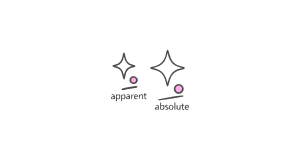
Is that star truly brilliant, or just very close to us? Astronomers distinguish between Apparent Magnitude (how bright a star looks to us) and Absolute Magnitude (how bright it would be if placed at a standard distance). This apparent vs absolute magnitude quiz challenges you to calculate the true powe... see moreof cosmic objects by accounting for the vast distances of space, helping you understand the real "heavy hitters" of the Milky Way.
see less

2.

What first name or nickname would you like us to use?

You may optionally provide this to label your report, leaderboard, or certificate.

2. Which factors directly influence the apparent stellar magnitude of a star as seen from Earth?

Explanation

If the amount of light hitting our telescopes depends on the source's power, the distance it travels, and obstacles in the way, then luminosity, distance, and dust are the defining factors for how bright a star looks.

Submit

3. If the difference between two stars in the star brightness scale is exactly 5 magnitudes, how much brighter is one than the other?

Explanation

If the magnitude scale is logarithmic and defined such that 5 steps equal a factor of 100 in light intensity, then a star of magnitude 1 is exactly 100 times brighter than a star of magnitude 6.

Submit

4. The brightness and distance relationship is governed by the ________ square law.

Explanation

If light spreads out in a sphere as it travels, then the intensity decreases according to the square of the distance; if this is the physical rule, then it is known as the inverse square law.

Submit

5. A star's absolute magnitude changes if the star moves further away from Earth.

Explanation

If absolute magnitude is an intrinsic property calculated at a fixed theoretical distance of 10 parsecs, then changing the star's actual real-world distance from Earth has no effect on that calculated value.

Submit

6. Star A has an apparent magnitude (m) of 5.0 and an absolute magnitude (M) of 5.0. How far away is this star?

Explanation

If absolute magnitude is defined as the apparent magnitude at a distance of 10 parsecs, and if the observed (m) matches the absolute (M), then the star must currently be located at exactly 10 parsecs.

Submit

7. When comparing apparent vs absolute magnitude, which of the following objects would have a negative apparent magnitude?

Explanation

If very bright objects are assigned numbers below zero on the magnitude scale, and if the Sun, Moon, and Sirius are the brightest light sources in our sky, then they all possess negative apparent magnitudes.

Submit

8. In the magnitude system astronomy uses, the lowercase letter 'm' represents ________ magnitude.

Explanation

If astronomical shorthand uses uppercase 'M' for the absolute or "Main" intrinsic brightness, then the lowercase 'm' is reserved for the apparent brightness observed from Earth.

Submit

9. What is the "Distance Modulus" in stellar magnitude calculations?

Explanation

If astronomers want to calculate distance, they compare how bright a star looks (m) to how bright it actually is (M); if the difference (m - M) provides a mathematical value related to distance, then that value is the distance modulus.

Submit

10. If a star is closer to Earth than 10 parsecs, its apparent magnitude (m) will be a smaller number than its absolute magnitude (M).

Explanation

If a star is moved closer than the standard 10-parsec line, it will appear brighter than it "truly" is; if the scale uses smaller numbers for brighter objects, then 'm' will be smaller than 'M'.

Submit

11. Which Greek astronomer is credited with creating the original star brightness scale by ranking stars from 1 to 6?

Explanation

If historical records attribute the first systematic ranking of stars based on visible brightness to a 2nd-century BC observer, then that individual is Hipparchus.

Submit

12. Why do we need the concept of absolute magnitude in magnitude system astronomy?

Explanation

If stars are at different distances, they are hard to compare; if we standardize them to 10 parsecs, we can see which are truly high-energy and use that info to calculate their distance from us.

Submit

13. A distance of 10 parsecs is approximately equivalent to ________ light-years.

Explanation

If one parsec is equal to roughly 3.26 light-years, then multiplying that unit by the standard distance of 10 results in 32.6 light-years.

Submit

14. If Star X has an absolute magnitude of -5 and Star Y has an absolute magnitude of +5, which star is intrinsically more powerful?

Explanation

If the magnitude scale dictates that lower numbers represent more light, and if -5 is a lower value than +5, then Star X is emitting significantly more energy than Star Y.

Submit

15. The apparent brightness of a star is inversely proportional to the square of its distance.

Explanation

If light spreads out over the surface area of a sphere (4 * pi * d^2), and if the intensity is the power divided by that area, then the brightness must be proportional to 1/d^2.

Submit

16. In apparent vs absolute magnitude studies, if a star is exactly 100 parsecs away, how will its apparent magnitude compare to its absolute magnitude?

Explanation

If 100 parsecs is much further than the standard 10 parsecs, then the star will look dimmer than its standardized value; if the scale uses larger numbers for dimmer objects, then 'm' must be larger than 'M'.

Submit

17. Which of the following statements are true about stellar magnitude?

Explanation

If the scale is logarithmic where 5 steps = 100x, then 1 step is 100^(1/5) which is approx 2.5; if it is a continuous scale, it allows for decimals and values above, at, or below zero.

Submit

18. Which of the following best describes the difference between apparent vs absolute magnitude?

Explanation

If apparent magnitude describes the observation of light from a specific location (Earth), and if absolute magnitude standardizes that observation to a specific distance, then apparent is the "look" while absolute is the "actual" intrinsic brightness.

Submit

19. The standard distance used to calculate the absolute stellar magnitude of any star is ________ parsecs.

Explanation

If astronomers need a fair way to compare the true luminosity of stars, then they must imagine them all at the same distance; if that distance is the industry standard, then the value is 10 parsecs.

Submit

20. In the magnitude system astronomy uses, a star with a magnitude of -2.0 is dimmer than a star with a magnitude of +3.0.

Explanation

If the magnitude scale is an inverted logarithmic scale, then smaller or more negative numbers represent brighter objects; if -2.0 is smaller than +3.0, then the -2.0 star must be the brighter one.

Submit
×
Saved
Thank you for your feedback!
View My Results
Cancel
  • All
    All (20)
  • Unanswered
    Unanswered ()
  • Answered
    Answered ()
Why does the Sun have the brightest apparent magnitude of any star in...
Which factors directly influence the apparent stellar magnitude of a...
If the difference between two stars in the star brightness scale is...
The brightness and distance relationship is governed by the ________...
A star's absolute magnitude changes if the star moves further away...
Star A has an apparent magnitude (m) of 5.0 and an absolute magnitude...
When comparing apparent vs absolute magnitude, which of the following...
In the magnitude system astronomy uses, the lowercase letter 'm'...
What is the "Distance Modulus" in stellar magnitude calculations?
If a star is closer to Earth than 10 parsecs, its apparent magnitude...
Which Greek astronomer is credited with creating the original star...
Why do we need the concept of absolute magnitude in magnitude system...
A distance of 10 parsecs is approximately equivalent to ________...
If Star X has an absolute magnitude of -5 and Star Y has an absolute...
The apparent brightness of a star is inversely proportional to the...
In apparent vs absolute magnitude studies, if a star is exactly 100...
Which of the following statements are true about stellar magnitude?
Which of the following best describes the difference between apparent...
The standard distance used to calculate the absolute stellar magnitude...
In the magnitude system astronomy uses, a star with a magnitude of...
play-Mute sad happy unanswered_answer up-hover down-hover success oval cancel Check box square blue
Alert!