Neurological Foundations of Sensory Integration

Reviewed by Editorial Team
The ProProfs editorial team is comprised of experienced subject matter experts. They've collectively created over 10,000 quizzes and lessons, serving over 100 million users. Our team includes in-house content moderators and subject matter experts, as well as a global network of rigorously trained contributors. All adhere to our comprehensive editorial guidelines, ensuring the delivery of high-quality content.
Learn about Our Editorial Process
| By Thames
T
Thames
Community Contributor
Quizzes Created: 10863 | Total Attempts: 9,689,207
| Questions: 28 | Updated: Aug 4, 2025
Please wait...
Question 1 / 29
🏆 Rank #--
0 %
0/100
Score 0/100

1. What is the role of receptors?

Explanation

Receptors don't simply convert energy but filter and transduce it to facilitate certain processes.

Submit
Please wait...
About This Quiz
Neurological Foundations Of Sensory Integration - Quiz

Explore the complexities of sensory organization and its neurological implications. This assessment focuses on understanding sensory integration and neurological responses, providing insights essential for professionals in neurology and neuroscience.

2.

What first name or nickname would you like us to use?

You may optionally provide this to label your report, leaderboard, or certificate.

2. What is the difference between exteroceptive and interoceptive sensitivity?

Explanation

Exteroceptive sensitivity pertains to sensing external stimuli, while interoceptive sensitivity pertains to sensing internal stimuli such as pain and hunger.

Submit

3. Describe the cell layers in the retina.

Explanation

The correct description of cell layers in the retina involves photoreceptive cells (rods and cones), followed by bipolar cells, and then ganglion cell layer. Amacrine and horizontal cells play supporting roles in the process.

Submit

4. Describe the visual paths from the retina to the primary visual cortex.

Explanation

The correct answer outlines the process by which the visual information is processed from the retina to the primary visual cortex, highlighting the division of the visual field between the eyes, the concept of contralateral and ipsilateral processing, and the involvement of the hemispheres.

Submit

5. What is another name for V1 in the human brain?

Explanation

V1, also known as the primary visual cortex, is located in the occipital lobe of the brain and is responsible for processing visual information. It is often referred to as the striate cortex due to the prominent line of Gennari observed in this region.

Submit

6. What area of the brain is associated with V2-V5?

Explanation

V2-V5 corresponds to the secondary association/prestriate cortex, which is responsible for processing complex visual information. The primary visual cortex is V1, located at the back of the brain. The cerebellum is primarily involved in coordinating movement and balance, not visual processing. The frontal lobe is responsible for higher cognitive functions such as reasoning and planning, not visual processing.

Submit

7. What does V2 stand for?

Explanation

V2 in this context refers to visual assembling and mapping, specifically referring to possible colour and form.

Submit

8. What are the 2 visual pathways?

Explanation

The visual pathways refer to the routes through which visual information is processed in the brain. The correct answers include the geniculate-striate pathway and the tectal-pulbinar pathways. Optic radiations, intracellular pathways, and olfactory bulb pathways are not part of the visual pathways and are incorrect choices.

Submit

9. Damage to the geniculate-striate pathway causes?

Explanation

Damage to the geniculate-striate pathway specifically affects visual processing and recognition, leading to visual agnosia.

Submit

10. Damage to the tectal pulvinar pathways causes?

Explanation

Damage to the tectal pulvinar pathways disrupts the coordination between movement and vision, leading to visual ataxia where individuals have difficulty knowing where they are going due to a lack of harmony between what they see and how they move.

Submit

11. What does V3 refer to?

Explanation

V3 refers to the concept of a dynamic form that involves moving shapes, possibly with color elements. It is a design or interactive element that adds a level of interactivity and visual interest to a project.

Submit

12. What two elements work together to create the visual appeal of a piece of art?

Explanation

In art, colour and form are essential components that artists use to create visual interest and convey meaning in their work.

Submit

13. What does V5 represent?

Explanation

V5 typically refers to the direction of motion, such as in physics or engineering contexts.

Submit

14. What is the term for dynamic forms of line orientation with color?

Explanation

The correct answer refers to the combination of dynamic forms of line orientation along with color, resulting in a cohesive visual element.

Submit

15. Identify the parts of the human ear responsible for hearing: pinna, tympanic membrane, ossicles (hammer, anvil, stirrup), cochlea, auditory nerve (cranial nerve).

Explanation

The correct answer includes the external ear structures (pinna and tympanic membrane), middle ear bones (ossicles - hammer, anvil, stirrup), inner ear structure responsible for hearing (cochlea), and the nerve connecting the ear to the brain for hearing (auditory nerve - cranial nerve). The incorrect answers mix up different parts of the ear or nerves not related to hearing.

Submit

16. What is place theory?

Explanation

Place theory posits that different areas of the basilar membrane are sensitive to different frequencies, enabling us to perceive the location and pitch of sound sources.

Submit

17. Describe the auditory pathway.

Explanation

The correct auditory pathway involves sound reaching the ear, being transmitted through the auditory nerve, and some fibers decussating while others remain ipsilateral. This pathway does not involve the eye, nose, or mouth, and the structures mentioned in the incorrect answers are related to different sensory pathways.

Submit

18. What is decussation?

Explanation

Decussation refers specifically to the crossing of pathways or nerves from one side of the body to the other.

Submit

19. Where does the inferior colliculli projects to?

Explanation

The correct answer indicates that the inferior colliculli projects bilaterally, as the information has already dessucated. This means that the projections occur to both sides of the brain. The incorrect answers focus on unilateral projections, projections to unrelated areas such as the visual cortex or cerebellum, which do not align with the actual function of the inferior colliculli.

Submit

20. What is a tonotopic map?

Explanation

A tonotopic map is a spatial arrangement of where different frequencies of sound are processed in the brain. This organization allows for the perception and differentiation of various pitches and frequencies in auditory stimuli.

Submit

21. What are the main long tracts of the Nervous system?

Explanation

The main long tracts of the Nervous system refer to the pathways that carry information between the brain and the spinal cord. The correct answer options provided are the Lateral Cortical Spinal Tract, Posterior Columns (sensory), and Anterolateral Pathways (sensory). The incorrect options include the Ventral Cortical Spinal Tract, Superior Peduncle (motor), and Spinothalamic Tract which do not represent the primary long tracts of the Nervous system.

Submit

22. What pathway is involved in transmitting pain signals from a burned finger?

Explanation

The anterolateral pathways, particularly the spinothalamic tract, are responsible for transmitting pain signals. These pathways differ from other sensory pathways that carry different types of sensations such as touch, motor control, and coordination.

Submit

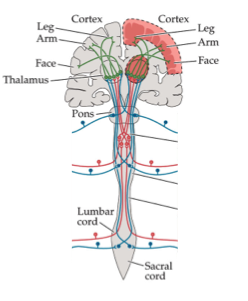
23. What parts of the body would be affected if the red region is damaged?

Explanation

Damage to the red region will result in sensory loss on the opposite side of the body due to decussation. This means that the effects will be contralateral to the lesion, unlike direct connections that would cause effects on the same side. The entire body may be affected, not just specific regions (e.g., only lower limbs), as the sensory modalities from that region are processed in the primary somatosensory cortex and relayed through the thalamus.

Submit

24. If damage occurs in the lateral pons and lateral medulla, which part of the body is affected?

Submit

25. What structures are involved in the perisylvian language arc?

Explanation

The perisylvian language arc involves structures primarily in the auditory processing and language production regions of the brain, not in the occipital lobe, temporal lobe, or cerebellum.

Submit

26. What area is responsible for comprehension of speech?

Explanation

Wernicke's area, located in the temporal lobe, is primarily responsible for comprehension of speech. Broca's area, located in the frontal lobe, is involved in speech production. The primary visual cortex is responsible for processing visual information. The cerebellum plays a role in coordination and motor control.

Submit

27. Describe the pathway responsible for producing speech.

Explanation

The correct pathway for producing speech involves the coordinated activation of specific brain regions, starting from Wernicke's area and ending at the facial muscles. Broca's area is responsible for motor programs related to speech, while the primary motor cortex and cerebellum are not directly involved in the speech production pathway.

Submit

28. What is the pathway responsible for reading?

Explanation

The correct pathway for reading involves the visual areas, angular gyrus, and Wernicke's area, as explained in the correct answer. The incorrect answers provided do not accurately represent the neural pathway involved in reading.

Submit
×
Saved
Thank you for your feedback!
View My Results
Cancel
  • All
    All (28)
  • Unanswered
    Unanswered ()
  • Answered
    Answered ()
What is the role of receptors?
What is the difference between exteroceptive and interoceptive...
Describe the cell layers in the retina.
Describe the visual paths from the retina to the primary visual...
What is another name for V1 in the human brain?
What area of the brain is associated with V2-V5?
What does V2 stand for?
What are the 2 visual pathways?
Damage to the geniculate-striate pathway causes?
Damage to the tectal pulvinar pathways causes?
What does V3 refer to?
What two elements work together to create the visual appeal of a piece...
What does V5 represent?
What is the term for dynamic forms of line orientation with color?
Identify the parts of the human ear responsible for hearing: pinna,...
What is place theory?
Describe the auditory pathway.
What is decussation?
Where does the inferior colliculli projects to?
What is a tonotopic map?
What are the main long tracts of the Nervous system?
What pathway is involved in transmitting pain signals from a burned...
What parts of the body would be affected if the red region is damaged?
If damage occurs in the lateral pons and lateral medulla, which part...
What structures are involved in the perisylvian language arc?
What area is responsible for comprehension of speech?
Describe the pathway responsible for producing speech.
What is the pathway responsible for reading?
play-Mute sad happy unanswered_answer up-hover down-hover success oval cancel Check box square blue
Alert!