
2D Geometry Concepts & Shapes Quiz

  • 3rd Grade,
  • 4th Grade
  • CCSS.Math.Content.3.G.A.1
Reviewed by Editorial Team
The ProProfs editorial team is comprised of experienced subject matter experts. They've collectively created over 10,000 quizzes and lessons, serving over 100 million users. Our team includes in-house content moderators and subject matter experts, as well as a global network of rigorously trained contributors. All adhere to our comprehensive editorial guidelines, ensuring the delivery of high-quality content.
Learn about Our Editorial Process
| By Thames
T
Thames
Community Contributor
Quizzes Created: 8156 | Total Attempts: 9,588,805
| Attempts: 13 | Questions: 12 | Updated: Jan 8, 2026
Please wait...
Question 1 / 12
🏆 Rank #--
Score 0/100

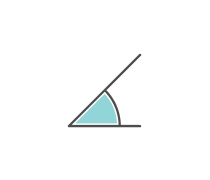
1) What is an acute angle?

Explanation

An acute angle is defined by its measurement being less than 90 degrees. This classification is important because it distinguishes acute angles from right and obtuse angles, which have larger measures. Accurate angle measurement allows students to correctly classify shapes and solve problems involving triangle types and angle relationships. Acute angles frequently appear in geometry problems, especially when analyzing polygons and determining their internal angle properties.

Submit
Please wait...
About This Quiz
Angles Quizzes & Trivia

Navigate flat shapes with this 2D geometry concepts quiz exploring core ideas. This geometry basics test covers points, lines, angles, triangles, quadrilaterals, circles, and area/perimeter through polygons MCQs.

Perfect for students seeking angles and shapes practice or coordinate plane review, it includes transformations and congruence with clear explanations. Enhance math geometry... see morequiz understanding of proofs and properties. see less

2) What is an angle?

Explanation

A vertex is the exact point where two rays or lines meet to form an angle. This point is critical because it determines where the angle begins and ends. In polygons, vertices connect sides and define the overall structure of the shape. Understanding vertices helps learners count angles correctly and analyze how shapes are formed geometrically.

Submit

3) What does an attribute describe in geometry?

Explanation

Attributes describe measurable or observable properties of shapes, such as sides, angles, and symmetry. These properties allow students to distinguish between different geometric figures. Without attributes, classification would rely on guesswork rather than mathematical reasoning. Attributes are also essential when comparing shapes and applying geometry rules accurately.

Submit

4) What is a circle?

Explanation

A circle has no straight sides or angles, which separates it from polygons. Every point on a circle’s boundary is equidistant from the center, forming a constant radius. This unique property allows calculations of circumference and area. Recognizing this distinction prevents incorrect classification and supports accurate geometric reasoning.

Submit

5) What are congruent figures?

Explanation

Congruent figures must match exactly in both size and shape. This means corresponding sides and angles are equal. Congruence allows one figure to perfectly overlap another without resizing. This concept is essential in geometry proofs and comparisons, ensuring precision when determining equality between figures.

Submit

6) What is an equilateral triangle?

Explanation

An equilateral triangle has all three sides equal, which forces all interior angles to also be equal. Since triangle angles always sum to 180 degrees, each angle measures 60 degrees. This predictable structure helps students identify triangle types and solve angle-based geometry problems efficiently.

Submit

7) What is a hexagon?

Explanation

A hexagon is defined by having exactly six sides. Polygon names are derived from Greek prefixes, making side counting a reliable classification method. Recognizing hexagons helps students connect mathematical concepts to real-world examples like honeycombs and tiled patterns.

Submit

8) What is a right angle?

Explanation

A right angle measures exactly 90 degrees and represents perpendicular lines. This angle is fundamental in constructing squares, rectangles, and grids. Identifying right angles correctly helps in drawing accurate shapes and solving problems involving alignment and spatial reasoning.

Submit

9) How many sides does a pentagon have?

Explanation

A pentagon has five sides, and the prefix “penta” helps identify this count. Side counting is the most dependable way to classify polygons. Understanding polygon naming conventions supports accurate communication and application of geometric rules.

Submit

10) Which shape has four equal sides and four right angles?

Explanation

A square is unique because it has both equal sides and four right angles. This makes it both equilateral and equiangular. Differentiating squares from other quadrilaterals is important when calculating area, perimeter, and symmetry properties.

Submit

11) What is an obtuse angle?

Explanation

An obtuse angle measures more than 90 degrees but less than 180 degrees. It is larger than a right angle but does not form a straight line. Identifying obtuse angles helps classify triangles and understand angle relationships accurately.

Submit

12) What is a vertex?

Explanation

Vertices connect sides in polygons and define where angles are formed. The number of vertices usually equals the number of sides. Understanding this relationship helps students analyze polygon structure and identify angles correctly.

Submit
×
Saved
Thank you for your feedback!
View My Results
Cancel
  • All
    All (12)
  • Unanswered
    Unanswered ()
  • Answered
    Answered ()
What is an acute angle?
What is an angle?
What does an attribute describe in geometry?
What is a circle?
What are congruent figures?
What is an equilateral triangle?
What is a hexagon?
What is a right angle?
How many sides does a pentagon have?
Which shape has four equal sides and four right angles?
What is an obtuse angle?
What is a vertex?
play-Mute sad happy unanswered_answer up-hover down-hover success oval cancel Check box square blue
Alert!



