Psych 251: Understanding Human Motor Systems and Control

Reviewed by Editorial Team
The ProProfs editorial team is comprised of experienced subject matter experts. They've collectively created over 10,000 quizzes and lessons, serving over 100 million users. Our team includes in-house content moderators and subject matter experts, as well as a global network of rigorously trained contributors. All adhere to our comprehensive editorial guidelines, ensuring the delivery of high-quality content.
Learn about Our Editorial Process
| By Thames
T
Thames
Community Contributor
Quizzes Created: 8156 | Total Attempts: 9,588,805
| Questions: 29 | Updated: Aug 4, 2025
Please wait...
Question 1 / 30
🏆 Rank #--
Score 0/100

1. What types of action occur in the Somatic system?

Explanation

The question is specifically asking about actions in the Somatic system, which involves voluntary control of skeletal muscles to move limbs.

Submit
Please wait...
About This Quiz
Psych 251: Understanding Human Motor Systems and Control - Quiz

Explore the intricacies of human action in Psych 251, focusing on psychological principles behind actions. This educational tool assesses understanding of action theories, enhancing skills in psychological analysis and application relevant to both academic and professional growth.

2.

What first name or nickname would you like us to use?

You may optionally provide this to label your report, leaderboard, or certificate.

2. What types of actions occur in the Autonomic system?

Explanation

The Autonomic system primarily deals with involuntary actions such as regulating blood pressure, digestion, heartbeat, hormonal secretion, and glandular activities. It is not responsible for voluntary muscle movements, sensory perception, or conscious control of breathing.

Submit

3. What kinds of action might happen within the CNS?

Explanation

Actions within the Central Nervous System (CNS) involve internal processes such as memory update and task switching, which do not occur in the external environment. Processing sensory information, controlling voluntary movements, and regulating heart rate are functions typically associated with other parts of the nervous system.

Submit

4. Supplementary motor cortex is _____ to primary motor cortex and ____ to premotor cortex?

Explanation

The supplementary motor cortex is located rostrally to the primary motor cortex and dorsally to the premotor cortex. The incorrect answers provide alternative directions that do not accurately describe the relative positions of the supplementary motor cortex in comparison to the primary motor cortex and premotor cortex.

Submit

5. How is motor control described as hierarchical?

Explanation

Motor control being hierarchical means that it is organized in a step-by-step manner, with each level of control building upon the previous one.

Submit

6. Provide evidence for the fact that motor plans can be abstract.

Explanation

The correct answer provides evidence that motor plans can be abstract by showcasing the ability to draw with different body parts controlled by different muscles, emphasizing motor equivalence and a hierarchical control system.

Submit

7. What are inverse models?

Explanation

Inverse models are used to determine how to move from a current position to a desired position, by generating motor commands. They are essential for planning and executing movements to reach specific goal states.

Submit

8. What is the purpose of forward models in motor control?

Explanation

Forward models play a crucial role in motor control by helping to evaluate motor plans and actions, compare desired outcomes with actual outcomes during movement, and quickly detect errors in motor execution.

Submit

9. What is an efference copy?

Explanation

An efference copy is a neural copy of a motor command sent to another part of the brain for prediction purposes.

Submit

10. What is feed forward control?

Explanation

Feed forward control involves sending a command to a limb without waiting for feedback in the hopes that it will be executed correctly. This approach is faster but less accurate compared to feedback control. It is often utilized for rapid movements such as eye movements (saccades).

Submit

11. What is feed back control?

Explanation

Feedback control involves sending motor commands to muscles, comparing the actual state to the desired state, and making adjustments based on errors. This process is slower but more accurate compared to direct control or immediate adjustments without evaluation.

Submit

12. Would the feedforward controller use a forward model or an inverse model?

Explanation

In feedforward control systems, an inverse model is commonly used to generate control inputs based on a desired state. This is because the system works backward from the desired state to determine the necessary actions. The use of an inverse model allows for more precise control in feedforward systems.

Submit

13. In what part of control are forward models used?

Explanation

Forward models are used in the feedback state during feedback control to predict the state of a system based on input and to adjust control actions accordingly.

Submit

14. What is the main function of the premotor cortex?

Explanation

The premotor cortex is specifically responsible for selecting goals and planning actions at a conceptual level, particularly in response to external stimuli.

Submit

15. Planning of voluntary actions begins at a conceptual level based on ______?

Explanation

The correct answer is 'goals' because setting specific objectives or desired outcomes helps guide the planning process.

Submit

16. What is readiness potential?

Explanation

Readiness potential refers to the brain activity leading up to a voluntary action, occurring before the conscious decision to move is made. It is not the immediate action taken once the decision is conscious, a measure of muscle tension, or a measure of the time taken to respond to a stimulus.

Submit

17. What is the main function of the Supplementary Motor Cortex (SMA)?

Explanation

The Supplementary Motor Cortex (SMA) is primarily involved in selecting goals and planning actions at a conceptual level, especially when those plans involve sequences of actions. It is more related to complex motor tasks rather than basic functions like walking, emotional regulation, or visual processing.

Submit

18. What does the motor cortex represent?

Explanation

The motor cortex is responsible for coordinating and executing voluntary movements of body parts. It does not control specific muscle actions, sensory perception, or cognitive functions.

Submit

19. Can the premotor cortex plan for two actions at the same time?

Explanation

The premotor cortex has the ability to plan for multiple actions simultaneously, as demonstrated by studies like the monkey example provided in the correct answer.

Submit

20. What are mirror neurons and provide an example?

Explanation

Mirror neurons are a specific type of neuron found in the premotor cortex that play a role in understanding and imitating the actions of others. These neurons fire both when a person performs an action and when they observe someone else performing the same action, hence the term 'mirror' neurons.

Submit

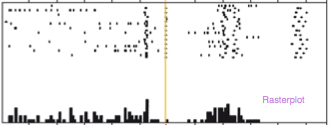
21. Explain the significance of the Peristimulus time histogram in this graph.

Explanation

The correct answer explains the role of Peristimulus time histogram in representing motor sequences and highlights the specific firing pattern of a SMA neuron in anticipation of movements.

Submit

22. What is the effect of muscimol injection into the SMA?

Explanation

Muscimol is a GABA agonist that inhibits the SMA, affecting the ability to perform sequences of actions. The incorrect answers describe effects opposite to the actual impact of muscimol injection into the SMA.

Submit

23. Describe the directional selectivity of the motor cortex.

Explanation

Correct answer explains that certain neurons in the motor cortex have directional selectivity, firing more intensely when movements are made in specific directions. This selectivity is not influenced by factors like randomness, speed of movement, or consistent activity regardless of direction.

Submit

24. What term describes the relationship between response rate and direction of movement in motor directional selectivity?

Explanation

A tuning curve summarizes the relationship between response rate and direction of movement in motor directional selectivity.

Submit

25. What is a population vector?

Explanation

A population vector refers to a method used in neuroscience to accurately represent actual movement direction by treating the firing of each neuron as a vector and adding up vectors for all neurons.

Submit

26. What do population vectors represent?

Explanation

Population vectors are representations of motor plans, which are neural signals responsible for coordinating movement.

Submit

27. How are population vectors formed from tuning curves?

Explanation

Population vectors are formed by combining the responses of multiple neurons with different tuning curves, not by simply averaging the firing rates or considering only a single neuron's tuning curve.

Submit

28. Areas in IP play important roles in ___?

Explanation

Areas in IP (Inferior Parietal) play important roles in guiding movements, correcting location, orientation, and configuration by integrating sensory information and coordinating motor actions.

Submit

29. Function of Lateral Intraparietal Sulcus (LIP)

Explanation

The Lateral Intraparietal Sulcus (LIP) specifically deals with representing space for eye movements, retina-centered receptive fields, and the location relative to where the eyes are looking. The incorrect answers provided do not align with the known function of LIP.

Submit
×
Saved
Thank you for your feedback!
View My Results
Cancel
  • All
    All (29)
  • Unanswered
    Unanswered ()
  • Answered
    Answered ()
What types of action occur in the Somatic system?
What types of actions occur in the Autonomic system?
What kinds of action might happen within the CNS?
Supplementary motor cortex is _____ to primary motor cortex and ____...
How is motor control described as hierarchical?
Provide evidence for the fact that motor plans can be abstract.
What are inverse models?
What is the purpose of forward models in motor control?
What is an efference copy?
What is feed forward control?
What is feed back control?
Would the feedforward controller use a forward model or an inverse...
In what part of control are forward models used?
What is the main function of the premotor cortex?
Planning of voluntary actions begins at a conceptual level based on...
What is readiness potential?
What is the main function of the Supplementary Motor Cortex (SMA)?
What does the motor cortex represent?
Can the premotor cortex plan for two actions at the same time?
What are mirror neurons and provide an example?
Explain the significance of the Peristimulus time histogram in this...
What is the effect of muscimol injection into the SMA?
Describe the directional selectivity of the motor cortex.
What term describes the relationship between response rate and...
What is a population vector?
What do population vectors represent?
How are population vectors formed from tuning curves?
Areas in IP play important roles in ___?
Function of Lateral Intraparietal Sulcus (LIP)
play-Mute sad happy unanswered_answer up-hover down-hover success oval cancel Check box square blue
Alert!