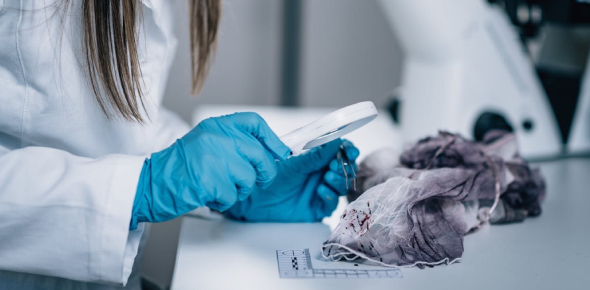
Forensic Science Quiz to Test Your Knowledge

Reviewed by Editorial Team
The ProProfs editorial team is comprised of experienced subject matter experts. They've collectively created over 10,000 quizzes and lessons, serving over 100 million users. Our team includes in-house content moderators and subject matter experts, as well as a global network of rigorously trained contributors. All adhere to our comprehensive editorial guidelines, ensuring the delivery of high-quality content.
Learn about Our Editorial Process
| By Thames
T
Thames
Community Contributor
Quizzes Created: 8157 | Total Attempts: 9,568,055
| Attempts: 14 | Questions: 14 | Updated: Nov 28, 2025
Please wait...
Question 1 / 15
🏆 Rank #--
Score 0/100
1. What is adipocere?

Explanation

Adipocere forms when bacteria break down body fats in moist, oxygen-poor environments, usually within weeks after death. The process converts fat into a wax-like substance that slows further decomposition. Forensic experts study adipocere to estimate postmortem intervals and understand burial conditions. Its presence suggests high moisture, limited oxygen, and relatively cool environments, making it significant in forensic examinations of buried or submerged remains.

Submit
Please wait...
About This Quiz
Criminal Justice Quizzes & Trivia

This forensic science quiz is designed to help learners test their understanding of key forensic concepts in a clear and structured way. The first part of the quiz focuses on essential topics such as decomposition, skeletal anatomy, crime scene processes, and laboratory principles.

In this forensic scientist quiz introduces... see morescenario-based questions to simulate real forensic applications. The quiz also supports students seeking a basic forensic science quiz to build confidence before advancing to more complex subjects. All questions are concise, accurate, and well-aligned with forensic science practices. see less

2.
You may optionally provide this to label your report, leaderboard, or certificate.
2. What is Alvar?

Explanation

Alvar is used in forensic body preparation after maceration, a process that removes soft tissue from skeletal remains. The chemical helps harden and stabilize bones, giving them a firm surface suitable for further analysis or identification. This ensures skeletal elements remain intact for anthropologists who need accurate morphological details for age, sex, trauma, or ancestry assessments. Alvar improves preservation and clarity of bone features during investigation.

Submit
3. What is autolysis?

Explanation

Autolysis occurs immediately after death when the body’s cells break down due to enzyme release. These enzymes, once contained within healthy cells, escape and digest surrounding tissues. The process begins in highly vascular and enzyme-rich organs first, such as the pancreas. Autolysis contributes to early decomposition stages and affects how quickly the body transitions into putrefaction. Understanding autolysis helps forensic scientists estimate initial postmortem changes.

Submit
4. What is the purpose of the chain of evidence?

Explanation

The chain of evidence ensures every piece of evidence is tracked from recovery to courtroom presentation. Investigators document who collected it, who handled it, and how it was stored. This prevents contamination or tampering, maintaining scientific validity. Courts require this documentation to accept evidence. Without a reliable chain, even strong forensic findings may be dismissed. Therefore, it protects both integrity and legal admissibility.

Submit
5. Who is Dale Stewart?

Explanation

Dale Stewart significantly shaped forensic anthropology by creating standards for estimating age from skeletal remains. Using large collections of bones, he identified measurable changes that occur across the lifespan. These standards allow forensic experts to analyze growth plates, bone density, remodeling, and degeneration. Stewart’s work provides consistent methods for age estimation, supporting identification efforts in archaeological and forensic cases.

Submit
6. What is a datum point?

Explanation

A datum point is a fixed, unmoving reference used to map an excavation site accurately. Archaeologists use it to create a grid system, ensuring all recovered remains and artifacts are documented in their precise locations. This spatial information helps reconstruct events, determine body positioning, and interpret burial context. Without a datum point, mapping becomes inconsistent and spatial relationships between findings could be lost.

Submit
7. What is forensic entomology?

Explanation

Forensic entomology uses insect colonization patterns to estimate time since death. Specific insects arrive at predictable stages, allowing experts to infer decomposition timelines. Temperature, environment, and insect development rates all guide calculations. Entomologists also analyze larvae feeding patterns, species succession, and pupation stages. This method is especially valuable in outdoor scenes where insects are primary decomposition agents.

Submit
8. What is the role of a forensic odontologist?

Explanation

Forensic odontologists specialize in identifying human remains using dental records, bite patterns, and tooth structures. Teeth resist decomposition, fire, and trauma better than many tissues. By comparing dental charts, X-rays, restorations, and unique dental features with antemortem records, odontologists can accurately confirm identity. They also analyze bite marks in certain cases. Their work is essential when other identification methods are unavailable.

Submit
9. What is the purpose of the Body Farm?

Explanation

The Body Farm was created to study human decomposition scientifically. Researchers place donated bodies in various environments, such as soil, shade, sun, water, or enclosed spaces. By observing temperature, insect activity, moisture, and other factors, scientists develop accurate postmortem interval estimates. The data supports criminal investigations and improves forensic methods. It remains essential for advancing decomposition research under controlled but realistic settings.

Submit
10. What is desiccation in human remains?

Explanation

Desiccation preserves remains by removing moisture, halting bacterial activity and slowing decomposition. When a body dries quickly due to heat, airflow, or arid conditions, tissues shrink and harden, creating natural mummification effects. Forensic scientists analyze desiccated tissues to estimate environmental exposure and postmortem intervals. The absence of moisture limits biological decay, making desiccation an important preservation process observed in many cases worldwide.

Submit
11. What is the main focus when studying the axial skeleton?

Explanation

Studying the axial skeleton typically begins with memorizing its bones, including the skull, vertebrae, sternum, and ribs. These bones form the body’s central framework. Knowing their names and locations helps learners understand structural protection of vital organs and serves as the foundation for advanced anatomical analysis. Memorization supports accurate identification in fields such as forensics, anatomy, and medical examinations.

Submit
12. What is the main focus when studying the appendicular skeleton?

Explanation

The appendicular skeleton includes the limbs and girdles, so memorizing its bones is foundational. Learners identify structures such as the humerus, radius, pelvis, femur, and scapula. This knowledge supports understanding body movement and how the skeleton interacts with muscles. In forensic settings, knowing these bones helps identify trauma, age indicators, or signs of disease. Memorization precedes deeper functional and comparative studies.

Submit
13. What is the diaphysis of a long bone?

Explanation

The diaphysis is the shaft of a long bone, composed mostly of compact bone that provides strength and weight support. It encloses the medullary cavity, which contains bone marrow. Forensic analysts study the diaphysis for trauma marks, remodeling, and density changes that can indicate age or cause of injury. Its structure makes it crucial for supporting movement and resisting bending forces.

Submit
14. What are epiphyses?

Explanation

Epiphyses are the rounded ends of long bones responsible for articulation and bone growth. In children and adolescents, growth plates within the epiphyses allow the bone to lengthen until maturity. Forensic scientists examine epiphyseal fusion patterns to estimate age at death. Fully fused epiphyses indicate adulthood, while partially fused ones suggest adolescence. Their shape and developmental stage are key indicators in skeletal identification.

Submit
×
Saved
Thank you for your feedback!
View My Results
Cancel
  • All
    All (14)
  • Unanswered
    Unanswered ()
  • Answered
    Answered ()
What is adipocere?
What is Alvar?
What is autolysis?
What is the purpose of the chain of evidence?
Who is Dale Stewart?
What is a datum point?
What is forensic entomology?
What is the role of a forensic odontologist?
What is the purpose of the Body Farm?
What is desiccation in human remains?
What is the main focus when studying the axial skeleton?
What is the main focus when studying the appendicular skeleton?

What is the diaphysis of a long bone?
What are epiphyses?
Alert!