
I’ve sat in enough budget meetings to know how this usually starts. Someone says training completion rates are flat, someone else says engagement is down, and within twenty minutes, the conversation has turned into “so which LMS should we buy?” That’s the wrong question.
I’ve built training programs from a folder of PowerPoints, and I’ve built them inside platforms with more dashboards than a cockpit, and the thing that actually predicts success was never the software. It was whether the pieces talked to each other. An employee learning ecosystem is what you get when content, data, managers, and daily work actually connect. Most companies don’t have one. They have a pile of tools that happen to sit in the same tech stack.
That’s what this comes down to: which pieces actually have to connect, where most teams wire it wrong, and what to fix first if you’re starting from that pile of disconnected tools instead of a system.
What Is an Employee Learning Ecosystem?
An employee learning ecosystem is the connected set of content, technology, people, and workflows that together support continuous learning inside a company. It is not a single platform. It is the relationship between the platform, the manager, the daily task, and the data that shows whether any of it worked.
Think of it less like a library and more like a nervous system. A library holds information. The nervous system moves it to where it’s needed, fast, and reports back on what happened. Most training stacks are libraries pretending to be nervous systems.
Right, moving on before this metaphor gets away from me.
Why Doesn’t My LMS Already Count as a Learning and Development Ecosystem?
Because an LMS stores and delivers content. That’s genuinely useful. It is also roughly a third of the job.
A learning and development ecosystem needs the LMS to talk to performance data, needs managers who reinforce what was taught, and needs the training itself embedded somewhere close to the actual moment of work. Buy the best LMS on the market and skip those three things, and you’ve bought an expensive filing cabinet. I’ve watched this happen at companies with genuinely excellent content library and zero measurable change in how people actually worked afterward.
The TalentLMS 2026 L&D Benchmark Report found that half of HR managers and 53% of employees say high workloads leave little room for training, even when it’s needed. That’s not a tooling problem. No LMS feature fixes a calendar that has no room in it. If your learning and development ecosystem doesn’t account for when and how people actually have capacity to learn, the platform underneath it barely matters.
What Actually Connects the Pieces of a Working Employee Learning Ecosystem?
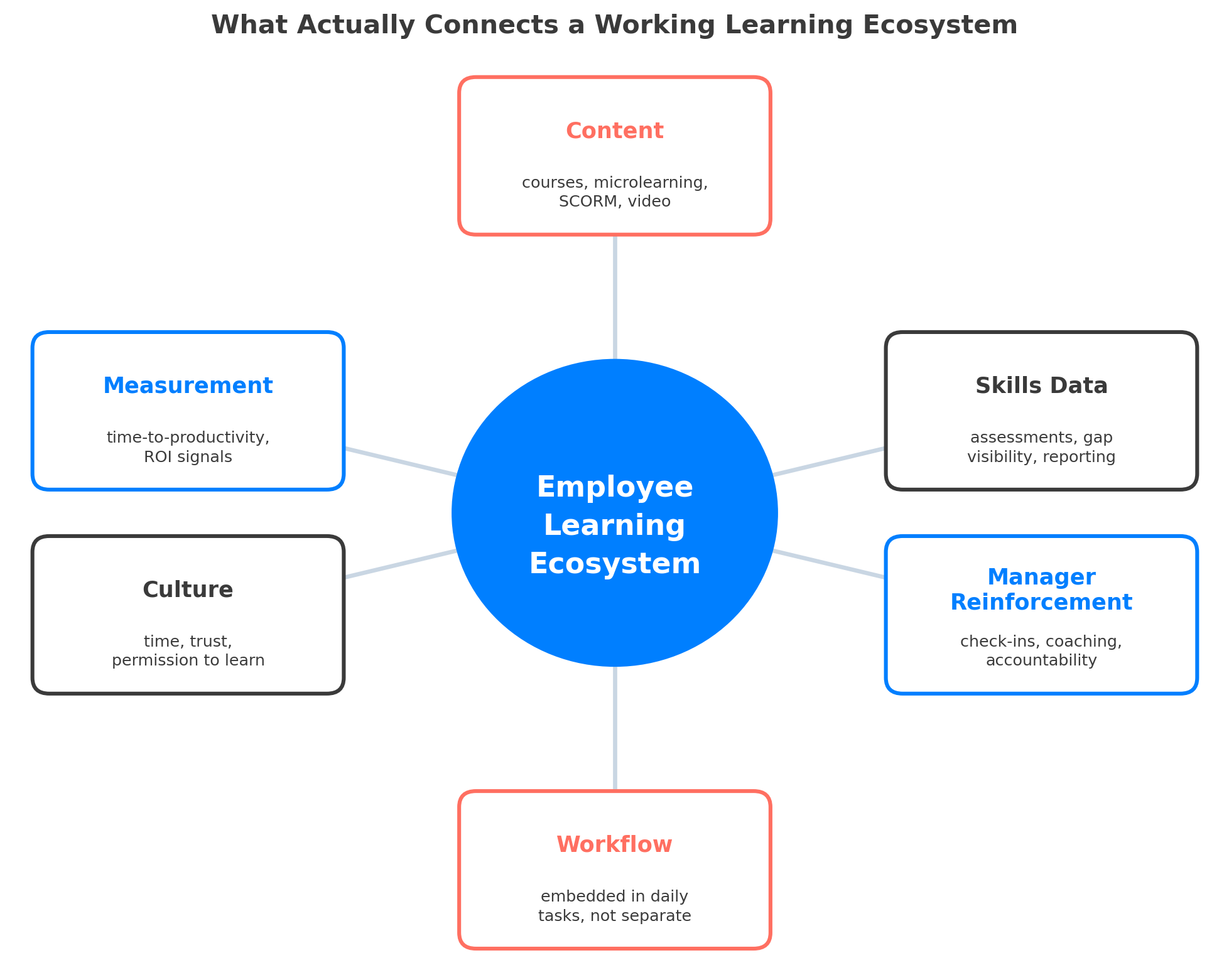
Four things, and I’m being deliberately unspecific about calling them “pillars” because the moment you treat them as separate boxes to check, you’ve already lost the thread. They overlap. That’s the point.
The Content Layer
This is the part everyone gets right first and stops improving on. Courses, microlearning, videos, SCORM packages, whatever format fits. Fine. The mistake is treating content as the finish line. Content is the raw material. On its own, it does nothing.
The Data Layer
This is where most corporate learning ecosystem efforts quietly die. Completion data tells you who clicked through. It tells you almost nothing about whether a skill exists now that it didn’t before. Real skills visibility means tracking assessment performance, not just video-watched percentages. LinkedIn’s 2026 Talent Velocity research found 86% of organizations say they can’t clearly see their current skills, can’t mobilize talent, and can’t keep pace with AI-driven change. That’s a data layer failure, not a content failure. Most of these companies have plenty of content.
The Manager Layer
Managers make or break a learning and development ecosystem, and almost nobody builds anything for them. Employees are receiving less support from managers on development than they used to, and the barrier isn’t willingness. It’s bandwidth and unclear expectations about what “supporting learning” is even supposed to look like day to day. Give a manager a five-minute script for a monthly skills check-in, and you’ll do more for retention than another course will.
The Workflow Layer
Training that lives outside the job gets treated like homework. Training that lives inside the job gets treated like part of the job. That distinction is everything. If a compliance module can only be completed by logging into a separate portal during “training time,” you’ve already told your employees it doesn’t matter enough to belong anywhere near their actual work. That’s the difference between a stack of disconnected software and an actual workplace learning ecosystem that people move through without thinking about it.
None of these four layers is optional, and none of them, alone, is an ecosystem. Skip the connective tissue between them and you’ve built an employee training ecosystem in name only: four separate systems wearing a single label, with nobody able to explain how a gap identified on Monday actually gets closed by Friday.
A functioning ecosystem is when a skills gap identified in the data layer automatically triggers a content assignment, about which a manager is notified, within the tool the employee already works in. That’s the whole trick.
Where Does Building a Corporate Learning Ecosystem Usually Go Wrong?
The biggest mistake isn’t choosing the wrong learning platform. It’s assuming that adding more tools automatically creates a better ecosystem. More often, it creates a more fragmented one.
The Josh Bersin Company’s fifth corporate learning study, published in 2026, shows why. Despite more than $400 billion spent on corporate training every year:
- 74% of senior leaders say their organizations lack the skills needed to stay competitive.
- Fewer than 5% of companies have built a truly integrated learning strategy, AI-powered or otherwise.
Companies aren’t struggling because they lack software. They’re struggling because their software doesn’t work together.
Instead of creating a connected employee learning ecosystem, many organizations end up with:
- Multiple platforms that don’t share learner data
- Separate completion and skills reports
- Duplicate content across different systems
- Employees switching between several logins to complete one learning journey
I’ve seen this happen more than once. A team identifies a gap and buys a point solution to solve it. Six months later, they have four different logins, three reports that don’t reconcile, and no reliable way to answer the question that matters most: Did employees actually build new skills?
That’s why I think a smaller, tightly integrated ecosystem almost always beats a larger one. Three connected tools will usually deliver more value than a stack of twelve disconnected platforms. Every additional vendor adds another integration, another dashboard, and another source of truth to manage.
Before buying another platform, audit the one you already have. In many cases, connecting existing tools will improve your learning ecosystem far more than expanding it.
What Should You Actually Do First?
Not buy a platform. I know that’s the opposite of what every vendor page, including ones I’ve written, will tell you.
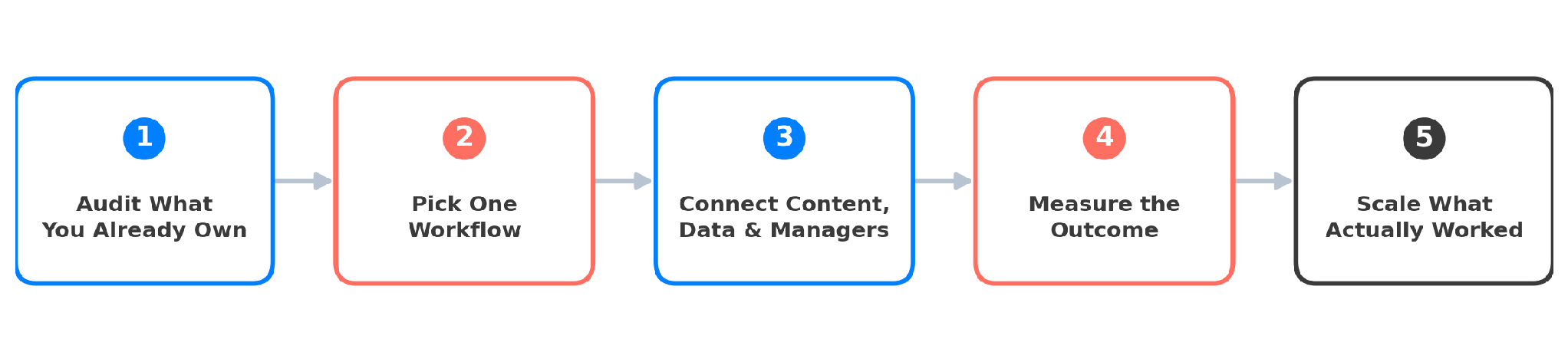
Step 1: Audit What You Already Have
Don’t buy a new platform first. Review your existing HR, LMS, collaboration, and performance tools to see which ones can already integrate. Fixing those connections is often faster, cheaper, and helps you identify the gaps before you invest in new software.
Step 2: Start With One High-Impact Workflow
Choose a single workflow instead of trying to transform everything at once. Onboarding is usually the best place to begin because it’s measurable, contained, and directly impacts employee retention. Platforms like ProProfs Training Maker can help you launch AI-powered courses and structured learning paths without a lengthy implementation.
Step 3: Delay Your Organization-Wide Skills Taxonomy
A company-wide skills taxonomy is valuable, but not as a starting point. First, prove your learning ecosystem with one successful workflow. Once you have real learning and performance data, you can build a taxonomy around the skills that actually matter.
Step 4: Build the Foundation Before Adding Gamification
Avoid launching badges, points, or leaderboards too early. Gamification only works when your learning content, integrations, and reporting are already reliable. Otherwise, it simply highlights existing problems.
Step 5: Measure Learning With Assessments, Not Just Completion
Track competence instead of course completion alone. Pair your training platform with a dedicated assessment tool like ProProfs Quiz Maker to verify skills through scored quizzes and assessments, giving you much more meaningful learning data.
How Do You Know If Your Workplace Learning Ecosystem Is Actually Working?
Completion rate is the metric everyone defaults to and it is close to useless on its own. A course can have a 95% completion rate and change absolutely nothing about how people do their jobs.
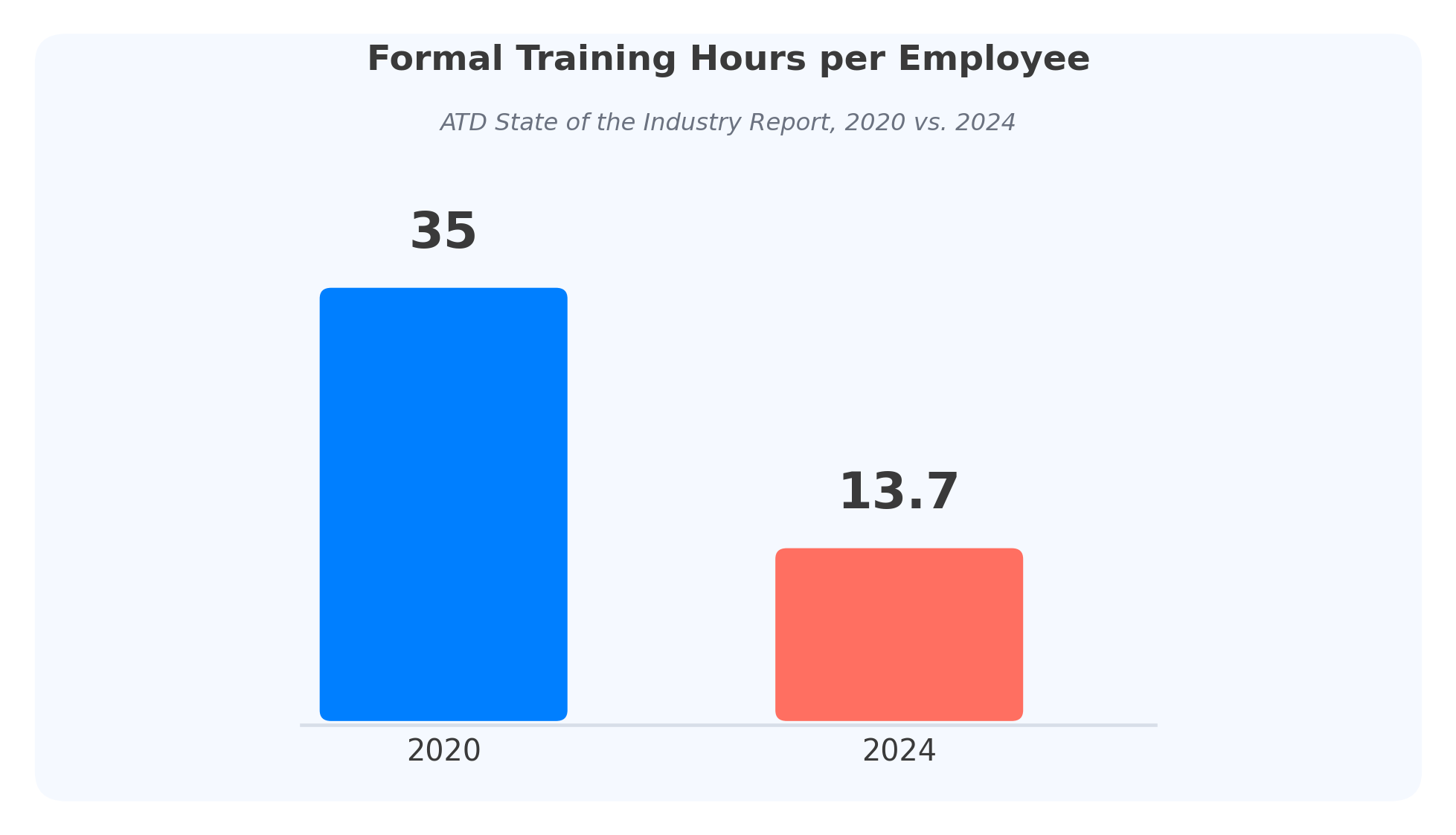
Better signals: assessment score trends over time, time-to-productivity for new hires, and whether managers report fewer repeated questions on the same topics. A workplace learning ecosystem earns its keep on those numbers, not on how many people logged in. ATD’s State of the Industry research found formal learning hours per employee dropped from 35 in 2020 to 13.7 in 2024, even as job complexity increased. A shrinking training footprint against rising complexity is exactly the kind of tension a working learning and development ecosystem is supposed to catch, and most dashboards are built in a way that hides it rather than surfaces it.
Proving ROI to leadership gets easier once you stop measuring activity and start measuring the gap between what a role requires and what the person in it can currently do. That number moving in the right direction is a business result. A completion percentage is not.
What Does This Actually Look Like Once It’s Running?
Picture a mid-sized company, the kind with a couple of hundred employees and one overworked training manager, the role I know best because I’ve been in it. Onboarding used to be a shared drive folder and a Zoom call. New hires took roughly six weeks to reach full productivity, and nobody could say why some took four weeks and others took ten.
The fix wasn’t a bigger platform. It was about connecting three things that already half-existed: a short onboarding course sequence, a manager check-in trigger on day 30, and a skills assessment on day 45 that fed back into which content was assigned next. Time-to-productivity dropped by nearly a third within two quarters, not because the content improved, but because the loop finally closed. That’s what an employee learning ecosystem is supposed to do, and it’s a smaller lift than most people assume once the employee training ecosystem around them is actually wired together. It’s not more content. It’s content that knows what happened after someone took it.
Reframe, Not a Recap: Stop Building a Library and Start Building a Loop
The instinct to fix training by adding a bigger, shinier system is understandable and, in my experience, almost always backward. A library sits there being comprehensive. A loop notices a gap, closes it, and tells you whether it worked. Every piece of this article points to the same idea from a different angle: connection matters more than content, and reinforcement matters more than the release date of your platform. Whether you call it a workplace learning ecosystem or an employee training ecosystem internally doesn’t matter much. What matters is whether the pieces actually talk to each other.
If you take exactly one thing from this, audit before you buy. The tools you already have are probably closer to an ecosystem than you think. They’re just not wired together yet.
Frequently Asked Questions
What is an employee learning ecosystem?
It's the connected set of training content, delivery technology, performance data, and manager reinforcement that together support continuous employee development. Unlike a standalone LMS, it includes the people, workflows, and reinforcement habits around the tools, not just the software itself, which is why buying a platform alone rarely fixes anything.
How is a learning ecosystem different from an LMS?
An LMS stores and delivers content, full stop. A learning ecosystem also connects that content to skills data, manager workflows, and the actual moment of work an employee is doing. An LMS can be one component inside a larger ecosystem, but on its own, it simply isn't one.
What are the core components of a corporate learning ecosystem?
Content, skills data, manager reinforcement, and workflow integration are the four working parts. Each piece matters less on its own than how tightly it connects to the others, since disconnected components create fragmentation and duplicate reporting rather than a single functioning system leadership can actually trust.
How much does it cost to build an employee learning ecosystem?
Cost depends far more on integration effort than on software price tags. Many companies already own most of the tools they need; the real cost is the time spent connecting existing systems and retraining manager habits, not new licensing fees for another standalone platform.
What's the biggest mistake companies make building a training ecosystem?
Adding more disconnected tools instead of connecting the ones they already own. Research from the Josh Bersin Company found fewer than 5% of companies have a coherent, integrated learning strategy despite heavy annual tool investment, which tells you the gap isn't a budget problem.
How do you measure whether a learning ecosystem is working?
Track assessment score trends, time-to-productivity for new hires, and any reduction in repeated manager questions, not just completion rates. A high completion percentage paired with no measurable change in skill or performance almost always means the ecosystem isn't actually functioning yet, whatever the dashboard shows.
Do small companies need a learning ecosystem too?
Yes, arguably more urgently, since small teams can't absorb the cost of disconnected training the way larger companies with dedicated L&D headcount can. A tightly wired ecosystem built from three connected tools often outperforms a large, fragmented stack regardless of overall company size.
Where should a company start when building one from scratch?
Audit existing tools before buying anything new, then pick a single workflow, usually onboarding, and connect content, data, and manager reinforcement within that one workflow first. Prove the model works there before expanding it company-wide across other teams and functions.

Let ProProfs AI Build a Quiz

 We'd love your feedback!
What did you like & how can we make it even better?
 Thanks for your feedback!
 Ask Your Question
Have a question? Get expert help to make your decision easier.