

I’ve spent enough years building assessments, running them, and then explaining the results to a room full of unconvinced managers to have strong opinions about employee assessment tools. Most “best of” lists in this space read like they were written by someone who’s never had to explain to a VP why a $12,000 assessment platform still couldn’t tell them whether a candidate could actually do the job.
This one’s different. I tested, compared, and in a couple of cases mildly argued with seven employee assessment tools that claim to handle skills testing, performance reviews, or both. Some are built for hiring. Some are built for the slower, ongoing work of figuring out if your current team is actually growing. A few try to do both and mostly succeed.
Here’s what I found, roughly in the order I’d recommend them.
What Actually Counts As An Employee Assessment Tool?
That’s the textbook version. In practice, the category splits into two camps that don’t always talk to each other. One camp is pre-hire skills testing, built to answer “can this person do the job before we hire them?” The other is ongoing performance and engagement software, built to answer “is this person still growing once we did.” A handful of tools, ProProfs Quiz Maker included, sit in the middle and let you build either kind of employee evaluation tool from the same question bank. Worth knowing before you pick one.
The 7 Employee Assessment Tools I Compared
Nobody wants to read seven full reviews before they know if any of this is worth their afternoon, so here’s the shape of the whole list first.
| Tool | Best For | Capterra Rating | Starting Price |
|---|---|---|---|
| ProProfs Quiz Maker | Custom skills & performance assessments, no developer needed | 4.5/5 | Free forever plan; paid plans from $20/month |
| TestGorilla | Pre-hire skills screening at scale | 4.1/5 | Free plan; Core from $1,700/year |
| HackerRank | Technical and coding skills assessment | 4.5/5 | From $199/month |
| iMocha | Enterprise skills intelligence and upskilling | 4.5/5 | From $75/month |
| Mercer | Mettl Talent Assessments | Large-scale psychometric and aptitude testing | 4.3/5 | Custom, quote-based |
| Culture Amp | Continuous performance reviews and engagement | 4.6/5 | Custom, quote-based |
| 15Five | Weekly check-ins and manager-led performance conversations | 4.7/5 | From $4/user/month |
A quick note before you skip to your favorite row: ratings and review counts shift monthly, so treat these as a snapshot rather than gospel. I pulled every number directly from the vendor’s own Capterra or G2 profile.
1. ProProfs Quiz Maker: Best for Creating Quizzes & Assessments for Business, Training, and Education
ProProfs Quiz Maker is the employee assessment tool I keep coming back to when I need something built by lunchtime, not after a procurement meeting.
Describe what you want to test, and the AI quiz maker drafts the questions for you. Upload a PDF, DOCX, or existing training manual, and it pulls questions straight from that document, or import a question bank you already built in Excel or Word, and it reads that in automatically. That trio of options alone has saved me more afternoons than I want to admit. You can use it here:

Let ProProfs AI Build a Quiz
What earns its spot at the top of this list is grading. The AI scoring engine grades every question type, including open-ended essay answers, against a rubric you set, so subjective skills like written communication stop being a guessing game for whoever’s marking them.
Add AI-powered reports flagging questions that are too easy, too hard, or badly worded, more than 20 question types, and a library of over a million pre-built questions, and you’ve got a genuinely flexible tool. It’s built for people who need results this week, not after a demo cycle.
Pros
- AI quiz generator creates assessments from prompts, PDFs, DOCX, PPT, webpages, or YouTube videos
- 20+ question types, including essay, audio, video, hotspot, drag-and-drop, and scenario-based questions
- Question banks with randomization reduce answer sharing
- AI-powered grading for essays and short answers using customizable rubrics
- Browser lockdown, webcam monitoring, screen proctoring, and IP tracking for secure assessments
- Automated certificates for learners who meet passing scores
- Instant feedback and detailed reports
- 70+ language support for global classrooms
Cons
- No dark mode, which can cause eye fatigue during extended assessment sessions
- Only cloud-based; no on-premise version available for organizations with strict data residency requirements
Pricing: Free for basic quizzes; Business plans start around $20/month (or roughly $120/year billed annually) for 100 active quiz takers, scaling from there.
2. TestGorilla: Best For Pre-Hire Skills Screening At Scale
TestGorilla built its name on breadth. Its test library covers everything from cognitive ability and personality to job-specific technical skills and coding, and you can stack up to 5 or 6 tests into a single assessment link. For high-volume hiring, that’s genuinely useful. You’re not juggling three separate vendors just to check both aptitude and role-specific skill in one sitting.
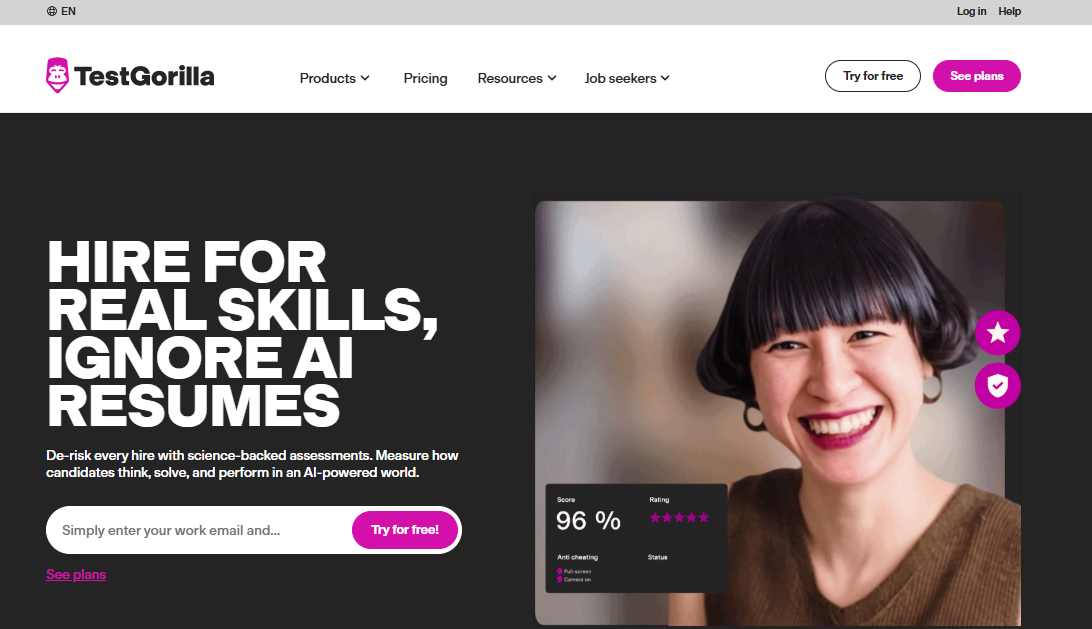
The dashboard automatically ranks candidates once scores come in, which is the part that hiring managers actually care about. You get a shortlist instead of a spreadsheet full of raw numbers. Where it gets messier is the pricing structure. Credits, seat limits, and candidate caps interact in ways reviewers consistently find confusing, and the jump between tiers is steep enough that fast-growing teams often outgrow the Core plan sooner than expected. It’s a strong tool for pre-hire screening. It’s a less obvious fit if what you actually need is ongoing assessment for people already on payroll.
Pros
- Massive test library spanning cognitive ability, personality, and job-specific skills
- Candidates are auto-ranked on one dashboard, cutting out manual scoring
- Free plan available, so you can test the workflow before committing
Cons
- Pricing tiers and credit systems are confusing enough that reviewers flag it repeatedly
- Per-candidate costs escalate quickly once a growing team outgrows the Core plan
- Built entirely for pre-hire screening, with no ongoing performance-tracking function
Pricing: Free plan available; Core plan starts at $1,700/year for 400 credits and 2 premium seats; the Plus tier is custom-priced.
3. HackerRank: Best For Technical And Coding Skills Assessment
If the skill you’re testing is code, HackerRank is close to the default choice, and there’s a reason for that. The live coding environment mirrors what a developer’s actual work looks like instead of a multiple-choice approximation of it, and the platform supports enough languages that you’re rarely stuck writing custom test cases yourself.
What I appreciate is that it doesn’t pretend that coding challenges tell the whole story. Reviewers, and I agree with them here, point out that heavy competitive-programming-style problems don’t always predict how someone performs on real system design or day-to-day engineering work. It’s excellent at what it does. What it does is narrower than a general employee assessment, and you’ll want a separate tool if you’re also evaluating soft skills, leadership potential, or ongoing performance once that developer is actually hired.
Pros
- Live coding environment feels like real developer work, not an abstract quiz
- Deep language support, so you’re rarely limited to one or two stacks
- Detailed candidate comparison and analytics built for hiring decisions
Cons
- Skews toward algorithmic, competitive-programming-style problems over real-world tasks
- Pricing gets steep quickly, and smaller teams say it feels expensive for occasional hiring
- Narrow focus on technical screening only, with no ongoing performance review function
Pricing: Starter plan from $199/month (1 user, 10 attempts); Pro plan around $449/month with unlimited users and 25 attempts.
4. iMocha: Best For Enterprise Skills Intelligence And Upskilling
iMocha’s pitch is bigger than “test candidates.” It’s trying to be the system that maps every skill across your entire workforce, not just the people you’re about to hire. That’s a genuinely different job than most tools on this list attempt, and enterprise teams doing internal mobility or skills-gap planning tend to like it for exactly that reason.
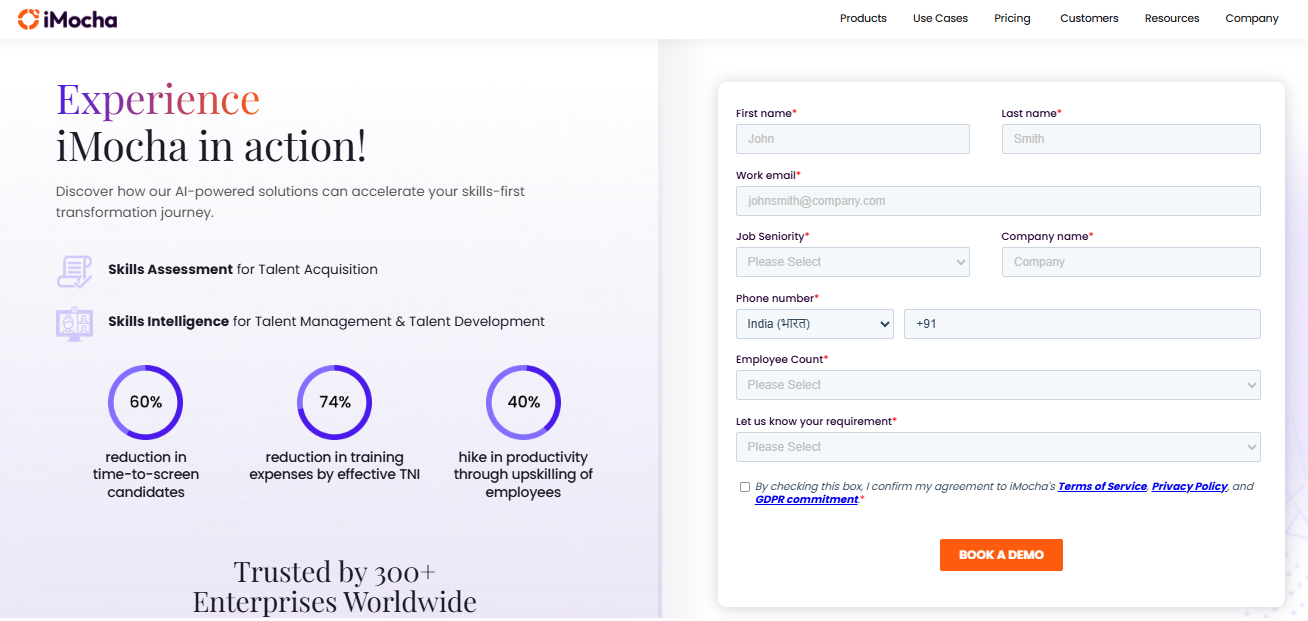
The test library is enormous and gets updated quickly whenever a new tool or language appears on the market. That said, more than one reviewer has flagged automated scoring errors, one described testing 35 candidates who all scored within a narrow band despite wildly different real-world skill levels. That’s not a small complaint for a workforce assessment software platform. If your use case is skills intelligence at scale and you’re prepared to spot-check the scoring, it’s worth a look. If you need dead-simple accuracy straight out of the box, weigh that review carefully first.
Pros
- Skills intelligence angle goes beyond hiring into internal mobility and workforce planning
- Test library updates quickly to cover new tools and emerging technologies
- Strong ATS and HRIS integrations built for enterprise workflows
Cons
- Some reviewers report inconsistencies in automated scoring accuracy
- Interface and reporting have been described by users as needing a refresh
- Pricing isn’t published anywhere, so budgeting requires a sales conversation
Pricing: Not publicly listed; third-party pricing data puts entry plans around $75/month, scaling with candidate volume.
5. Mercer | Mettl Talent Assessments: Best For Large-Scale Psychometric And Aptitude Testing
Mercer | Mettl comes from the world of large-scale, research-backed psychometric testing, and it shows. The assessments lean heavily on validated aptitude and personality science rather than simple skills quizzes, which matters if you’re trying to predict leadership potential or culture fit rather than just whether someone can use a spreadsheet.
It’s built for volume. Reviewers mention using it for campus recruitment drives and identifying high-potential employees across large organizations, which is a different job entirely than a 20-person startup screening its first few hires. The tradeoff is flexibility. Several reviewers wanted the ability to add fully custom questions rather than relying on the existing bank, and pricing is quoted per requirement rather than published anywhere, which makes it genuinely hard to comparison-shop. If you’re an HR team evaluating aptitude and personality at scale rather than narrow technical skills, it earns a serious look as a staff assessment tool.
Pros
- Backed by real psychometric and organizational-behavior research, not just quiz logic
- Strong fit for large-scale hiring and internal high-potential identification
- Wide range of assessment types spanning aptitude, personality, and coding
Cons
- Custom question creation is more limited than many reviewers would like
- Pricing isn’t public, so every quote requires a direct sales call
- Some reviewers report billing and credit-renewal friction between contract cycles
Pricing: Custom, quote-based; no published starting price or self-serve free trial.
6. Culture Amp: Best For Continuous Performance Reviews And Engagement
Culture Amp is less about testing a single skill in isolation and more about tracking how someone is doing over time, which matters more than it sounds. Gallup research puts the share of employees who strongly agree their performance reviews are fair at just 29%, and accurate at only 26%. Structured review cycles, engagement surveys, and goal tracking all live in one place, and the AI survey-response summarization genuinely saves time when you’re staring down hundreds of open-text answers.
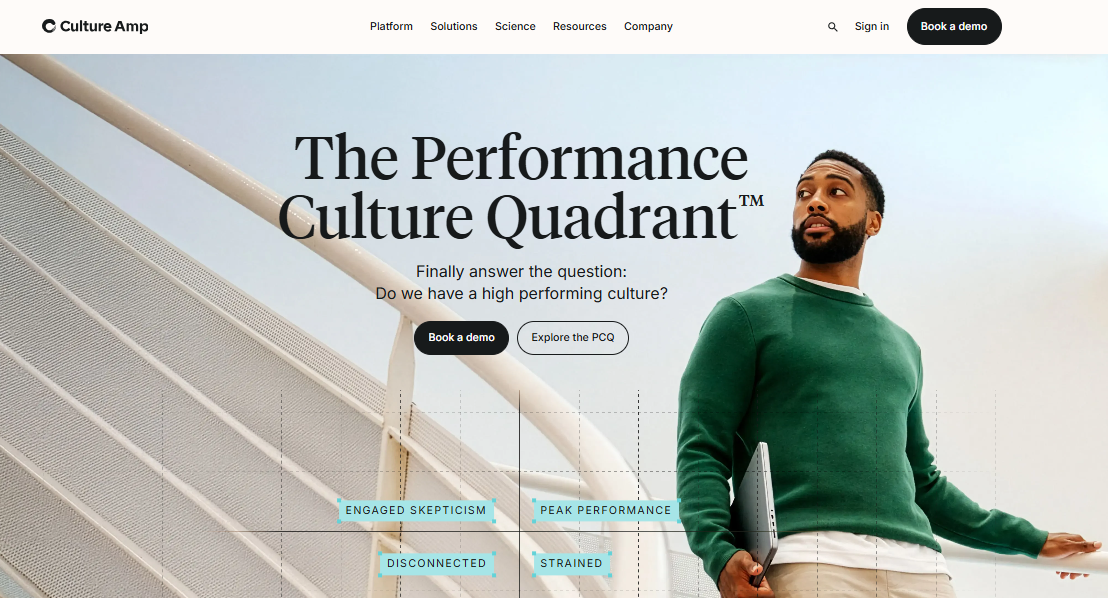
Reviewers who’ve used it for years tend to say the same thing in two different ways: it’s excellent until your company outgrows it. Several long-time customers describe rigid workflows, limited customization for things like talent grids, and admin processes, like reopening an entire review cycle just to extend one person’s deadline, that don’t scale gracefully past a few hundred employees. If continuous, structured employee evaluation tools for engagement and performance are the priority, and your headcount is under that threshold, it’s a strong, well-reviewed choice.
Pros
- Combines engagement surveys, performance reviews, and goal tracking in one platform
- AI summarization of open-text survey responses saves real admin time
- High marks for ease of use once teams are fully onboarded
Cons
- Workflows get rigid and hard to customize as headcount scales up
- No published pricing; every plan requires a sales conversation
- Some review-cycle admin tasks, like individual deadline extensions, stay needlessly manual
Pricing: Custom, quote-based; third-party estimates put entry pricing around $30/user/month.
7. 15Five: Best For Weekly Check-Ins And Manager-Led Performance Conversations
15Five’s whole argument is that the annual review is the wrong unit of measurement, and the data actually backs that up. Gallup research has found that only 14% of employees strongly agree their annual review motivates them to improve, which is a rough number for an entire category of software to sit on. The platform runs on short weekly check-ins instead, paired with 1:1 agendas, OKR tracking, and lightweight peer recognition through what it calls “High Fives.”
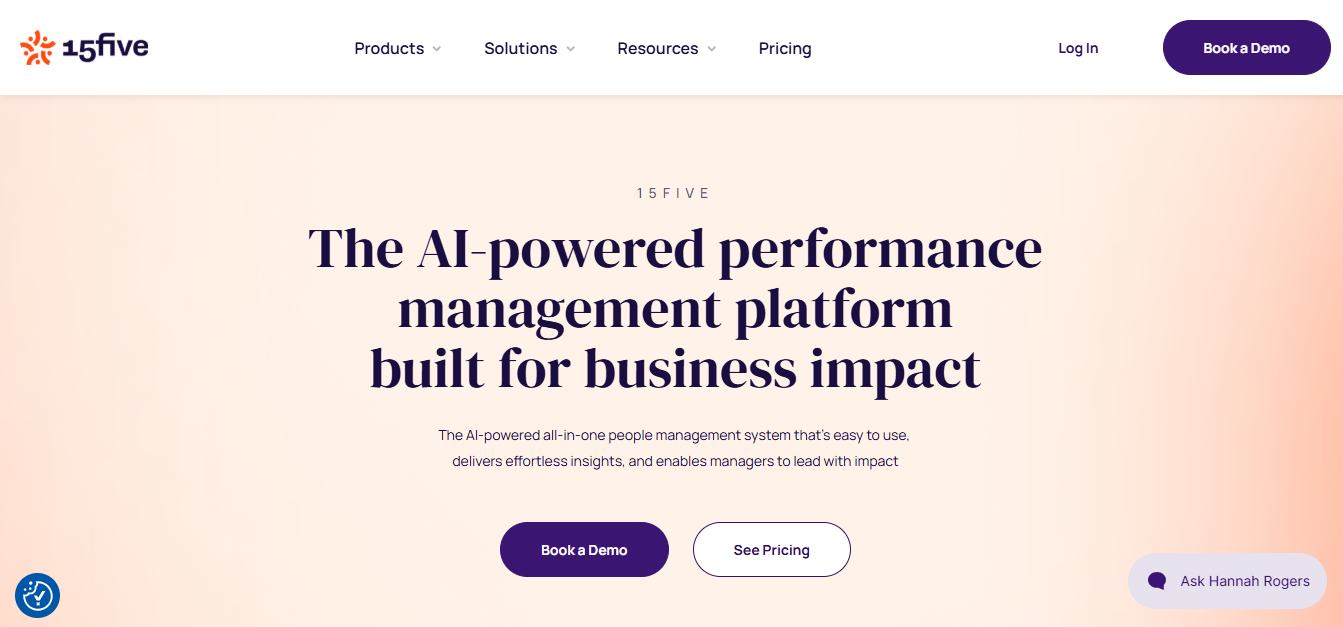
What stands out is how consistently reviewers praise the weekly check-ins for keeping feedback regular without feeling burdensome. The AI coaching layer also helps managers respond constructively rather than simply collect data. Some reviewers note that pricing increases as you add manager coaching or move beyond the entry plan, while others say the question sets can become repetitive over time. Even so, it’s a strong choice for organizations that prioritize continuous feedback over annual reviews.
Pros
- Highest review volume and rating of any tool on this list
- Weekly check-in format drives real completion rates instead of survey fatigue
- AI manager-coaching add-on is a genuine differentiator, not a gimmick
Cons
- Advanced customization and reporting sit behind higher-priced tiers
- Check-in question sets can start feeling repetitive after six or so months
- Not built for pre-hire skills testing at all; performance and engagement only
Pricing: Starts around $4/user/month for the Engage tier (billed annually); Total Platform and coaching add-ons cost more.
My 3 Picks If You’re Not Going To Read The Whole List
If you want the short version, here it is.
Best overall / best value: ProProfs Quiz Maker. It’s the only employee assessment tool here that lets you build a skills test, a training quiz, and a basic performance check from the same account, with AI doing the heavy lifting on writing and grading, without a five-figure annual commitment.
Best for technical hiring: HackerRank, if code is specifically what you’re testing and you have the budget for it.
Best for ongoing performance conversations: 15Five, if your real problem is that nobody talks between annual reviews, and you want something people will actually use every week.
How I Evaluated These Employee Assessment Tools
I didn’t rank these off vendor homepages, because vendor homepages are marketing copy, not evidence.
- User Reviews & Ratings: I looked at real customer reviews and ratings on trusted platforms like G2 and Capterra to understand what users genuinely liked, disliked, and experienced after using each tool.
- Essential Features & Functionality: I evaluated each tool’s core features and overall capabilities to see how well it handled employee assessments, skills testing, performance reviews, reporting, and day-to-day assessment workflows.
- Ease of Use: I assessed how easy each tool was to learn and use by considering its interface, navigation, setup process, and overall user experience for both administrators and employees.
- Customer Support: I reviewed the quality of customer support by looking at response times, available support channels, onboarding resources, documentation, and how effectively vendors helped customers resolve issues.
- Value for Money: I compared pricing with the features, performance, scalability, and overall user experience to determine whether each tool delivered strong value for its cost.
So Which One Actually Earns A Spot In Your Stack?
None of these seven tools is wrong, exactly. They’re just built for different jobs, and the mistake I see most often is buying the one with the flashiest demo instead of the one that matches what you’re actually trying to measure.
If you need one flexible tool that handles skills testing, training quizzes, and basic performance checks without forcing you into an enterprise contract, ProProfs Quiz Maker is where I’d start, largely because you can be running your first assessment the same afternoon you sign up. If your entire problem is pre-hire technical screening, HackerRank or TestGorilla will serve you better. If it’s ongoing performance and engagement at scale, look at Culture Amp or 15Five instead.
Pick based on the job, not the logo.
Frequently Asked Questions
What's the best employee assessment tool for a small business?
For most small teams, ProProfs Quiz Maker is the easiest entry point. It has a free-forever plan, AI-assisted question writing and grading, and no long-term contract, which matters when you're not sure yet how much testing volume you'll actually need.
Are employee assessment tools accurate?
They're only as accurate as the questions and scoring behind them. Look for tools with rubric-based or AI-assisted grading and validated question banks, and be skeptical of any platform that can't explain how it scores subjective answers like essays or video responses.
What's the difference between skills assessment tools and performance review software?
Skills assessment tools, like TestGorilla or HackerRank, measure a specific capability at a single point in time, usually before hiring. Performance review software, like Culture Amp or 15Five, tracks how someone is doing continuously, over months or years, not just once.
How much do employee assessment tools cost?
Anywhere from free to well over $1,700 a year, depending on scale. Tools built for small teams or single use cases, like ProProfs Quiz Maker or 15Five's entry tier, start under $25 a month. Enterprise psychometric platforms often require a custom quote instead.
Can employee assessment tools reduce hiring bias?
Structured, standardized testing does reduce some forms of bias compared to unstructured interviews, since every candidate answers the same questions under the same conditions. It doesn't eliminate bias in how questions are written or scored, so the tool's grading logic still matters.
Do I need separate tools for hiring versus ongoing performance reviews?
Not always. A handful of tools, ProProfs Quiz Maker among them, let you build both pre-hire skills tests and internal performance quizzes from the same question bank. Dedicated performance platforms like 15Five, though, are built specifically for the ongoing side and don't do pre-hire screening at all.
Is ProProfs Quiz Maker free?
Yes, there's a free-forever plan for basic quizzes and assessments. Paid Business plans start around $20 a month for higher question limits, AI grading at scale, and features like custom certificates and secure exam settings.
Let ProProfs AI Build a Quiz

 We'd love your feedback!
What did you like & how can we make it even better?
 Thanks for your feedback!
 Ask Your Question
Have a question? Get expert help to make your decision easier.