
I’ve built more employee assessment tests than I can easily count at this point, for roles running from warehouse leads to product marketers, and here’s the pattern I keep running into: most of them get built backward.
Somebody drafts the quiz first, throws in a mix of logic puzzles and personality items because that’s what the last vendor demo showed, and only afterward asks what the test is supposed to predict. That’s how you end up with something legally shaky and no better at picking good hires than a coin flip.
Building an employee assessment test online doesn’t have to go that way. Done in the right order, it’s one of the fastest ways to make hiring or ongoing performance checks genuinely more accurate. Here’s how I actually do it.
What Is an Employee Assessment Test?
In practice, the term covers a lot of ground. Some people mean a pre-hire skills test. Others mean an ongoing employee evaluation test used to check competency after someone’s already on payroll. The mechanics below work for both, though the compliance stakes are highest when you’re using a test to decide who gets hired.
Why Most Poorly Designed Assessment Tests Fall Apart
Nobody sets out to build a discriminatory test. It happens by accident, usually because the person building it skipped the one step that actually protects them: tying every question back to the job itself.
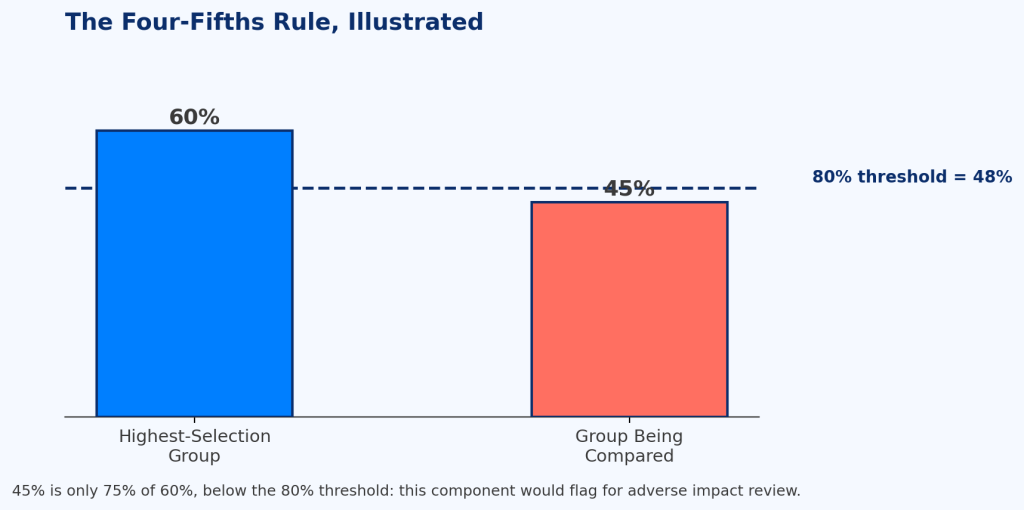
Here’s the federal baseline, and it’s worth knowing cold. The Equal Employment Opportunity Commission enforces the Uniform Guidelines on Employee Selection Procedures, which include the so-called four-fifths rule. Adverse impact is generally indicated when one group’s selection rate falls below 80% of the highest group’s selection rate. That’s not a suggestion. It’s the number federal enforcement agencies actually use to flag a test as a problem.
This matters more than most teams assume. According to SHRM’s 2022 survey of 1,688 HR professionals, more than half of employers, 56%, already use pre-employment assessments, and 79% say assessment scores carry as much or more weight as traditional hiring criteria. Assessments aren’t a niche practice anymore. They’re mainstream enough that “we’ll just wing it” is no longer a defensible position if someone challenges your process.
As SHRM’s Chief of Staff and Head of Government Affairs, Emily M. Dickens, put it, HR professionals are “leading the way in using skills-based hiring” to reach talent pools that traditional screening misses. That only holds up, though, if the underlying test is actually validated and job-related. An off-the-shelf personality quiz bolted onto a hiring process because it “seemed useful” is exactly the kind of component that fails a four-fifths check later.
The fix isn’t complicated. It’s a job analysis, and it takes less time than people think.
A Job Analysis Doesn’t Need to Be a Project
You don’t need a six-week study. You need to be able to answer, in one sentence, what this test is actually measuring and why that thing predicts success in the role. If you can’t do that, you’re not ready to write questions yet.
Pull three sources: the actual tasks the role performs day to day, the two or three skills that separate a strong performer from a mediocre one (ask a manager who’s actually done the hiring for this role, not just HR), and any regulatory or safety requirements tied to the position. That’s your test’s spine, and it’s what turns a generic quiz into a defensible employee skills test. Everything else is decoration.
Does a Shorter Test Really Reduce Candidate Drop-Off?
Here’s the part almost everyone gets wrong, including me for a few years.
The assumption baked into most hiring advice is that long assessments scare candidates off, so the fix is to cut the test down to five or ten minutes. A 2017 peer-reviewed study in the Journal of Applied Psychology, based on data from hundreds of thousands of pre-hire assessments, found something different: assessment length barely predicts completion rates at all. Shortening a test by fifteen minutes bumped completion by only 1 to 2%. Most of the drop-off happened in the first couple of pages, regardless of how long the full test was.
What actually drives dropout is motivation and clarity, not the clock. A ThriveMap survey found that candidates who abandon assessments cite the process taking too long (47%), not understanding why they’re taking it (37%), and not seeing how it connects to the job (30%), roughly in that order. Notice that “too long” and “unclear why” are tangled together. A candidate who understands exactly what’s being measured and why tolerates a longer test just fine. One who’s confused bails on page two of a five-minute quiz.
So the actual lever isn’t trimming your employee assessment test down to the bone. It’s telling candidates, in plain language, what they’re about to do and why it’s relevant to the job they applied for. That one sentence at the top of your test does more for completion rates than cutting content ever will.
How to Create an Employee Assessment Test Online, Step by Step
This is the order I actually use. Skipping around causes most of the problems above.

Step 1: Define What You’re Measuring Before You Write a Single Question
Go back to your one-sentence job analysis. Turn it into two or three measurable competencies. “Communication skills” is too vague to build a fair question around. “Can write a clear, three-sentence status update for a non-technical stakeholder” is something you can actually test and score consistently.
Step 2: Match Question Types to What You’re Actually Testing
This is where most generic templates fail. A cognitive aptitude question tells you almost nothing about whether someone can operate a specific piece of equipment or handle an irate customer. Pick formats that match the skill:
- Skills and technical questions for anything with a right answer (software proficiency, technical procedures, compliance knowledge)
- Situational judgment questions for roles heavy on decision-making under ambiguity (management, customer service, sales)
- Work-sample or scenario questions for anything you can simulate (writing samples, a mock customer email, a short case)
Skip cognitive and personality batteries unless you have a specific, validated reason to include them. They’re the components most likely to trip the four-fifths rule and least likely to tell you something a work sample wouldn’t tell you better.
Step 3: Build the Test in Your Online Tool
Here’s where the actual building happens, and it’s faster than people expect if you did steps one and two properly. Most modern quiz platforms let you either build questions from scratch or generate a starter draft from an existing document. Platforms like ProProfs Quiz Maker let you describe what you’re testing for, or upload a job description, and get a draft set of questions across more than twenty formats, including scenario-based and video-response items, that you then edit down to match your actual competencies.
Don’t accept an AI-drafted question as final. Read every one back against the competency it’s supposed to measure. If a question doesn’t map cleanly to something on your list from Step 1, cut it, no matter how clever it sounds.
Step 4: Decide Your Scoring Before You Second-Guess Yourself Mid-Review
Set your scoring rubric before candidates start submitting answers, not after you’ve seen a few responses and start feeling generous or harsh depending on who you liked in the interview. For objective questions, this is simple: correct or incorrect, weighted by importance. For open-ended or scenario questions, write a short rubric (what a strong, adequate, and weak answer looks like) before you grade anyone.
Auto-grading tools that support custom rubrics for open-ended responses save real time here, especially once you’re evaluating more than a handful of candidates for the same role.
Step 5: Decide How Locked Down It Actually Needs to Be
Not every job assessment test needs proctoring, shuffled question order, or a timer counted down to the second. Match security to stakes. A low-stakes internal employee evaluation test for an existing team member doesn’t need the same lockdown as a remote, high-volume hiring assessment where cheating risk and legal defensibility both run higher. Overbuilding security on a low-stakes test just adds friction that candidates notice and resent.
Step 6: Tell Candidates What This Is and How Long It Takes
One sentence at the top: what the test measures, roughly how long it takes, and how it factors into the decision. This directly addresses the confusion and opacity that drives most of the dropout data above. It costs you nothing and it’s the single highest-leverage line you’ll write in this whole process.
Step 7: Deploy, Then Check Your Own Numbers
Once you’ve run the test on a real candidate pool, actually look at your pass rates by group. This is the practical version of the four-fifths rule: if one group’s pass rate falls noticeably below 80% of another group’s, that component needs a second look before you lean on it for more hires. Reporting dashboards that break down results by question, not just by final score, make this a five-minute check instead of a manual spreadsheet exercise.
What to Actually Prioritize If This Is Your First Time Doing This
If you only do three things from everything above, do these.
Prioritize job-relatedness over polish. A plain-looking test built from a real job analysis beats a beautifully designed one built from a generic template every time it matters, which is to say every time someone challenges a hiring decision.
What can wait: gamification, elaborate branding, a long, sprawling question bank. None of that moves the needle on validity, and all of it can be added later without touching the core test.
The trap to avoid: treating a personality or culture-fit test as a “safe,” low-effort addition because it feels less clinical than a skills test. Personality assessments are exactly the category most likely to create an adverse impact without anyone noticing, because nobody thinks to check them the way they’d check a technical exam. If you add one, validate it the same way you’d validate anything else, or leave it out.
A Starter Question Bank You Can Copy Right Now
This is the free template part. Adapt the categories and language to your specific role, but the structure holds for most positions. Each category below maps to a step from the process above, so you’re not just filling in blanks; you’re testing the right thing on purpose.
Skills and Technical (aim for 4 to 6 questions)
This category is the backbone of most employee skills test builds, and usually the safest place to weight your scoring.
- Walk through the exact steps you’d take to complete [specific task from the job description].
- Which tool or method would you use to solve [specific job-relevant problem], and why?
- Identify the error in this sample [document, code snippet, spreadsheet, procedure].
Situational Judgment (aim for 3 to 5 questions)
- A customer/coworker is upset about [realistic scenario]. What do you say first?
- You’re given two competing priorities with the same deadline. Walk through how you’d decide which comes first.
- You notice a process isn’t being followed correctly by a peer. What do you do?
Work Sample (aim for 1 to 2 questions, weighted heavily)
- Draft a short [email, report section, customer response] based on this brief.
- Given this raw data or scenario, produce the output you’d actually hand to a manager.
Keep the whole employee assessment test under 20 to 25 minutes for entry-level roles and up to 45 minutes for management or executive roles, and always lead with a sentence explaining what’s being measured and why.
The Test You Skip Building Is the One That Costs You Later
An employee assessment test isn’t a formality you bolt onto the end of a job posting. Whether you call it a job assessment test, a skills screen, or something your ATS invented, it’s the one part of hiring you can actually make consistent, defensible, and genuinely predictive, if you build it in the right order. Start with what the job actually requires, match your question types to that, and don’t skip the five-minute compliance check at the end. That’s the whole system. Everything else is just execution.
Frequently Asked Questions
What is an employee assessment test?
An employee assessment test is a structured tool used to measure a candidate's or employee's skills, knowledge, or job readiness against specific, job-relevant criteria. It's used both in hiring, to compare candidates objectively, and post-hire, to check ongoing competency or identify training needs.
How long should an employee assessment test be?
For entry-level hiring, keep it under 20 to 25 minutes. Management and executive assessments can run up to 45 minutes without a meaningful dropout penalty. Length matters less than clarity: telling candidates what's being measured and why affects completion more than trimming minutes.
Are employee assessment tests legal?
Yes, when they're job-related, validated, and consistently applied to everyone in the same role. The EEOC's Uniform Guidelines on Employee Selection Procedures require that any job assessment test showing adverse impact under the four-fifths rule be validated as job-related and consistent with business necessity before it's used to make hiring decisions.
What is the four-fifths rule in employee testing?
It's the federal benchmark for adverse impact under the EEOC's Uniform Guidelines: if one demographic group's selection rate on a test falls below 80% of the highest-scoring group's rate, enforcement agencies generally treat that as evidence of adverse impact, which then requires further review or a business-necessity justification.
Can I create an employee assessment test for free?
Yes. Most online quiz and assessment tools, including ProProfs Quiz Maker, offer a free plan that supports building and scoring a basic assessment. The starter question bank in this guide gives you a free structure to build from regardless of the tool you use.
What's the difference between an employee assessment test and an employee evaluation test?
An employee assessment test typically screens candidates before hire. An employee evaluation test measures an existing employee's competency, often for training, promotion, or compliance tracking. The question-design principles are the same; the legal stakes around adverse impact are highest for the pre-hire version.
How many questions should a job assessment test have?
There's no fixed number. Aim for enough questions to reliably cover 2 to 3 core competencies, typically 8 to 15 total for a single-role employee skills test, weighted toward work-sample and situational items rather than padded out with filler cognitive or personality questions.
Do employee skills tests actually improve hiring quality?
Evidence suggests yes when the test is validated and job-related. SHRM's 2022 research found 78% of HR professionals reported improved hire quality after adopting assessments, and 79% weight assessment scores as heavily as traditional hiring criteria.
Should personality tests be part of an employee assessment test?
Only with caution. Personality and culture-fit tests are more likely to produce adverse impact without a clear, validated link to job performance. If you include one, validate it the same way you would a skills test, or leave it out and rely on situational and work-sample questions instead.
How do I make an assessment test accessible for candidates with disabilities?
Offer reasonable accommodations under the ADA, such as extended time, alternate formats, screen-reader compatibility, or assistive technology support, and make the accommodation request process clear and easy to find before the candidate ever starts the test, not buried in a follow-up email after they've already struggled through it.

Let ProProfs AI Build a Quiz

 We'd love your feedback!
What did you like & how can we make it even better?
 Thanks for your feedback!
 Ask Your Question
Have a question? Get expert help to make your decision easier.