Companies in the US spend over $100 billion on training every year, but I’ve learned the hard way that spending more doesn’t automatically improve performance. When results slip, most teams rush to “build a course.” I start earlier with a training needs assessment so I can be sure training is actually the right move.
I treat it like due diligence before investing. First, I get clear on the business outcome we need. Then I look at where performance breaks down and why.
Sometimes it’s a real skill gap. Other times, it’s messy processes, unclear expectations, or the wrong tools, and training would only waste time. That’s where a solid training needs analysis earns its place, giving you clarity on who needs support and what actually needs to change.
In this blog, I’ll break down what a training needs assessment is, when to run one, the simplest way to conduct it step by step, and a few practical examples you can copy for your own team.
What Is a Training Needs Assessment?
A training needs assessment is a structured way to identify the gap between current performance and the level of performance an organization expects. Instead of assuming training is the answer, it helps pinpoint what’s actually missing, who needs support, and what intervention will create improvement.
For example, an online quiz can quickly validate whether a team truly understands a new policy, product update, or standard operating procedure before any training is planned.
Watch: How to Create an Online Quiz: Step-by-Step Tutorial
In practice, a training needs assessment answers four questions:
- What outcome needs to improve?
- What is happening right now that’s falling short?
- Why is the gap happening?
- What is the best solution, and is training even the right solution?
A strong training needs assessment typically produces:
- A prioritized list of skill or knowledge gaps (by role or team)
- The groups or individuals who need training now vs later
- Recommended solutions (training, coaching, job aids, process fixes)
- Clear success metrics to measure improvement
Think of it as a simple flow: business goals → current performance evidence → root cause → targeted action plan.
Why Is Training Needs Assessment Important?
A training needs assessment keeps training focused on what actually improves performance. Instead of running programs based on assumptions, it helps identify real gaps, the right audience, and the best path forward.
Here’s why it matters:
- Prevents Unnecessary Training: Not everyone needs the same training at the same time. A needs assessment avoids blanket programs and focuses effort where it will make a difference.
- Pinpoints the Right Gaps: It helps clarify what employees are missing, whether that’s role knowledge, process clarity, or job-critical skills.
- Confirms Whether Training Is the Right Fix: Some issues come from unclear workflows, poor tools, or mismatched expectations. A training needs assessment helps separate training needs from operational fixes.
- Helps Prioritize What to Address First: It makes it easier to rank needs by urgency and business impact, so critical gaps get attention before lower-priority topics.
- Improves ROI and Accountability: When training is tied to specific gaps, it’s easier to set goals, measure improvement, and show results to stakeholders.
A strong training needs assessment turns training into a targeted performance investment instead of a routine activity.
When Should You Conduct a Training Needs Assessment?
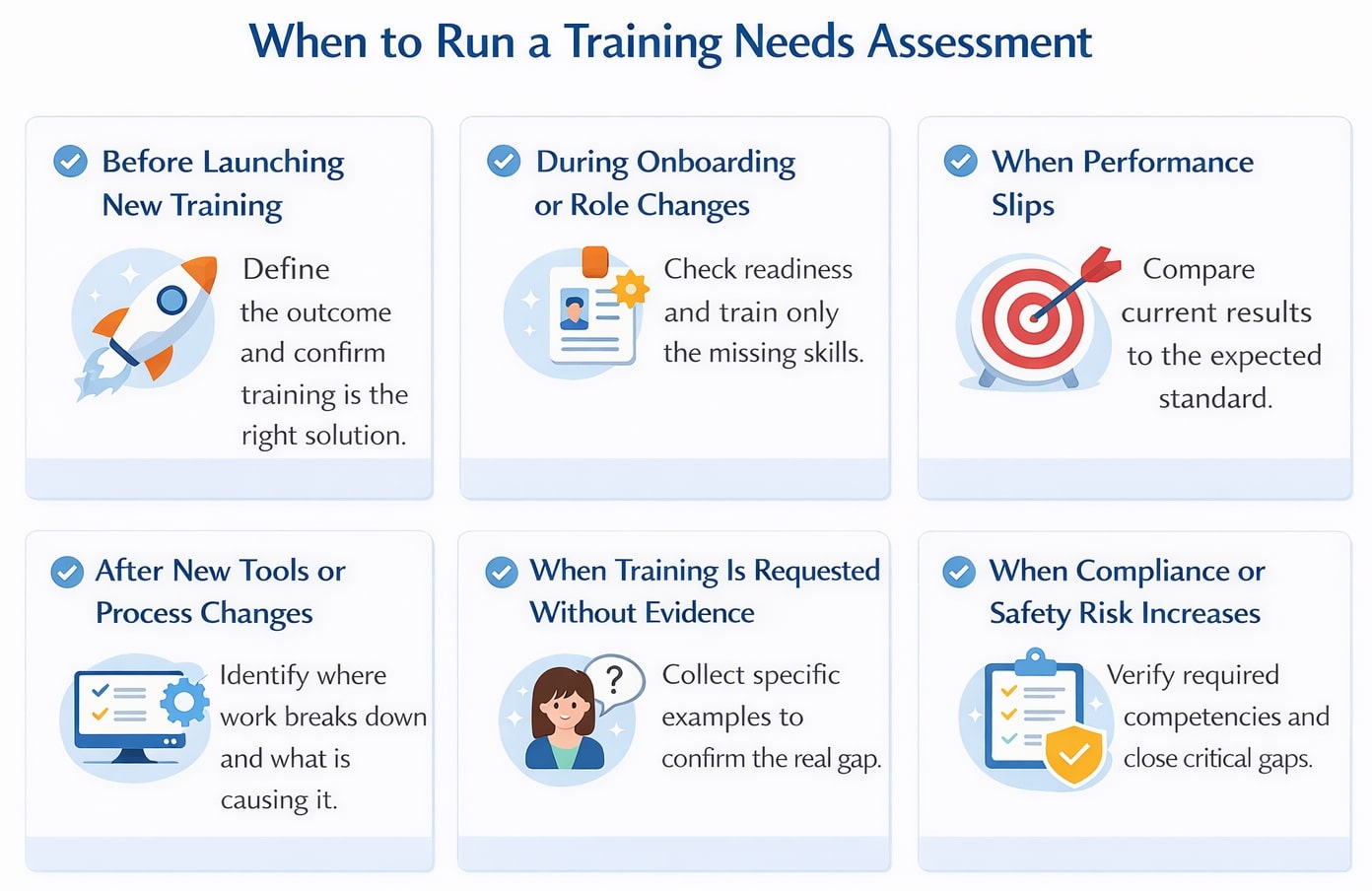
A training needs assessment is most valuable when a training decision is about to be made and you want evidence, not guesses. If you’re asking, “Do we need training here?” that’s usually the signal to run one.
1. Before Launching Any New Training Program
Action: Define the outcome you want (fewer errors, faster ramp-up, higher CSAT), then confirm whether the gap is a skills issue or a process issue. If you can’t name the outcome, pause.
2. During Onboarding, Role Changes, or Promotions
Action: Run a short baseline check, especially during employee onboarding, to see what the person can already do vs. what the role demands, then assign only what closes that gap.
3. When Performance Dips, Quality Drops, or Targets Are Missed
Action: Compare current performance data with the expected standard. Then talk to high performers to define what “good” looks like and where others are falling short.
4. After New Tools, Policies or Workflows Are Introduced
Action: Identify the exact step where people get stuck (handoffs, system usage, compliance steps), then assess knowledge and behavior around that moment.
5. When Managers Say “Training Is Needed” but Can’t Define the Problem
Action: Ask for two to three specific examples of failure (missed steps, customer complaints, rework). If examples vary widely, the issue may be clarity or process, not training.
6. When Compliance, Safety, or Certification Risks Increase
Action: List required competencies, then verify them through quick assessments or supervisor validation. Treat this as risk control, not a checkbox exercise.
7. When Planning Quarterly or Annual Training Priorities
Action: Start with business priorities, rank roles by impact, and assess only the critical capabilities tied to those priorities to avoid bloated training calendars.
A simple rule: If training is being discussed, run a training needs assessment first so the solution is targeted, defensible, and measurable.
Types of Training Needs Assessment
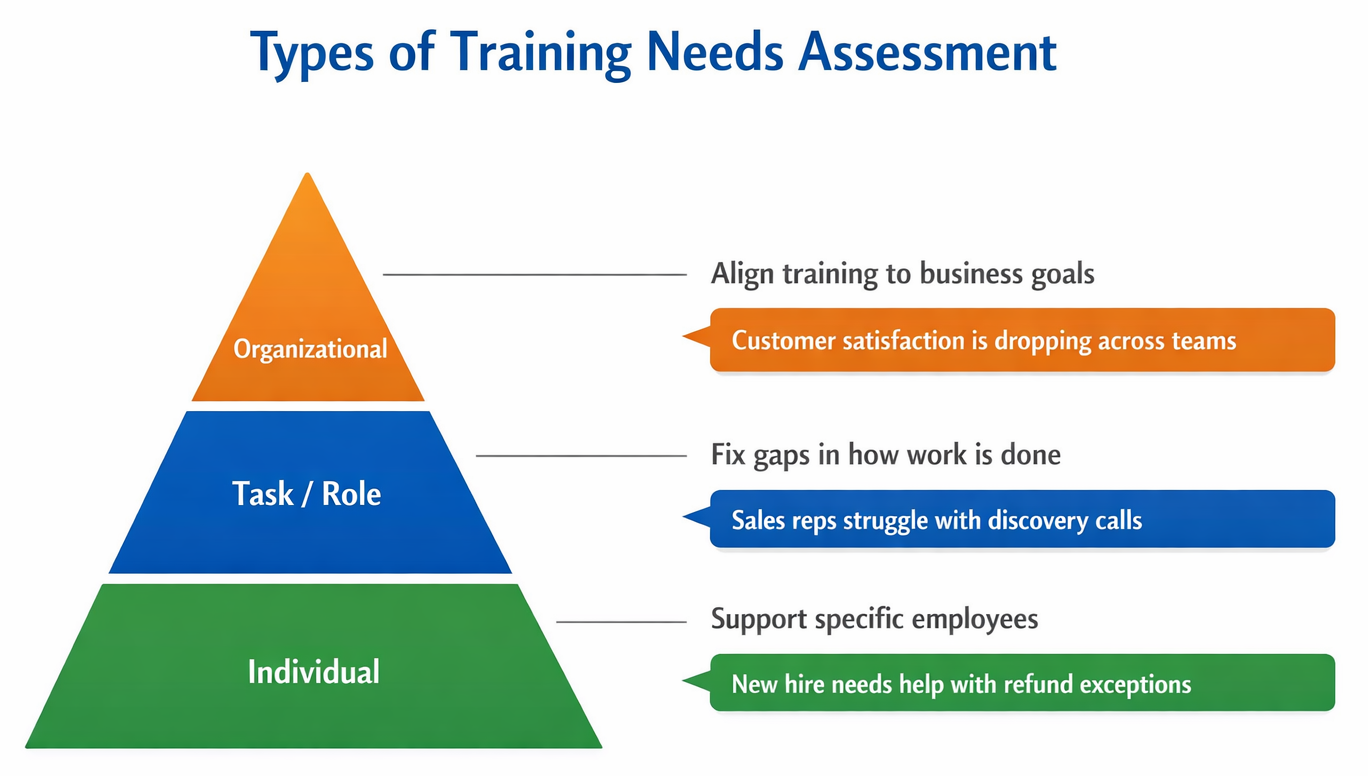
A training needs assessment works best when it looks at needs from more than one angle. That’s why it’s typically done at three levels. These types of training needs assessment help pinpoint whether the gap is strategic, role-based or individual, so the fix is targeted.
Quick Comparison of the Three Levels
| Level | What It Focuses On | Best For | Example Trigger |
|---|---|---|---|
| Organizational | Business goals, enterprise-wide capability gaps, performance trends | Company-wide priorities, change initiatives, leadership alignment | Customer satisfaction drops across multiple teams |
| Task or role | Job tasks, workflows, SOPs, role competencies | Standardizing performance, reducing errors, improving execution | Sales team struggles with discovery and qualification |
| Individual | Personal performance, skill and knowledge gaps | Onboarding, promotions, coaching, performance improvement | One employee’s metrics fall below role expectations |
1. Organizational-Level Training Needs Assessment
This level focuses on the big picture. It looks at where the organization is falling short on business goals and which capability gaps are getting in the way. It’s most useful when leaders are trying to improve outcomes like customer satisfaction, quality, compliance, productivity, or retention.
What it clarifies:
- Which departments or groups need support most
- Which skills matter for the next phase of the business
- What outcomes the training should move
To conduct this macro-level analysis, you need to:
- Thoroughly examine your business goals, skill inventory, customer satisfaction survey reports, and work culture
- Find areas where training is most needed (for instance, a specific department or group of employees)
- Conduct a SWOT analysis (strengths, weaknesses, opportunities, and threats) to better understand your business situation
2. Task- or Role-Level Training Needs Assessment
This level zooms into the work itself. It analyzes job tasks, workflows and role expectations to define what “good performance” looks like and where it breaks down. It’s ideal when a team’s performance is inconsistent or when errors and rework keep repeating.
What it clarifies:
- Which tasks require stronger skills or knowledge
- What standards people should be meeting
- Where the process or role expectations need to be tightened
3. Individual-Level Training Needs Assessment
This level focuses on the employee. It helps identify who needs support, what kind of support they need, and how specific the gap is. It’s useful for onboarding, promotions, performance improvement plans and role transitions.
What it clarifies:
- Who is struggling and in what areas
- Whether the issue is skill, knowledge, or behavior
- What targeted training or coaching would help
A simple way to use these levels: start broad when the issue is unclear, then narrow down. A strong training needs assessment often begins with organizational signals, moves into role tasks and ends with individual gaps.
FREE. All Features. FOREVER!
Try our Forever FREE account with all premium features!
How to Conduct a Training Needs Assessment
A training needs assessment works best when it follows a clear sequence, but still feels like real decision-making. The goal is to move from “something’s not working” to a focused plan you can justify, execute and measure, without defaulting to training too early.
Step 1: Define the Outcome You Want to Improve
Start with the business result, not the course. If the goal is fuzzy, the assessment becomes guesswork. A strong outcome is specific and measurable. For example, “reduce onboarding ramp time from eight weeks to five,” “lower compliance errors by 30%,” or “increase first-call resolution from 60% to 75%.”
Step 2: Pinpoint the Performance Gap With Evidence
Now compare what’s happening today with what should be happening. Focus on patterns, not isolated incidents. If a sales team is missing targets, look for consistent breakdowns, like low meeting-to-opportunity conversion or weak qualification scores in call reviews.
If a support team’s CSAT (customer satisfaction score) drops, check whether the decline is concentrated in a new cohort, a product area, or a specific workflow.
A clean output here is a defensible gap statement, such as: “New hires average 78% CSAT while tenured reps average 92%,” or “Audit findings doubled after the new policy rollout.”
Step 3: Identify the Real Cause of the Gap
This is where most teams go wrong. A gap does not automatically mean a training problem. Before recommending training, pressure-test the cause.
Sometimes the issue is not skill. For example, reps may be underperforming because the process changed, but the SOPs did not, or because a tool is slow and people are skipping steps to save time.
In other cases, it is a true knowledge gap, like employees misunderstanding refund edge cases, missing key safety steps, or struggling to use a new system feature correctly.
Keep it practical. Review a small sample of real work, talk to managers and high performers, and look for the few repeat causes that explain most of the problem.
Step 4: Define the Capability Gap in Specific Terms
If the cause is knowledge or skill, get specific enough that training can actually target it. Avoid labels like “communication” unless you can tie them to observable tasks.
For example:
- Instead of “product knowledge,” it might be “explaining plan limitations without creating confusion.”
- Instead of “time management,” it might be “prioritizing tickets using severity rules and SLAs.”
- Instead of “sales skills,” it might be “asking discovery questions that uncover budget, authority and timeline.”
This is also where comparing high performers helps. If top performers follow a clear call flow or checklist and others do not, you have a concrete training target.
Step 5: Prioritize What to Address First
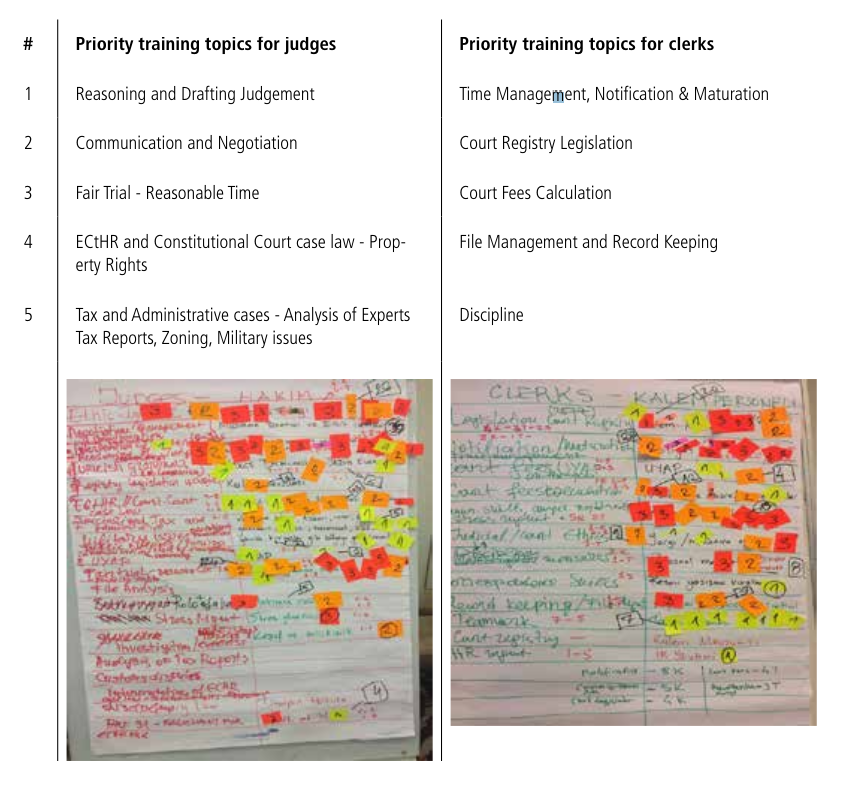
Image source: Council of Europe
A training needs assessment often reveals a long list. The mistake is trying to train everything. Prioritize based on impact and risk.
For example, if compliance gaps can lead to penalties, that moves ahead of soft-skill refreshers. If customer churn is rising due to poor onboarding, onboarding training outranks advanced career development modules.
The goal is a short, high-impact set of needs you can act on now, with the rest staged for later.
Step 6: Choose the Right Fix and Define Success
Only now should you decide on the solution. Training might be right, but it is not the only option. Sometimes the best fix is a clearer SOP, a checklist, a job aid, or a manager coaching routine.
If training is the answer, match the format to the gap.
Policy confusion usually needs short scenario practice on real edge cases. Workflow breakdowns often improve with guided simulations and step-by-step practice. Behavior gaps tend to respond better to coaching support with a simple rubric, not just content.
Close the loop by defining how you will measure success:
- Baseline metric (where performance is today)
- Follow-up metric (what changes after the intervention)
- Outcome metric (what business result should improve)
For example, if you use an online quiz as a post-training check, quiz reports can show who mastered the material, which topics still cause mistakes, and whether the training is ready to scale.
Watch: How to Review Quiz Reports & Statistics
Training Needs Assessment Methods
A training needs assessment is most reliable when you combine methods. One method can show you what is happening, another can explain why it is happening, and a third can confirm how widespread it is.
1. Skill Assessments
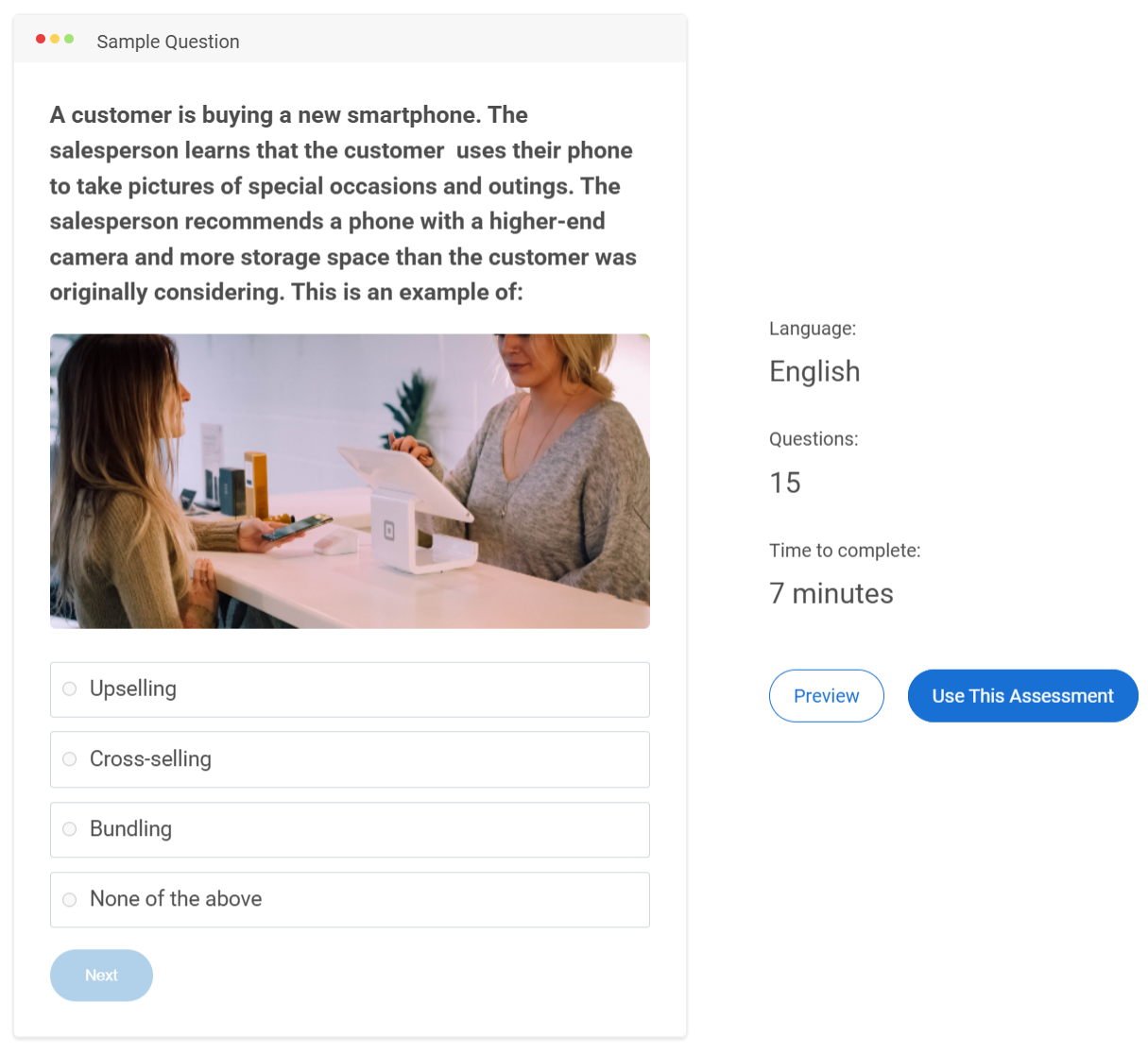
Skill assessments give you a clear baseline of what employees know and can do today. They work best when the role has defined standards, and you need to pinpoint gaps by topic, task, or team.
Use skill assessments when you need to answer questions like: Are people missing knowledge, or is something else getting in the way?
A few ways to make them more useful:
- Keep questions tied to real job tasks, not trivia.
- Segment results by role, tenure, or location to spot patterns.
- Use pre- and post-checks to confirm improvement after training.
Example: If customer escalations rise, a short assessment on refund exceptions and troubleshooting steps can show whether the issue is policy knowledge or execution.
2. Surveys and Questionnaires
Surveys help you reach many employees quickly, especially across distributed teams. They are great for uncovering friction points that do not show up in dashboards, like unclear expectations, missing resources, or confusing workflows.
To get actionable responses, ask about specific moments in the job. A simple mix works well:
- a few rating questions (clarity, confidence, frequency of issues)
- one or two open-ended prompts (biggest blocker, what would help most)
Example: If new hires repeatedly flag the same tasks as “least confident,” those tasks become your onboarding training priorities.
Watch: How to Create an Employee Survey or Questionnaire
3. Interviews and Focus Groups
Interviews add the “why” behind the data. They are especially valuable when performance problems are complex, leadership wants clarity, or you need to validate whether training is the right solution.
Individual interviews work well for role-specific detail. Focus groups help identify shared pain points across a team, like breakdowns in handoffs or inconsistent processes.
To make this method stronger, talk to a mix of people:
- high performers (to define what good looks like)
- managers (to understand expectations and constraints)
- newer or struggling employees (to surface real obstacles)
4. Observation and Work Sampling
Observation shows what employees actually do, not what they say they do. It is useful for task-heavy roles where performance depends on consistent execution, such as support, operations, sales calls, or compliance-driven work.
Instead of observing everything, sample high-impact moments:
- critical steps where errors are costly
- common failure points or rework stages
- customer-facing interactions and escalations
- handoffs between teams
Example: If quality issues keep repeating, observing the exact step where work is reviewed or handed off often reveals a missed checklist step or a misunderstood standard.
5. Data and Performance Records
Performance data makes your assessment defensible. It helps separate “we feel we need training” from “here is what is not working.” The insight comes from patterns, not isolated numbers.
Useful sources include:
- KPIs and productivity metrics
- QA scores, audits, evaluation reports
- customer complaints, CSAT trends, escalations
- safety incidents, compliance findings
- performance reviews and coaching notes
Example: If audit failures spike right after a policy change, the timing alone suggests a knowledge gap or rollout issue worth investigating before building a full program.
Use a simple three-part mix: one method to show the gap (data or assessments), one to explain why it exists (interviews or observation), and one to confirm how widespread it is (surveys). This makes the training needs assessment clear, credible, and easier to act on.
Training Needs Assessment vs. Skill Gap Analysis
A training needs assessment and a skill gap analysis are closely related, but they are not the same.
A skill gap analysis focuses on one thing: the difference between the skills employees have today and the skills they need to perform a role well. It is a useful tool, especially when you already know the performance issue is tied to capability.
A training needs assessment is broader. It starts with the business outcome and performance gap, then examines what is causing that gap. Sometimes the cause is a skill gap.
Other times it is process friction, unclear expectations, poor tools, or inconsistent coaching. In those cases, training alone will not solve it.
Quick Comparison
| Area | Training Needs Assessment | Skill Gap Analysis |
|---|---|---|
| Scope | Broad, performance and business-outcome focused | Narrow, skill-focused |
| Starting point | Business goals and performance gaps | Role requirements and current skill levels |
| What it identifies | Training needs and non-training fixes | Skills to build or improve |
| Typical output | Prioritized action plan | List of skills and proficiency gaps |
| Best used when | You are deciding whether training is needed | You already know skills are the issue |
When to Use Each
Use a training needs assessment when the problem is unclear, when performance is slipping, or when leadership is asking for training but the root cause is uncertain. It protects you from treating training as the default solution.
Use a skill gap analysis when the role expectations are clear, and you need a sharper view of capability, such as during onboarding, promotions, role transitions, or building a competency framework.
A skill gap analysis can be part of a training needs assessment, but it should not replace it. The needs assessment tells you what needs to change. The skill gap analysis helps you define what skills to build when training is truly the right move.
Training Needs Assessment Examples
The fastest way to understand a training needs assessment is to see what the output looks like in real situations. Below are three examples that show how the same process applies across different goals, without turning into a massive project.
Example 1: Onboarding That Takes Too Long
Situation: New hires are taking longer than expected to become fully productive.
What the assessment looks at: ramp time by cohort, common errors in early work, manager feedback, and a short baseline skills check.
What it typically reveals: the gap is rarely “they need more training” in general. More often it is a few specific tasks where people get stuck, plus missing job aids or unclear handoffs.
Resulting action plan: targeted micro-training on the top two to three tasks, clearer SOPs, and a simple readiness check before new hires handle work independently.
Example 2: Sales Team Missing Targets
Situation: Pipeline looks healthy, but deals are not closing.
What the assessment looks at: conversion rates by stage, call reviews, win-loss notes, and manager interviews to define what top performers do differently.
What it typically reveals: the issue may be inconsistent discovery, weak qualification, or poor handling of objections, not “sales training” broadly.
Resulting action plan: focused coaching and practice on the specific sales moments that break deals, supported by quick assessments and role-play rubrics.
Example 3: Compliance Errors After a Policy Change
Situation: Audit findings spike after a new policy rollout.
What the assessment looks at: audit reports, the exact steps where errors occur, employee feedback on what feels unclear, and a short knowledge check on the policy’s edge cases.
What it typically reveals: employees understand the headline rule, but struggle with exceptions, or the process documentation is outdated.
Resulting action plan: scenario-based training on exceptions, updated SOPs, and a post-check to confirm understanding before the next audit cycle.
These examples highlight the real value of a training needs assessment: it turns a vague training request into a clear plan that defines the gap, identifies the cause, and focuses effort where it will actually change results.
FREE. All Features. FOREVER!
Try our Forever FREE account with all premium features!
How to Measure Training Effectiveness After a Training Needs Assessment
A training needs assessment tells you what to fix. Measuring effectiveness tells you whether it actually got fixed. Without a measurement plan, training can feel successful because it was completed, even if performance never changes.
The key is to measure at three points: before, immediately after, and on the job.
1. Start With a Baseline Before Training
Before anything is delivered, capture the current state. This baseline should match the gap you identified in the training needs assessment.
That baseline might be:
- a short pre-assessment on job knowledge or policy understanding
- a QA score, audit score, or error rate for a specific task
- a cycle-time metric like time-to-resolution or time-to-competency
- a customer metric such as CSAT, escalations, or churn signals
If you cannot measure the baseline, it becomes hard to prove progress later.
2. Measure Learning Right After Training
Immediately after training, check whether employees absorbed what they were supposed to learn. This is where post-assessments, quizzes, or scenario questions help.
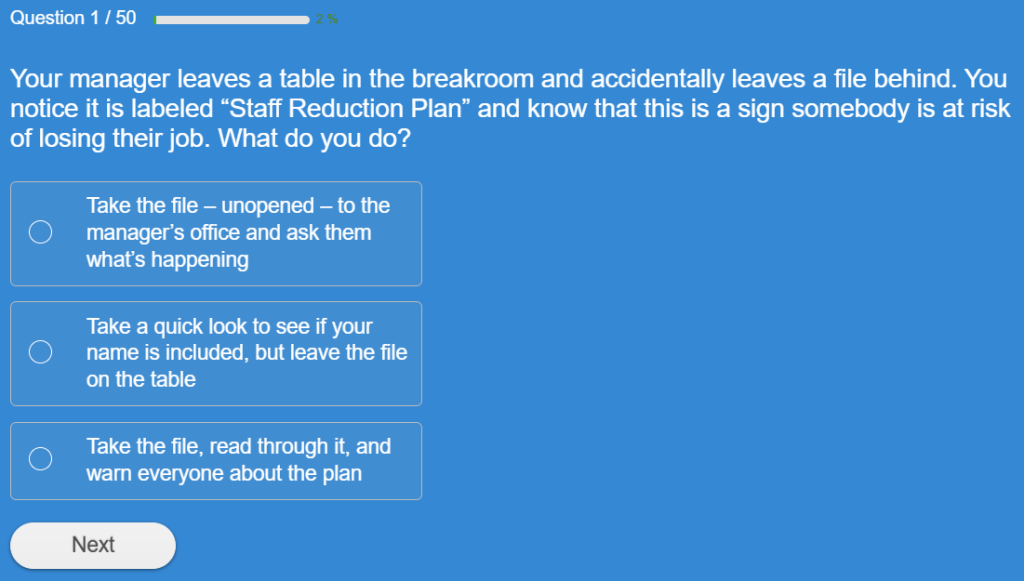
Keep the check aligned with real work. If the training is about handling customer objections, measure decision-making in scenarios, not definitions. If it is about compliance, test exceptions and edge cases, not just the headline rule.
3. Measure Behavior Where It Matters: On the Job
This is the part most teams skip. People can pass a test and still not apply the skill at work. Look for evidence in real workflows.
Depending on the role, this might include:
- improved QA and fewer repeated mistakes
- better call scoring or more consistent execution of a checklist
- fewer escalations or less rework
- faster completion times without sacrificing quality
Manager check-ins, short rubrics, and work sampling can make this measurable without adding heavy process.
4. Tie It Back to Business Outcomes
Finally, connect behavior change to the business outcome that triggered the assessment. This is how you show ROI and protect training budgets.
Examples of outcome measures:
- higher CSAT, fewer complaints
- reduced audit findings or safety incidents
- improved conversion rates or reduced churn
- faster onboarding with stable quality
A strong training needs assessment makes measurement easier because it already defined the gap and the target.
The simplest approach is to track one baseline metric, one learning metric, and one business outcome metric. If all three improve, you have a clear story that training worked.
Common Mistakes to Avoid in Training Needs Assessment
A training needs assessment should lead to clear decisions and cleaner training plans. These mistakes can quietly dilute your findings and make the final recommendations harder to apply.
1. Starting With the Solution Instead of the Decision
Beginning with “we need a course” locks you into training before the assessment has done its job. A strong training needs assessment should end with a recommendation, not begin with one.
2. Using Vague Problem Statements
Broad labels like “communication issues” or “low ownership” are hard to act on. If the problem cannot be tied to a specific task, moment, or standard, the training plan will stay generic.
3. Relying Too Heavily on Self-Reported Inputs
Surveys and manager opinions can be useful, but they can also be biased. People often describe what feels difficult, not what is driving the performance gap. Cross-check perception with real evidence.
4. Assessing Everyone the Same Way
A one-size approach misses role-specific gaps. The evidence you need for a sales role will differ from what you need for a support, ops, or compliance role. Tailor the assessment to the work.
5. Ignoring Constraints That Block Performance
Performance can fail even when skills are present. Common blockers include tool access, unclear approvals, overloaded workloads, or competing priorities. If these constraints are not captured, the assessment will recommend training for problems that training cannot remove.
6. Collecting Too Much Data and Losing Focus
It is easy to turn a training needs assessment into a data collection project. The goal is clarity, not volume. Gather what you need to make the decision, then move forward.
7. Not Documenting What Success Should Look Like
If the assessment does not specify what improved performance looks like, training results become subjective. Clear success criteria keep stakeholders aligned and make follow-through easier.
Turn Training Into a Real Performance Win
A training needs assessment gives you clarity before you commit time, budget, and attention. Instead of guessing what people need, it helps you spot real gaps, prioritize what matters, and choose the right fix, whether that’s training, coaching, enablement, or a process change.
To put this into motion, start small. Pick one team or role, define one measurable outcome, and run a lightweight training needs assessment using two or three methods. Build only what’s needed, measure impact, and scale what works.
When you want to run this at scale without adding admin work, ProProfs Quiz Maker can support the assessment side quietly. Create role-based quizzes quickly with AI, standardize delivery with smart settings, and use quiz reports to see who needs help, where gaps persist, and what to improve next.
Frequently Asked Questions

How to conduct a training needs analysis
To conduct a training needs analysis, follow clear TNA process steps: define the business outcome, review current performance data, identify the gap, diagnose the root cause, pinpoint the skills or knowledge required, prioritize needs by impact and risk, then select the right intervention and set measures to track improvement.
What are the three levels of TNA?
The three levels of TNA are organizational, task or role, and individual. Organizational level aligns training with business goals and capability gaps. Task or role level focuses on specific job tasks and standards. Individual level identifies who needs targeted support to meet expectations.
What 6 questions would you ask to ascertain the training needs required?
Ask: What outcome must improve? Where is performance falling short? Who is most affected? What is causing the gap? What should employees do differently to meet the standard? How will success be measured after the intervention to confirm that the need was addressed?

Let ProProfs AI Build a Quiz

 We'd love your feedback!
What did you like & how can we make it even better?
 Thanks for your feedback!
 Ask Your Question
Have a question? Get expert help to make your decision easier.